01BiografiaBiography
Italica, l'orfano di Spagna (76–93 d.C.)
Italica, the Spanish orphan (76–93 AD)
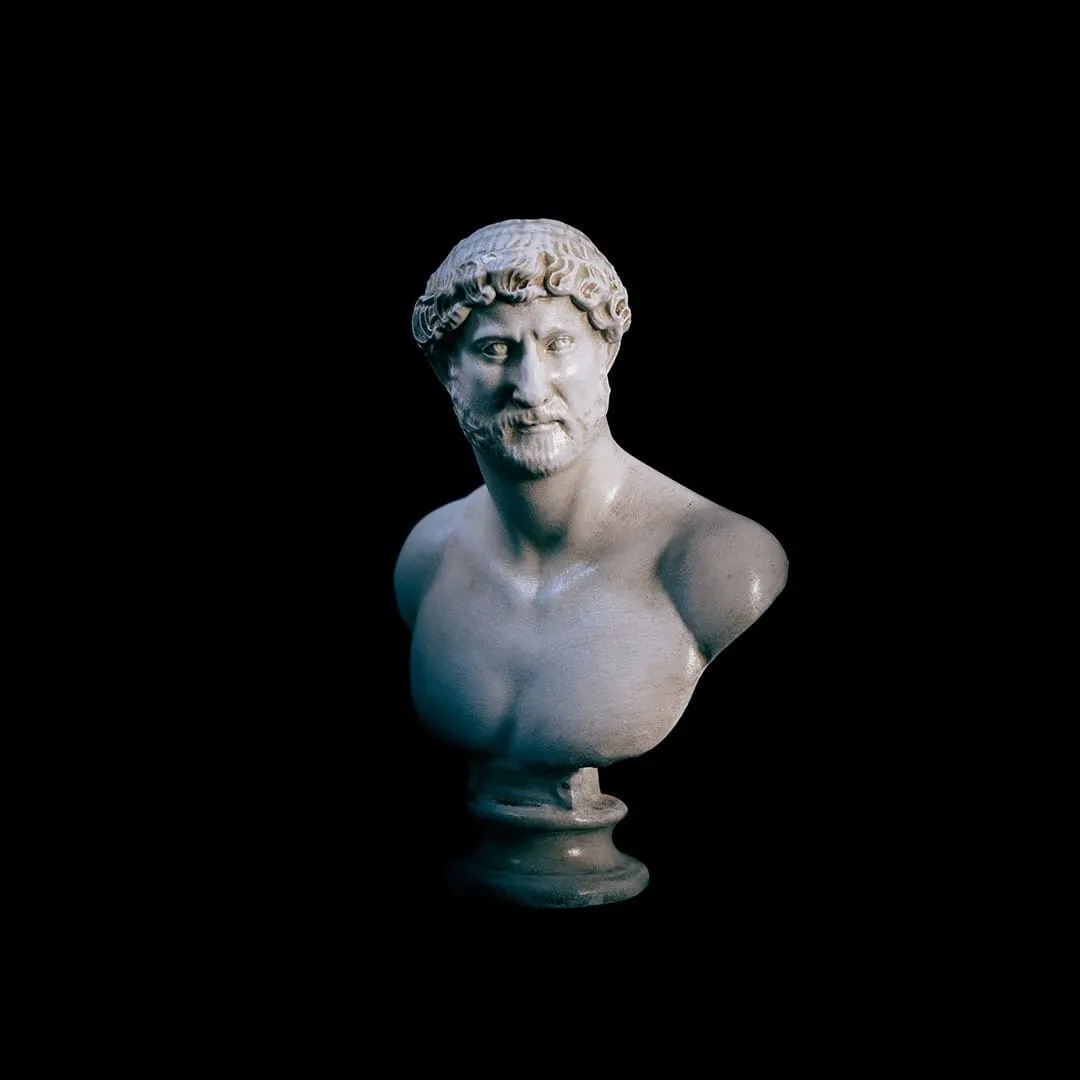
Publio Elio Adriano nacque il 24 gennaio del 76 d.C. ad Italica in Hispania Baetica, la stessa colonia di Scipione che aveva dato i natali a Traiano. Il padre, Publio Elio Adriano Afro, era senatore di rango pretorio e parente del futuro imperatore (probabilmente cugino di primo grado). La madre Domizia Paolina veniva da Cadice. A dieci anni Adriano rimase orfano di entrambi i genitori. Fu affidato a una doppia tutela: Traiano stesso, già generale di Domiziano, e il prefetto del pretorio Publio Acilio Attiano, anch'egli di Italica. La sua educazione fu militare e greca insieme. Aveva quattordici anni quando partecipò alla prima caccia col cugino sulle colline iberiche: una passione, quella venatoria, che lo avrebbe accompagnato per tutta la vita.
Publius Aelius Hadrianus was born on 24 January 76 AD at Italica in Hispania Baetica, the same Scipionic colony that had given birth to Trajan. The father, Publius Aelius Hadrianus Afer, was a senator of praetorian rank and kinsman of the future emperor (probably first cousin). The mother Domitia Paulina came from Cadiz. At ten Hadrian was orphaned of both parents. He was entrusted to a double guardianship: Trajan himself, already Domitian's general, and the praetorian prefect Publius Acilius Attianus, also from Italica. His education was military and Greek together. He was fourteen when he took part in his first hunt with his cousin in the Iberian hills: a passion, the venatorial, that would accompany him all his life.
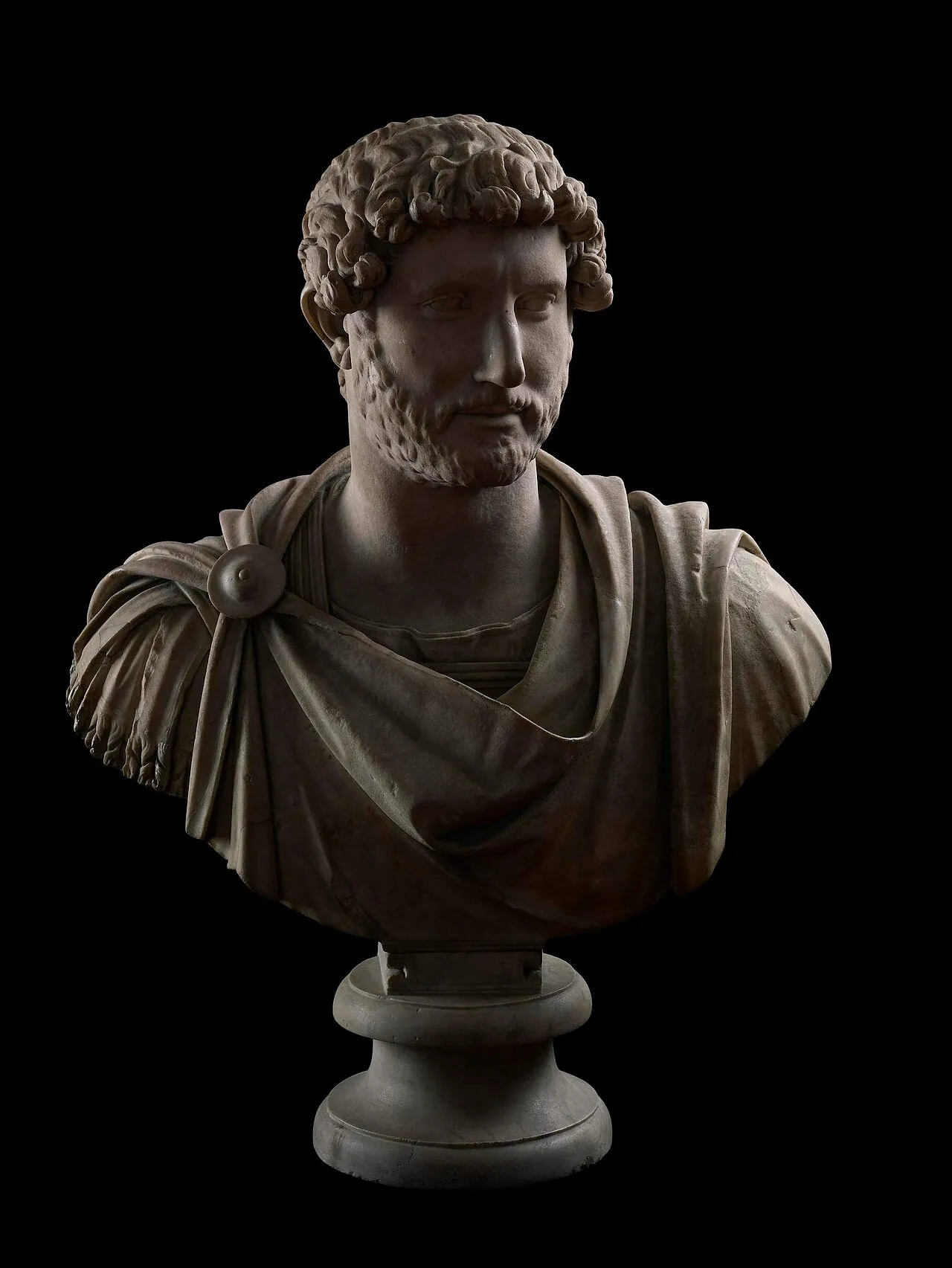
Il greco lo affascinò precocemente. Si racconta che già a quindici anni amasse circondarsi di poeti, sofisti, retori di lingua greca; per questo i compagni di palestra lo soprannominarono, in modo affettuosamente ironico, Graeculus, "il piccolo greco". Non era un complimento nel mondo romano dell'epoca, che considerava la cultura ellenica al tempo stesso superiore e degna di sospetto. Adriano se ne fece motto: passò la vita a fare propri i costumi greci (la barba portata corta in segno di virilità greca contro la rasatura latina, l'amore per la filosofia, l'iniziazione ai misteri di Eleusi, la fondazione di città greche).
Greek fascinated him precociously. It is told that already at fifteen he loved to surround himself with poets, sophists, Greek-speaking rhetors; for this his schoolmates nicknamed him, affectionately ironically, Graeculus, "the little Greek". It was no compliment in the Roman world of the time, which considered Hellenic culture at once superior and worthy of suspicion. Hadrian made it his motto: he spent his life making Greek customs his own (the beard worn short as a sign of Greek virility against Latin shaving, love of philosophy, initiation into the Eleusinian Mysteries, the foundation of Greek cities).
La carriera sotto Traiano (93–117 d.C.)
The career under Trajan (93–117 AD)
Adriano percorse il cursus honorum con la regolarità di un dossier costruito su misura. Tribuno militare in tre legioni successive (II Adiutrix in Pannonia, V Macedonica in Mesia, XXII Primigenia in Germania Superiore) tra il 95 e il 99 d.C.: era un'esperienza eccezionale per ampiezza geografica. Sposò nel 100 d.C. Vibia Sabina, pronipote di Traiano per parte materna: matrimonio politico voluto dalla moglie di Traiano Plotina, sua protettrice personale. Il rapporto coniugale fu sempre difficile, freddo, senza figli. Sabina lo accompagnò nei viaggi imperiali per dovere, mai per amore. Si dice che Adriano abbia detto, parlando di lei: «Se non fossi imperatore, l'avrei mandata via per la sua scorbuticità». Eppure quando lei morì nel 137, le dedicò il rito della deificazione.
Hadrian ran the cursus honorum with the regularity of a custom-built dossier. Military tribune in three successive legions (II Adiutrix in Pannonia, V Macedonica in Moesia, XXII Primigenia in Upper Germany) between 95 and 99 AD: an exceptional experience for geographical breadth. In 100 AD he married Vibia Sabina, Trajan's great-niece on his mother's side: a political marriage wanted by Trajan's wife Plotina, his personal protectress. The marital relationship was always difficult, cold, without children. Sabina accompanied him on imperial travels out of duty, never love. Hadrian is said to have said, speaking of her: «If I were not emperor, I would have sent her away for her churlishness». Yet when she died in 137, he dedicated to her the rite of deification.
Sotto Traiano, Adriano fu questore (101), tribuno della plebe (105), pretore (107), governatore della Pannonia Inferiore (107–108), console suffetto (108). Partecipò a entrambe le guerre daciche (101–102 e 105–106) come membro dello staff dell'imperatore. Nella campagna partica del 114–117 fu legato in Siria, posizione di assoluta fiducia. Quando Traiano fu colpito dall'ictus in Cilicia nell'estate del 117, Adriano si trovava ad Antiochia ed era l'unico erede plausibile. La leggenda nera contemporanea sostenne che la moglie di Traiano, Plotina, sempre sua amica e protettrice, orchestrò l'adozione postuma, dettando di nascosto il documento durante i tre giorni in cui la morte dell'imperatore fu tenuta segreta. Vera o non, la successione fu accettata senza opposizione armata.
Under Trajan, Hadrian was quaestor (101), tribune of the plebs (105), praetor (107), governor of Lower Pannonia (107–108), suffect consul (108). He took part in both Dacian wars (101–102 and 105–106) as a member of the emperor's staff. In the Parthian campaign of 114–117 he was legate in Syria, a position of absolute trust. When Trajan was struck by his stroke in Cilicia in summer 117, Hadrian was at Antioch and was the only plausible heir. The contemporary black legend held that Trajan's wife Plotina, always his friend and protectress, orchestrated the posthumous adoption, secretly dictating the document during the three days when the emperor's death was kept silent. True or not, the succession was accepted without armed opposition.
L'ascesa difficile (117–121 d.C.)
The difficult accession (117–121 AD)
Adriano cominciò il regno con due decisioni esplosive. La prima: l'abbandono delle province orientali conquistate da Traiano (Armenia, Mesopotamia, Assiria, Adiabene), riportando il confine sull'Eufrate come al tempo di Augusto. La seconda: l'esecuzione di quattro consolari traianei: Avidio Nigrino, Lusio Quieto (il vincitore della guerra giudaica), Cornelio Palma (il conquistatore dell'Arabia), Publilio Celso, accusati di complotto. La Historia Augusta sostiene che Adriano fosse innocente del fatto e che il prefetto del pretorio Attiano avesse agito d'iniziativa; Adriano in ogni caso ne pagò il prezzo politico per il resto della vita. Il Senato non gli perdonò mai del tutto né l'abbandono delle conquiste né le esecuzioni. Quando, nell'autunno del 117, entrò finalmente in Roma per la prima volta da imperatore, la sua popolarità senatoria era già compromessa.
Hadrian began his reign with two explosive decisions. The first: the abandonment of the eastern provinces conquered by Trajan (Armenia, Mesopotamia, Assyria, Adiabene), restoring the border to the Euphrates as in Augustus's time. The second: the execution of four Trajanic consulars: Avidius Nigrinus, Lusius Quietus (victor of the Jewish war), Cornelius Palma (conqueror of Arabia), Publilius Celsus, charged with conspiracy. The Historia Augusta maintains that Hadrian was innocent of the deed and that the praetorian prefect Attianus had acted on his own initiative; Hadrian in any case paid the political price for the rest of his life. The Senate never fully forgave him either for the abandonment of conquests or for the executions. When, in autumn 117, he finally entered Rome for the first time as emperor, his senatorial popularity was already compromised.
La fine: Baia, luglio 138 d.C.
The end: Baiae, July 138 AD
Negli ultimi anni Adriano soffriva di una grave idropisia cardiaca con edemi diffusi. Si era ritirato nella villa imperiale di Baia, nel golfo di Napoli, dove il clima mite era ritenuto terapeutico. Si lamentava continuamente del dolore e cercò più volte di farsi uccidere dai propri servi, che rifiutarono. Dettò un epitaffio in versi divenuto celebre: l'addio a se stesso, breve, dolce e disilluso. Morì il 10 luglio del 138 d.C. a sessantadue anni, dopo ventun anni di regno. Aveva già adottato come successore Antonino Pio, imponendo a sua volta che questi adottasse a sua volta sia il giovane Marco Aurelio sia Lucio Vero: con quell'unica decisione costruì la successione di tre generazioni. Le ceneri furono trasferite nel suo mausoleo, l'attuale Castel Sant'Angelo, nel 139, dopo che fu finalmente completato dal successore.
In his last years Hadrian suffered from a serious cardiac dropsy with widespread oedema. He had retired to the imperial villa of Baiae, in the Gulf of Naples, where the mild climate was thought therapeutic. He complained continually of pain and several times tried to have himself killed by his own servants, who refused. He dictated a famous verse epitaph: a farewell to himself, brief, sweet and disenchanted. He died on 10 July 138 AD at sixty-two, after twenty-one years of reign. He had already adopted Antoninus Pius as successor, imposing in turn that the latter adopt both the young Marcus Aurelius and Lucius Verus: with that single decision he constructed the succession of three generations. The ashes were transferred to his mausoleum, today's Castel Sant'Angelo, in 139, after it was finally completed by his successor.
hospes comesque corporis,
quae nunc abibis in loca
pallidula, rigida, nudula,
nec, ut soles, dabis iocos…"
«Piccola anima vagante e gentile, ospite e compagna del corpo, dove ora ti recherai, pallida, rigida e nuda, e non darai più, come solevi, i tuoi scherzi…» — Adriano, epitaffio dettato a Baia poco prima della morte (Historia Augusta, Vita Hadr. 25)
guest and companion of the body,
whither now will you depart,
pale, stiff and naked,
never again, as you used, to make your jokes…" — Hadrian, epitaph dictated at Baiae shortly before death (Historia Augusta, Vita Hadr. 25)
02Battaglie e Campagne MilitariBattles and Military Campaigns
Adriano è ricordato come il principe della pace armata: in ventun anni di regno non condusse mai un'offensiva di conquista. Eppure sotto di lui l'esercito raggiunse la massima professionalizzazione: ispezionò personalmente quasi ogni legione dell'Impero (esiste un suo celebre discorso ai soldati conservato su iscrizione a Lambaesis, in Africa, del 128 d.C., il Sermones Castrenses, in cui critica e loda i singoli reggimenti dopo le manovre), introdusse nuove formazioni tattiche, costruì opere di fortificazione permanente lungo tutte le frontiere. La sua unica vera guerra fu invece di pacificazione interna: la terza rivolta ebraica.
Hadrian is remembered as the prince of armed peace: in twenty-one years of reign he never conducted an offensive of conquest. Yet under him the army reached its maximum professionalization: he personally inspected almost every legion of the Empire (his famous speech to the soldiers survives in an inscription at Lambaesis, in Africa, of 128 AD, the Sermones Castrenses, in which he criticises and praises individual units after manoeuvres), introduced new tactical formations, built permanent fortification works along all the frontiers. His only real war was instead one of internal pacification: the third Jewish revolt.
- 132–135 d.C.Rivolta di Bar Kokhba — La causa fu doppia: il divieto di Adriano della circoncisione (equiparata alla castrazione per legge generale) e la decisione di rifondare Gerusalemme come colonia romana col nome di Aelia Capitolina e un tempio a Giove sull'area del Tempio di Salomone. Il Simone bar Kosiba — chiamato Bar Kokhba ("figlio della stella") dal rabbino Aqiba che lo riteneva il Messia, guidò una rivolta di proporzioni catastrofiche. Ebbero successo iniziale: occuparono Gerusalemme, batterono moneta col proprio nome, fondarono uno stato ebraico autonomo. Adriano dovette chiamare il suo migliore generale, Sesto Giulio Severo, dalla Britannia. La controffensiva fu sistematica: dodici legioni, cinque anni di guerra a basso intensità, distruzione metodica di ogni villaggio ribelle. Bar Kokhba fu ucciso nella fortezza di Betar nell'estate del 135. Cassio Dione parla di 580.000 morti ebrei in combattimento, 985 villaggi distrutti, "metà della Giudea spopolata"; centinaia di migliaia furono ridotti in schiavitù. Gerusalemme fu rasa al suolo, ricostruita come Aelia Capitolina, e agli ebrei fu vietato l'ingresso pena la morte. La diaspora divenne definitiva e Adriano cancellò il nome stesso della provincia ribattezzandola Syria Palaestina.Bar Kokhba Revolt — The cause was double: Hadrian's prohibition of circumcision (equated with castration by general law) and the decision to refound Jerusalem as a Roman colony under the name Aelia Capitolina with a temple to Jupiter on the site of Solomon's Temple. Simon bar Kosiba — called Bar Kokhba ("son of the star") by the rabbi Aqiba who believed him the Messiah, led a revolt of catastrophic proportions. They had initial success: they occupied Jerusalem, struck coinage in their own name, founded an autonomous Jewish state. Hadrian had to summon his best general, Sextus Julius Severus, from Britain. The counter-offensive was systematic: twelve legions, five years of low-intensity war, methodical destruction of every rebel village. Bar Kokhba was killed in the fortress of Betar in summer 135. Cassius Dio speaks of 580,000 Jewish dead in combat, 985 villages destroyed, "half of Judea depopulated"; hundreds of thousands were reduced to slavery. Jerusalem was razed, rebuilt as Aelia Capitolina, and Jews were forbidden entry on pain of death. The diaspora became definitive and Hadrian erased the very name of the province by renaming it Syria Palaestina.
- 117–118 d.C.Pacificazione del Danubio — Al momento dell'ascesa Adriano dovette fronteggiare le rivolte di Sarmati e Roxolani sul basso Danubio, e la pressione iazige sulla Pannonia. Risolse pagando sussidi ai capi tribali e cedendo loro alcune terre al di là del Danubio inferiore (la Dacia di Traiano fu ridotta nei suoi confini meridionali). Era la stessa politica di disimpegno strategico dell'Oriente: pace pagata.Pacification of the Danube — At the moment of accession Hadrian had to face revolts of Sarmatians and Roxolani on the lower Danube, and Iazyge pressure on Pannonia. He resolved by paying subsidies to tribal chiefs and ceding to them some lands beyond the lower Danube (Trajan's Dacia was reduced in its southern borders). It was the same strategy of strategic disengagement of the East: paid peace.
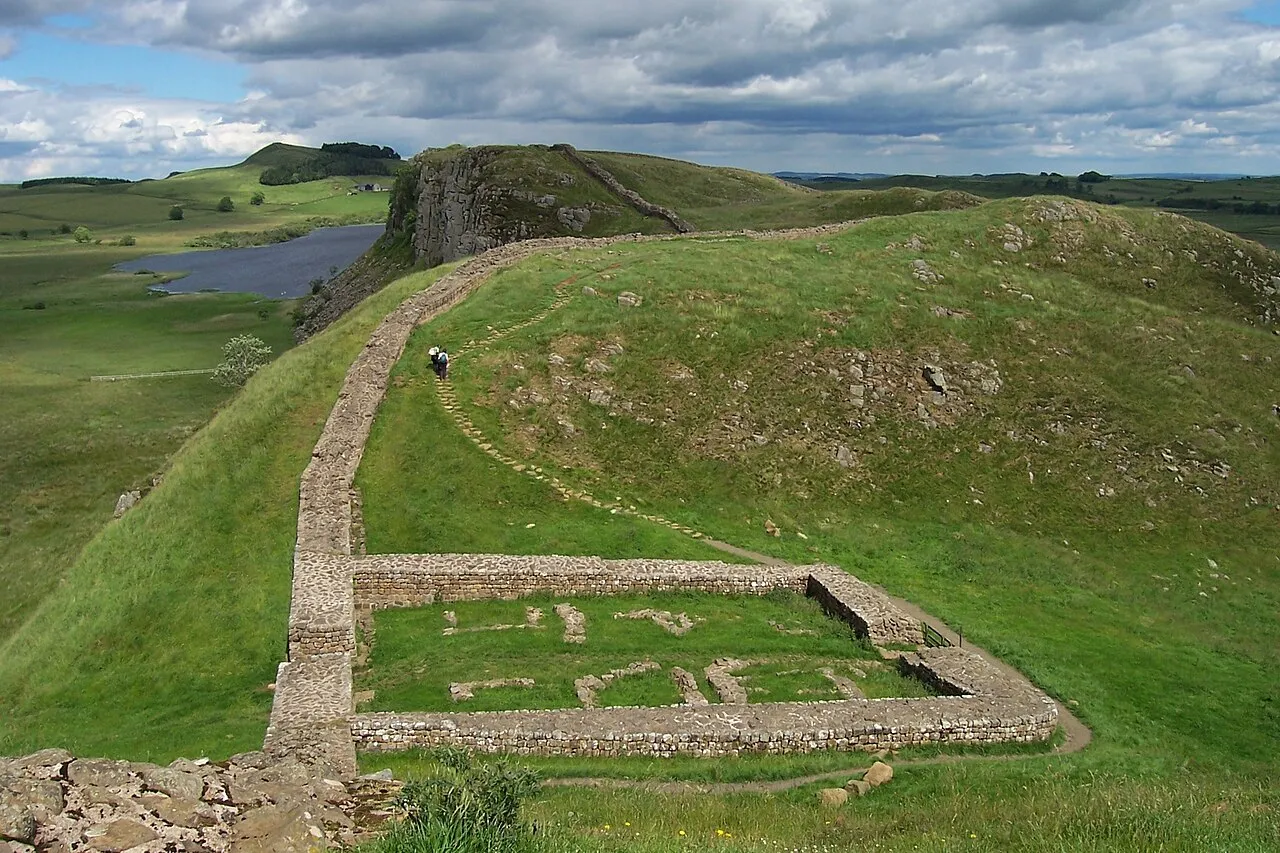
- 122 d.C.Britannia e il Vallo — Nel 122 Adriano visitò personalmente la Britannia, dove le tribù dei Brigantes a nord stavano premendo sulla provincia. Decise di abbandonare i territori scozzesi conquistati sotto i Flavi e di costruire una frontiera fortificata permanente da costa a costa: il Vallum Hadriani, lungo 117 km, alto 4-5 metri, con 80 fortini minori (milecastles) e 16 grandi forti legionari. Era la dichiarazione plastica della nuova politica imperiale: non più conquista, ma confine.Britain and the Wall — In 122 Hadrian personally visited Britain, where the Brigantes tribes to the north were pressing on the province. He decided to abandon the Scottish territories conquered under the Flavians and build a permanent fortified frontier from coast to coast: the Vallum Hadriani, 117 km long, 4-5 metres high, with 80 minor forts (milecastles) and 16 large legionary forts. It was the plastic declaration of the new imperial policy: no more conquest, but a frontier.
03Riforme e ProvvedimentiReforms and Measures
L'Edictum Perpetuum di Salvio Giuliano
The Edictum Perpetuum of Salvius Julianus
Nel 131 d.C. Adriano affidò al giovane giurista Lucio Ottavio Cornelio Publio Salvio Giuliano Emiliano, per gli amici Salvio Giuliano, africano di Hadrumetum, il compito di redigere la versione definitiva e immutabile dell'edictum praetoris, il programma annuale di norme con cui per cinque secoli i pretori avevano governato il diritto romano. Era una rivoluzione: l'Edictum Perpetuum codificava una volta per tutte la giurisprudenza romana, sottraendola all'iniziativa dei singoli magistrati e trasformandola in normativa imperiale immodificabile. Da quel momento il diritto romano fu legge in senso moderno. Salvio Giuliano divenne il giurista più ricco e influente dell'Impero, e la sua opera sarebbe stata la base della Compilazione di Giustiniano quattrocento anni dopo, che a sua volta sarebbe stata il fondamento di tutto il diritto civile europeo.
In 131 AD Hadrian entrusted the young jurist Lucius Octavius Cornelius Publius Salvius Iulianus Aemilianus, to friends Salvius Julianus, African of Hadrumetum, with the task of drafting the definitive and immutable version of the edictum praetoris, the annual programme of norms by which for five centuries the praetors had governed Roman law. It was a revolution: the Edictum Perpetuum codified Roman jurisprudence once and for all, subtracting it from the initiative of individual magistrates and transforming it into immodifiable imperial legislation. From that moment Roman law was law in the modern sense. Salvius Julianus became the richest and most influential jurist of the Empire, and his work would be the basis of Justinian's Compilation four hundred years later, which in turn would be the foundation of all European civil law.
Il limes fortificato
The fortified limes
Adriano trasformò la frontiera romana da limite mobile in frontiera permanente. Sostituì la politica espansiva di Traiano con un sistema di fortificazioni continue: il Vallum Hadriani in Britannia (117 km), il limes Germanico-retico (568 km di palizzata di legno e poi muratura fra Reno e Danubio), il limes Africano di Tripolitania (oltre 700 km di forti e fossati nel Sahara), il limes Pannonico e Moesico sul Danubio. Era una rivoluzione strategica: l'Impero accettava esplicitamente di avere un confine. La guarnigione di frontiera fu professionalizzata: nacque l'idea dei limitanei, soldati-coloni stanziati in modo permanente che vivevano accanto al confine col proprio podere. Era un modello che sarebbe rimasto in vigore per duecento anni.
Hadrian transformed the Roman frontier from a movable limit into a permanent frontier. He replaced Trajan's expansive policy with a system of continuous fortifications: the Vallum Hadriani in Britain (117 km), the Germanic-Raetian limes (568 km of wooden palisade and then masonry between Rhine and Danube), the African limes of Tripolitania (over 700 km of forts and ditches in the Sahara), the Pannonian and Moesian limes on the Danube. It was a strategic revolution: the Empire explicitly accepted having a frontier. The frontier garrison was professionalised: the idea of the limitanei was born, soldier-colonists permanently stationed who lived next to the frontier with their own farm. It was a model that would remain in force for two hundred years.
Amministrazione, fisco, esercito
Administration, fiscus, army
Riformò il consilium principis, il consiglio di gabinetto dell'imperatore, trasformandolo in un organo permanente con membri stipendiati, equestri e senatori, scelti per competenza e non per rango. I cavalieri (ordo equester) sostituirono progressivamente i liberti negli incarichi amministrativi di vertice: era la nascita dell'amministrazione professionale moderna. Riformò le imposte indirette accorpando tributi sparsi nel quadragesima (2,5%) generalizzata. Cancellò i debiti fiscali arretrati per oltre 900 milioni di sesterzi in un solo gesto, facendo bruciare pubblicamente i registri al Foro: era un'amnistia simbolica e pratica insieme, dieci volte il bilancio militare annuale. Riorganizzò il rapporto fra imperatore e città provinciali nominando i curatores rei publicae: commissari imperiali per le finanze municipali.
He reformed the consilium principis, the emperor's cabinet council, transforming it into a permanent organ with salaried members, equestrians and senators, chosen for competence and not rank. The knights (ordo equester) progressively replaced freedmen in top administrative posts: it was the birth of modern professional administration. He reformed indirect taxes by merging scattered tributes into a generalised quadragesima (2.5%). He cancelled arrear tax debts for over 900 million sesterces in a single gesture, having the registers publicly burned at the Forum: it was a symbolic and practical amnesty at once, ten times the annual military budget. He reorganised the relationship between emperor and provincial cities by appointing the curatores rei publicae, imperial commissioners for municipal finances.
04Opere e CostruzioniWorks and Constructions
Il Pantheon
The Pantheon
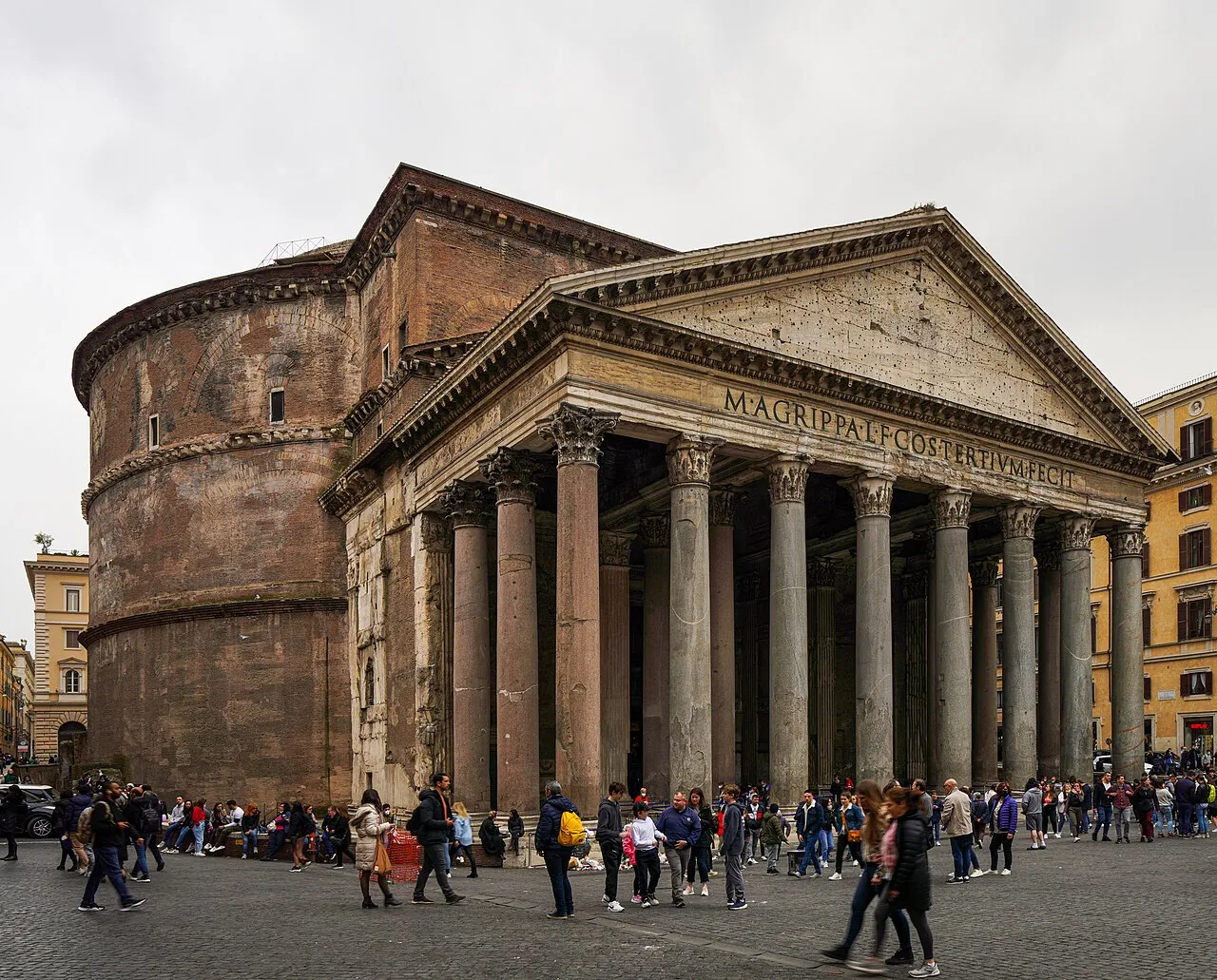
Il Pantheon che oggi vediamo a Roma è in tutto e per tutto un'opera adrianea. Il tempio originale di Agrippa (27 a.C.) era andato distrutto in un incendio sotto Tito; Domiziano l'aveva ricostruito ma fu di nuovo bruciato sotto Traiano. Adriano lo riedificò radicalmente tra il 118 e il 125 d.C., conservando però con sublime modestia il vecchio frontone con l'iscrizione M·AGRIPPA·L·F·COS·TERTIVM·FECIT: "Marco Agrippa, figlio di Lucio, console per la terza volta, lo fece". Era un omaggio agli antichi e una scelta antiaccademica: il nuovo tempio, infatti, non aveva nulla a che fare con quello originale. La sua cupola di 43,30 metri di diametro, perfettamente uguale all'altezza interna, resta dopo diciannove secoli la più grande cupola in cemento non armato mai realizzata; St Peter di Roma, completata nel 1593, è inferiore di un metro. L'oculus centrale di 8,7 metri è l'unica fonte di luce: un raggio solare che si muove lungo l'interno scandendo le ore. Era contemporaneamente sacello pagano dei sette pianeti, capolavoro tecnico-ingegneristico, e probabilmente sala del trono imperiale per le udienze pubbliche di Adriano stesso, che vi sedeva tra Augusto e i deificati.
The Pantheon we see today in Rome is entirely a Hadrianic work. Agrippa's original temple (27 BC) had been destroyed in a fire under Titus; Domitian had rebuilt it but it was burned again under Trajan. Hadrian rebuilt it radically between 118 and 125 AD, preserving however with sublime modesty the old pediment with the inscription M·AGRIPPA·L·F·COS·TERTIVM·FECIT: "Marcus Agrippa, son of Lucius, consul for the third time, made it". It was a homage to the ancients and an antiacademic choice: the new temple, in fact, had nothing to do with the original one. Its dome of 43.30 metres in diameter, perfectly equal to the interior height, remains after nineteen centuries the largest unreinforced concrete dome ever built; St Peter in Rome, completed in 1593, is one metre smaller. The central oculus of 8.7 metres is the only source of light: a sun ray that moves along the interior marking the hours. It was simultaneously a pagan shrine of the seven planets, an engineering masterpiece, and probably the imperial throne room for the public audiences of Hadrian himself, who sat there between Augustus and the deified.
Villa Adriana di Tivoli
Hadrian's Villa at Tivoli
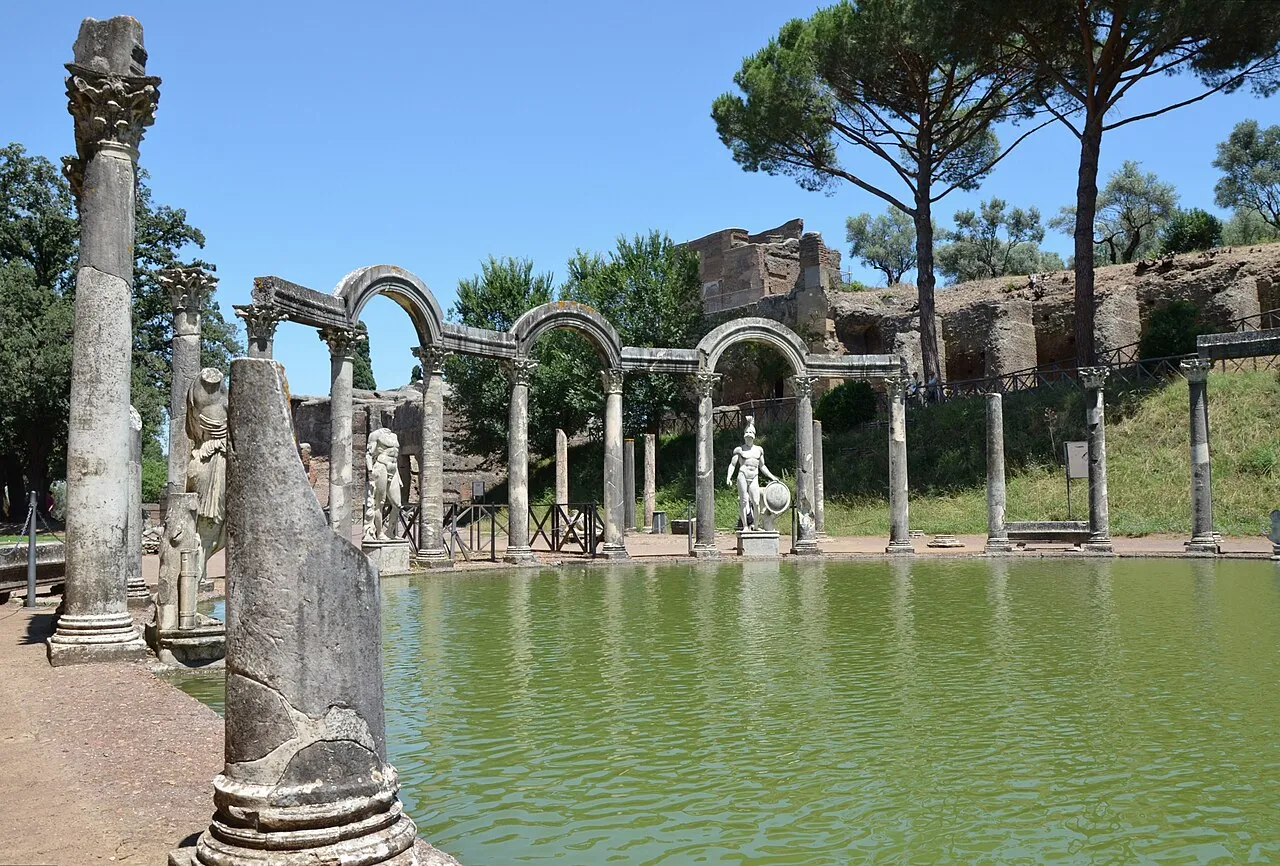
A circa trenta chilometri da Roma, ai piedi dei monti Tiburtini, Adriano fece costruire fra il 118 e il 138 d.C. la più grande villa imperiale mai realizzata: oltre 120 ettari di estensione (più del doppio della Città del Vaticano), con più di trenta complessi architettonici distinti, terme, biblioteche, teatri, templi, una caserma per i pretoriani, residenze separate per la corte. Era contemporaneamente reggia, riserva di caccia, museo e laboratorio architettonico personale: Adriano stesso disegnava molti edifici. La caratteristica più straordinaria è che ogni complesso evoca un luogo amato nei viaggi imperiali. La Stoa Poikile ricreava il portico dipinto di Atene; l'Accademia, il giardino filosofico di Platone; il Liceo, quello di Aristotele; il Pretium, il santuario di Tempe in Tessaglia; il Canopo, il canale e tempio di Serapide vicino Alessandria, completo di statue egittizzanti di Antinoo divinizzato. L'Inferi evocavano persino l'oltretomba. Era un'enciclopedia in pietra del mondo conosciuto. Saccheggiata nel Rinascimento (molte sue statue popolano oggi i Vaticani, il Louvre, il British Museum) rimane uno degli ensemble archeologici più estesi al mondo.
About thirty kilometres from Rome, at the foot of the Tiburtine mountains, Hadrian had built between 118 and 138 AD the largest imperial villa ever realised: over 120 hectares in extent (more than double Vatican City), with more than thirty distinct architectural complexes, baths, libraries, theatres, temples, a barracks for the praetorians, separate residences for the court. It was simultaneously palace, hunting reserve, museum and personal architectural laboratory: Hadrian himself designed many buildings. The most extraordinary feature is that each complex evokes a place loved in the imperial travels. The Stoa Poikile recreated the painted portico of Athens; the Academy, Plato's philosophical garden; the Lyceum, Aristotle's; the Tempe, the sanctuary of Tempe in Thessaly; the Canopus, the canal and temple of Serapis near Alexandria, complete with Egyptianising statues of the deified Antinous. The Inferi even evoked the afterlife. It was a stone encyclopaedia of the known world. Plundered in the Renaissance (many of its statues today populate the Vatican Museums, the Louvre, the British Museum) it remains one of the largest archaeological ensembles in the world.
Il Mausoleo (Castel Sant'Angelo)
The Mausoleum (Castel Sant'Angelo)
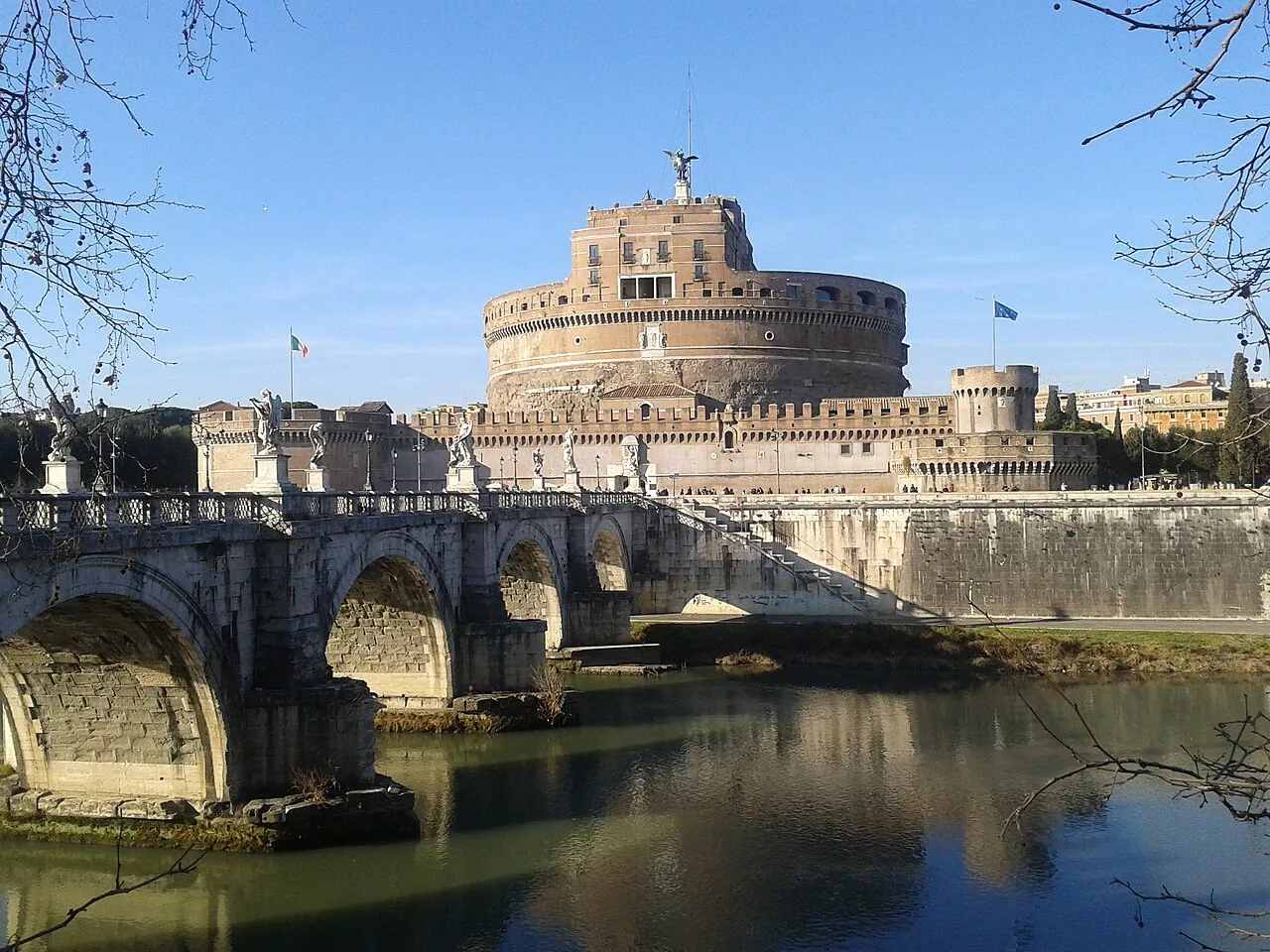
Sul lato destro del Tevere, di fronte al Campo Marzio, Adriano cominciò a costruire dal 134 d.C. il proprio Mausoleo: un tamburo cilindrico di settanta metri di diametro su base quadrata, ricoperto in origine di marmi e di piante di cipresso sulla sommità, sormontato da una quadriga di bronzo guidata da una statua dell'imperatore. Era ispirato al Mausoleo di Augusto, ma più grande. Vi vennero sepolti Adriano, la moglie Sabina, e tutti i suoi successori antonini fino a Caracalla nel 217 d.C. Nel Medioevo divenne fortezza papale (da cui il nome odierno di Castel Sant'Angelo, riferito alla visione di Gregorio Magno durante la peste del 590 d.C.), e fu collegato al Vaticano da un corridoio segreto, il passetto, che salvò la vita ai papi più di una volta. Il Ponte Elio (oggi Ponte Sant'Angelo) lo collegava al Campo Marzio.
On the right side of the Tiber, opposite the Campus Martius, Hadrian began to build from 134 AD his own Mausoleum: a cylindrical drum of seventy metres in diameter on a square base, originally covered in marble and with cypress trees on the summit, crowned by a bronze quadriga driven by a statue of the emperor. It was inspired by Augustus's Mausoleum, but larger. There were buried Hadrian, his wife Sabina, and all his Antonine successors down to Caracalla in 217 AD. In the Middle Ages it became a papal fortress (whence the modern name Castel Sant'Angelo, referring to Gregory the Great's vision during the plague of 590 AD), and was connected to the Vatican by a secret corridor, the passetto, which saved the popes' lives more than once. The Aelian Bridge (today Ponte Sant'Angelo) connected it to the Campus Martius.
Atene: l'Olympieion e la rifondazione
Athens: the Olympieion and the refoundation
Atene fu la sua città del cuore. La frequentò più volte (124–125, 128–129, 131–132 d.C.), vi fu iniziato ai Misteri di Eleusi al grado supremo (epoptes), e vi ricoprì per due volte la carica di arconte eponimo, cosa che un imperatore non aveva mai fatto. Le sue opere ateniesi rifondarono letteralmente la città: completò il colossale Tempio di Zeus Olimpio (Olympieion), iniziato sette secoli prima da Pisistrato e mai finito: centoquattro colonne corinzie alte diciassette metri, le più alte mai costruite. Costruì la Biblioteca di Adriano, l'Arco di Adriano (con la celebre iscrizione doppia: "Questa è Atene, antica città di Teseo" da una parte, "Questa è la città di Adriano, e non più di Teseo" dall'altra), un acquedotto, un ginnasio. Fece di Atene la capitale culturale del Panellenismo imperiale. Per i greci era il nuovo Pericle.
Athens was his city of the heart. He visited it several times (124–125, 128–129, 131–132 AD), was initiated into the Eleusinian Mysteries at the supreme grade (epoptes), and twice held the office of eponymous archon, something an emperor had never done. His Athenian works literally refounded the city: he completed the colossal Temple of Olympian Zeus (Olympieion), begun seven centuries earlier by Pisistratus and never finished: one hundred and four Corinthian columns seventeen metres high, the tallest ever built. He built the Library of Hadrian, the Arch of Hadrian (with the famous double inscription: "This is Athens, the ancient city of Theseus" on one side, "This is the city of Hadrian, and no longer of Theseus" on the other), an aqueduct, a gymnasium. He made Athens the cultural capital of imperial Panhellenism. For the Greeks he was the new Pericles.
05Antinoo, l'Amato di BitiniaAntinous, the Beloved of Bithynia
L'incontro
The encounter
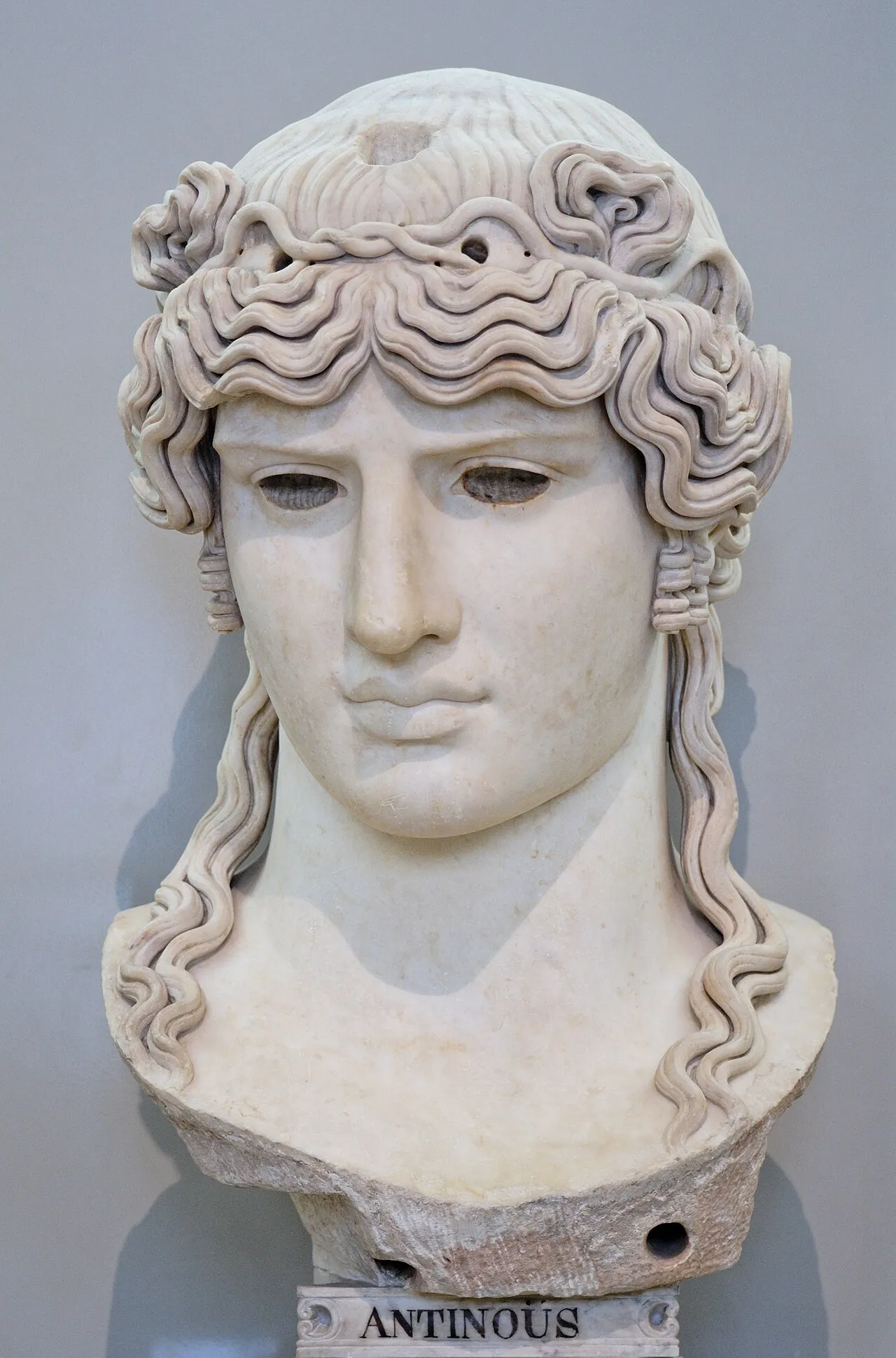
Antinoo nacque attorno al 110 d.C. a Claudiopoli in Bitinia (l'odierna Bolu, in Turchia settentrionale), da una famiglia greca probabilmente modesta. Adriano lo incontrò durante uno dei suoi viaggi imperiali in Oriente, forse a Nicomedia, verso il 123–124 d.C. Il giovane aveva tredici o quattordici anni; l'imperatore quasi cinquanta. Lo prese al suo servizio personale e da quel momento fu inseparabile da lui per circa otto anni. Nelle ricostruzioni iconografiche (oltre 120 ritratti sopravvissuti, la più ricca galleria d'immagini di un solo individuo dell'antichità dopo gli imperatori stessi) Antinoo appare come un giovane di straordinaria bellezza efebica: ricci scuri folti, sguardo malinconico, lievemente reclinato, labbra carnose. Era il tipo del pais kalos della pederastia greca classica, ma in versione monumentale e officiale.
Antinous was born around 110 AD at Claudiopolis in Bithynia (modern Bolu, in northern Turkey), to a Greek family probably of modest means. Hadrian met him during one of his imperial travels in the East, perhaps at Nicomedia, around 123–124 AD. The youth was thirteen or fourteen; the emperor almost fifty. He took him into his personal service and from that moment was inseparable from him for about eight years. In iconographic reconstructions (over 120 surviving portraits, the richest gallery of images of a single individual of antiquity after the emperors themselves) Antinous appears as a young man of extraordinary ephebic beauty: thick dark curls, melancholy gaze, slightly inclined head, full lips. He was the type of the pais kalos of classical Greek pederasty, but in monumental and official version.
Il rapporto fra Adriano e Antinoo fu sempre più di quello che convenzionalmente i romani consideravano accettabile fra un imperatore maturo e un giovane straniero. Si trattava di una relazione affettiva profonda, conclamata, pubblica. Antinoo lo accompagnava nei viaggi, partecipava alle cacce (era passato alla storia un episodio in Mauretania nel 128 d.C., in cui Adriano lo salvò da un leone che lo stava per uccidere, episodio celebrato dal poeta Pancrate sull'Olimpo letterario alessandrino con un poemetto sopravvissuto in frammenti), era presente alle udienze, viveva nei suoi appartamenti privati. La tradizione antica e moderna tende a vedere in lui non solo l'amante ma anche il confidente: l'unica persona davanti a cui Adriano potesse abbandonare la corazza imperiale.
The relationship between Hadrian and Antinous was something more than what Romans conventionally considered acceptable between a mature emperor and a young foreigner. It was a deep, declared, public affective relationship. Antinous accompanied him on travels, took part in hunts (an episode passed into history in Mauretania in 128 AD, in which Hadrian saved him from a lion that was about to kill him, an episode celebrated by the poet Pancrates on Alexandria's literary Olympus with a poem surviving in fragments), was present at audiences, lived in his private apartments. Both ancient and modern tradition tends to see in him not only the lover but the confidant: the only person before whom Hadrian could lay aside the imperial armour.
La morte sul Nilo (ottobre 130 d.C.)
Death on the Nile (October 130 AD)
Nell'autunno del 130 d.C. la corte imperiale risaliva il Nilo da Alessandria verso Tebe a bordo di una flottiglia di battelli, in viaggio di rappresentanza e di pellegrinaggio religioso (Adriano voleva visitare i Colossi di Memnone all'alba per ascoltarne il celebre "canto"). Durante una sosta presso Besa, in Egitto medio, all'altezza del 24 ottobre, Antinoo annegò nel Nilo. Le circostanze rimangono fra i misteri più discussi dell'antichità. Cassio Dione enumera tre ipotesi: incidente (cadde in acqua durante una sosta), sacrificio rituale (si offrì volontariamente per allungare la vita dell'imperatore malato), assassinio politico per gelosia di corte. Adriano stesso scrisse nella sua autobiografia, perduta ma citata dalla Historia Augusta, che era stato un incidente. Eppure il suo dolore fu tale da spingere Cassio Dione a una frase celebre: «pianse come una donna». Faceva costruire ovunque statue del giovane, lo fece divinizzare immediatamente, cosa che richiedeva di norma il decreto del Senato e che Adriano impose con un gesto autocratico.
In autumn 130 AD the imperial court was ascending the Nile from Alexandria toward Thebes on board a flotilla of boats, on a journey of representation and religious pilgrimage (Hadrian wanted to visit the Colossi of Memnon at dawn to hear their famous "song"). During a stop near Besa, in middle Egypt, around 24 October, Antinous drowned in the Nile. The circumstances remain among the most debated mysteries of antiquity. Cassius Dio enumerates three hypotheses: accident (he fell into the water during a stop), ritual sacrifice (he voluntarily offered himself to prolong the life of the ailing emperor), political assassination from court jealousy. Hadrian himself wrote in his autobiography, lost but cited by the Historia Augusta, that it had been an accident. Yet his grief was such that it pushed Cassius Dio to a famous phrase: «he wept like a woman». He had statues of the youth built everywhere, had him deified immediately, something that normally required a Senate decree and which Hadrian imposed by autocratic gesture.
Il culto e Antinoöpoli
The cult and Antinoopolis
Adriano fondò sul posto stesso dell'annegamento una nuova città, Antinoöpoli, popolata di coloni greci provenienti dall'Egitto e dall'Asia, organizzata sul modello delle poleis ateniesi, dotata di tempio, ginnasio, teatro e culto pubblico di Antinoo-Osiride. La città durò per oltre cinque secoli e ne sono stati scavati ancora oggi resti significativi. Contemporaneamente fece istituire giochi panellenici antinoici a Mantinea (in Arcadia), Atene, Argo, Eleusi: gare atletiche e musicali in onore del nuovo dio. Furono coniate monete con la sua effigie in Egitto, in Bitinia, in Asia. Le statue di Antinoo (come dio iniziatico, come Dioniso, come Apollo, come Osiride) furono erette ovunque nell'Impero per oltre un secolo: il culto durò fino all'editto di Teodosio del 391 d.C. che vietò il paganesimo. Antinoo è probabilmente l'ultimo dio del pantheon classico greco-romano, il finale di una civiltà religiosa lunga duemila anni.
Hadrian founded on the very spot of the drowning a new city, Antinoopolis, populated by Greek colonists from Egypt and Asia, organised on the model of Athenian poleis, equipped with a temple, gymnasium, theatre and public cult of Antinous-Osiris. The city lasted for over five centuries and significant remains have been excavated even today. At the same time he had Panhellenic Antinoeian games instituted at Mantinea (in Arcadia), Athens, Argos, Eleusis: athletic and musical contests in honour of the new god. Coins were struck with his image in Egypt, in Bithynia, in Asia. Statues of Antinous (as initiatic god, as Dionysus, as Apollo, as Osiris) were erected throughout the Empire for over a century: the cult lasted until Theodosius's edict of 391 AD which forbade paganism. Antinous is probably the last god of the classical Greco-Roman pantheon, the finale of a religious civilisation two thousand years long.
Per gli storici moderni la figura di Antinoo è anche un capitolo cruciale della storia dell'identità sessuale. Marguerite Yourcenar nel romanzo Memorie di Adriano (1951) ne fa il fulcro emotivo del libro; lo studioso Royston Lambert (Beloved and God, 1984) ha ricostruito la biografia documentale. Le cento e più statue conservate (quella più celebre l'Antinoo Mondragone del Louvre, alta circa un metro e novanta) sono fra gli oggetti d'arte antichi più direttamente leggibili come ritratti individuali, e per questo da sempre amati: per i neoplatonici fiorentini del Rinascimento erano simbolo della bellezza ideale; per Winckelmann nel Settecento furono il vertice della classicità; per Walter Pater e Oscar Wilde nell'Ottocento divennero l'icona di un'erotica classicistica.
For modern historians the figure of Antinous is also a crucial chapter in the history of sexual identity. Marguerite Yourcenar in the novel Memoirs of Hadrian (1951) makes him the emotional pivot of the book; the scholar Royston Lambert (Beloved and God, 1984) reconstructed the documentary biography. The hundred or more preserved statues (the most famous the Antinous Mondragone of the Louvre, about one metre ninety high) are among the ancient art objects most directly legible as individual portraits, and for this always loved: for the Florentine Neoplatonists of the Renaissance they were a symbol of ideal beauty; for Winckelmann in the 18th century they were the peak of classicism; for Walter Pater and Oscar Wilde in the 19th century they became the icon of a classicising eroticism.
06Il Viaggiatore UniversaleThe Universal Traveller
Nessun imperatore prima o dopo viaggiò quanto Adriano. Dei ventun anni di regno (117–138 d.C.), almeno dodici li passò fuori dall'Italia. Era una scelta politica deliberata: invece di governare per delega tramite governatori (modello di Augusto e Traiano), Adriano voleva conoscere personalmente ogni provincia, ispezionare ogni legione, dialogare con ogni élite locale. La rete delle vie consulares dell'Impero raggiunse il suo massimo splendore proprio per supportare i suoi spostamenti. Quasi ovunque andasse, fondava o ricostruiva città, restaurava templi, finanziava acquedotti, costruiva archi. Esistono iscrizioni adrianee in oltre 130 città dell'Impero. Per i suoi sudditi era il principe visibile, una rarità storica.
No emperor before or after travelled as Hadrian did. Of the twenty-one years of his reign (117–138 AD), he spent at least twelve outside Italy. It was a deliberate political choice: instead of governing by delegation through governors (the model of Augustus and Trajan), Hadrian wanted to know personally every province, inspect every legion, dialogue with every local elite. The network of viae consulares of the Empire reached its maximum splendour precisely to support his movements. Almost everywhere he went he founded or rebuilt cities, restored temples, financed aqueducts, built arches. Hadrianic inscriptions exist in over 130 cities of the Empire. For his subjects he was the visible prince, a historical rarity.
Il primo viaggio (121–125 d.C.)
The first journey (121–125 AD)
Dal 121 al 125 d.C. percorse la metà occidentale dell'Impero. Visitò la Gallia (Lione, Augustodunum), poi la Germania dove ispezionò le legioni del Reno e iniziò la costruzione del limes germanicus. Nel 122 attraversò il mare per la Britannia, dove avviò la costruzione del Vallo che porta il suo nome. Tornò in Gallia, scese in Spagna a Tarragona dove svernò nel 122–123 ricevendo le ambascerie delle province ispaniche. Da lì attraversò il Mediterraneo per la Mauretania, e poi per l'Asia Minore dove probabilmente conobbe Antinoo. Visitò la Cappadocia, il Ponto, la Bitinia, l'Asia, la Frigia, la Misia. Nel 124 toccò Atene per la prima volta da imperatore, dove rimase per quasi un anno facendosi iniziare ai Misteri di Eleusi. Tornò a Roma nell'estate del 125. Era stato fuori per quattro anni.
From 121 to 125 AD he traversed the western half of the Empire. He visited Gaul (Lyons, Augustodunum), then Germany where he inspected the Rhine legions and began the construction of the limes germanicus. In 122 he crossed the sea to Britain, where he initiated the construction of the Wall that bears his name. He returned to Gaul, descended to Spain at Tarragona where he wintered in 122–123 receiving the embassies of the Hispanic provinces. From there he crossed the Mediterranean to Mauretania, and then to Asia Minor where he probably met Antinous. He visited Cappadocia, Pontus, Bithynia, Asia, Phrygia, Mysia. In 124 he reached Athens for the first time as emperor, where he remained for almost a year and was initiated into the Eleusinian Mysteries. He returned to Rome in summer 125. He had been away for four years.
Il secondo viaggio (128–134 d.C.) e l'Egitto
The second journey (128–134 AD) and Egypt
Nell'estate del 128 ripartì. Visitò il Nord Africa: a Cartagine assistette alle rifondazioni urbane, a Lambaesis in Numidia pronunciò il celebre discorso alle legioni di stanza in Africa (l'iscrizione del Sermones Castrenses è tuttora visibile sulla pietra in situ). Ripassò per Atene dove svernò 128–129. Nel 129 visitò Antiochia, Palmira, Gerasa (Jerash) in Decapoli, e l'Arabia Petraea di Petra. Nel 130 entrò in Giudea: la sua visita fu il detonatore della rivolta di Bar Kokhba due anni più tardi. Da lì scese in Egitto: visitò la tomba di Pompeo a Pelusio, Alessandria, dove restaurò il sepolcro di Alessandro Magno e dialogò con i filosofi del Museion. Risalì il Nilo, ed è in questo viaggio che Antinoo morì nell'ottobre del 130. Continuò il viaggio nonostante il lutto: visitò i Colossi di Memnone a Tebe, dove sua moglie Sabina lasciò due iscrizioni in greco oggi ancora leggibili sulla statua. Tornò ad Antiochia, e da lì in Asia, in Tracia, in Macedonia, finalmente a Roma nel 134, dopo sei anni di assenza.
In summer 128 he left again. He visited North Africa: at Carthage he attended urban refoundations, at Lambaesis in Numidia he delivered the celebrated speech to the African legions (the inscription of the Sermones Castrenses is still visible on stone in situ). He passed again through Athens where he wintered 128–129. In 129 he visited Antioch, Palmyra, Gerasa (Jerash) in the Decapolis, and Petra's Arabia Petraea. In 130 he entered Judea: his visit was the detonator of the Bar Kokhba revolt two years later. From there he descended to Egypt: he visited Pompey's tomb at Pelusium, Alexandria, where he restored the tomb of Alexander the Great and dialogued with the philosophers of the Museion. He ascended the Nile, and it is on this journey that Antinous died in October 130. He continued the journey despite mourning: he visited the Colossi of Memnon at Thebes, where his wife Sabina left two inscriptions in Greek still legible today on the statue. He returned to Antioch, and from there to Asia, to Thrace, to Macedonia, finally to Rome in 134, after six years of absence.
Il Panhellenion (132 d.C.)
The Panhellenion (132 AD)
L'opera più ambiziosa del suo filellenismo politico fu la fondazione, ad Atene nel 132 d.C., del Panhellenion: un'organizzazione interstatale che raggruppava tutte le città di lingua greca dell'Impero (in Grecia, Macedonia, Tracia, Asia Minore, Egitto, Cirenaica) in una lega culturale-religiosa. Il Panhellenion aveva sede ufficiale presso il tempio di Zeus Olimpio appena completato, era presieduto a turno dalle città membre, organizzava giochi e festival, codificava l'identità collettiva del mondo greco. Era anche un meccanismo politico per dare ai greci dell'Impero una rappresentanza istituzionale: Adriano voleva che la grecità fosse riconosciuta non solo come cultura ma come identità imperiale, parallela alla latinità. L'idea che Roma fosse un Impero biculturale, greco-latino, nacque concretamente con lui.
The most ambitious work of his political Philhellenism was the foundation, in Athens in 132 AD, of the Panhellenion: an interstate organisation grouping all the Greek-speaking cities of the Empire (in Greece, Macedonia, Thrace, Asia Minor, Egypt, Cyrenaica) into a cultural-religious league. The Panhellenion had its official seat at the just-completed temple of Olympian Zeus, was presided over in turn by the member cities, organised games and festivals, codified the collective identity of the Greek world. It was also a political mechanism to give the Greeks of the Empire institutional representation: Hadrian wanted Hellenism to be recognised not only as culture but as imperial identity, parallel to Latinity. The idea that Rome was a bicultural Empire, Greco-Latin, was born concretely with him.
07Eredità e Giudizio StoricoLegacy and Historical Judgement
Il principe-intellettuale
The intellectual prince
Adriano è l'imperatore-intellettuale per eccellenza della tradizione antonina. Era poeta (l'epitaffio in versi sopra citato), filosofo (intimo dei circoli stoici ed epicurei), musicista, architetto attivo (disegnava personalmente padiglioni e templi), matematico (corrispondeva con Tolemeo), iniziato ai Misteri di Eleusi, esperto di astronomia e magia. Marc Aurelio, che lo conobbe da bambino, lo ricorda nei Pensieri come "il maestro del comportamento misurato". Eppure il giudizio antico è ambivalente: l'opera di Adriano fu di pace e cultura, ma il suo carattere era difficile, geloso, eccitabile, vendicativo. Le quattro esecuzioni iniziali e quella finale di vari nipoti (incluso quello che era stato il suo erede designato, Lucio Cejonio Commodo) lasciarono l'ombra del tiranno sulla sua figura.
Hadrian is the intellectual-emperor par excellence of the Antonine tradition. He was a poet (the verse epitaph cited above), philosopher (intimate of Stoic and Epicurean circles), musician, active architect (he personally designed pavilions and temples), mathematician (he corresponded with Ptolemy), initiated into the Eleusinian Mysteries, expert in astronomy and magic. Marcus Aurelius, who knew him as a child, remembers him in the Meditations as "the master of measured behaviour". Yet the ancient judgement is ambivalent: Hadrian's work was of peace and culture, but his character was difficult, jealous, excitable, vindictive. The four initial executions and the final one of various nephews (including the one who had been his designated heir, Lucius Ceionius Commodus) left the shadow of the tyrant on his figure.
La successione antonina
The Antonine succession
La sua decisione politica più felice fu la successione. Già malato, fece adottare nel 138 d.C. il senatore Tito Aurelio Antonino, cinquantenne, sereno, mai compromesso in alcuna intrigo, con la condizione esplicita che questi adottasse a sua volta sia Marco Annio Vero (futuro Marco Aurelio, allora diciassettenne) sia Lucio Vero (figlio del suo erede prematuramente morto Cejonio Commodo). Era una pianificazione a tre generazioni del trono imperiale, dei migliori talenti di Roma. Funzionò per ottant'anni: Antonino Pio regnò 23 anni in pace assoluta, Marco Aurelio 19 anni di filosofia stoica, e solo Commodo (figlio biologico di Marco Aurelio) ne spezzò la sequenza. La grande età degli Antonini, ciò che Gibbon avrebbe definito "il periodo più felice del genere umano", fu costruita da Adriano sul letto di morte.
His happiest political decision was the succession. Already ill, in 138 AD he had the senator Titus Aurelius Antoninus adopted (fifty years old, serene, never compromised in any intrigue) with the explicit condition that he in turn adopt both Marcus Annius Verus (the future Marcus Aurelius, then seventeen) and Lucius Verus (son of his prematurely deceased heir Ceionius Commodus). It was a three-generation planning of the imperial throne, with the best talents in Rome. It worked for eighty years: Antoninus Pius reigned 23 years in absolute peace, Marcus Aurelius 19 years of Stoic philosophy, and only Commodus (Marcus Aurelius's biological son) broke the sequence. The great age of the Antonines, what Gibbon would call "the happiest period of mankind", was built by Hadrian on his deathbed.
Le opere materiali
The material legacies
L'eredità fisica di Adriano è tra le più visibili di tutta la storia romana. Il Pantheon, ancora intatto e in uso da 1900 anni, è probabilmente l'edificio più influente nella storia dell'architettura mondiale: ha ispirato Bramante a San Pietro, Soufflot al Panthéon di Parigi, Jefferson alla Rotunda dell'Università della Virginia, fino al Tempio dei Mormoni a Salt Lake City. Villa Adriana rimane il modello dell'otium aristocratico per duemila anni, dalle ville rinascimentali italiane fino a quelle di Stanford White. Il Vallo in Britannia segna ancora oggi il confine simbolico fra Inghilterra e Scozia. Castel Sant'Angelo domina il Tevere. L'Olympieion di Atene è una delle rovine più impressionanti del mondo greco. L'Edictum Perpetuum è il fondamento del diritto civile europeo. I ritratti di Antinoo sono oggi nei musei più importanti del mondo. Nessun altro imperatore ha lasciato un'impronta materiale così ampia e così pacifica.
Hadrian's physical legacy is among the most visible of all Roman history. The Pantheon, still intact and in use for 1,900 years, is probably the most influential building in world architectural history: it inspired Bramante at St Peter's, Soufflot at the Paris Panthéon, Jefferson at the University of Virginia Rotunda, down to the Salt Lake Mormon Temple. Hadrian's Villa remains the model of aristocratic otium for two thousand years, from Italian Renaissance villas to those of Stanford White. The Wall in Britain still marks the symbolic boundary between England and Scotland. Castel Sant'Angelo dominates the Tiber. The Olympieion of Athens is one of the most impressive ruins of the Greek world. The Edictum Perpetuum is the foundation of European civil law. The portraits of Antinous are today in the most important museums of the world. No other emperor has left so wide and so peaceful a material impress.
Le Memorie di Yourcenar
Yourcenar's Memoirs
Nel 1951 la scrittrice franco-belga Marguerite Yourcenar pubblicò il romanzo Memorie di Adriano, scritto in forma di lettera dell'imperatore morente a Marco Aurelio. Era il frutto di quarant'anni di lavoro storico-letterario, basato su tutte le fonti antiche e moderne disponibili. Il libro vinse il Prix Femina e divenne uno dei capolavori della letteratura europea del Novecento. Yourcenar restituì ad Adriano la complessità psicologica che le fonti antiche non avevano potuto cogliere: il rapporto con Antinoo, il dolore della perdita, la malattia, la riflessione sull'arte di governare, il bilancio finale dell'esperienza umana. La sua opera è la ragione per cui, ancora oggi, Adriano è il romano più presente nella memoria culturale europea moderna dopo Cesare. Per Yourcenar Adriano fu «quasi l'ultimo uomo libero» dell'antichità: l'ultimo capace di una sintesi tra azione e contemplazione che il mondo cristiano successivo avrebbe spezzato per sempre.
In 1951 the Franco-Belgian writer Marguerite Yourcenar published the novel Memoirs of Hadrian, written in the form of a letter from the dying emperor to Marcus Aurelius. It was the fruit of forty years of historical-literary work, based on all available ancient and modern sources. The book won the Prix Femina and became one of the masterpieces of 20th-century European literature. Yourcenar restored to Hadrian the psychological complexity that the ancient sources had not been able to grasp: the relationship with Antinous, the grief of loss, illness, reflection on the art of governing, the final balance of human experience. Her work is the reason why, even today, Hadrian is the Roman most present in modern European cultural memory after Caesar. For Yourcenar, Hadrian was «almost the last free man» of antiquity: the last capable of a synthesis between action and contemplation that the subsequent Christian world would break forever.