01Le CauseThe Causes
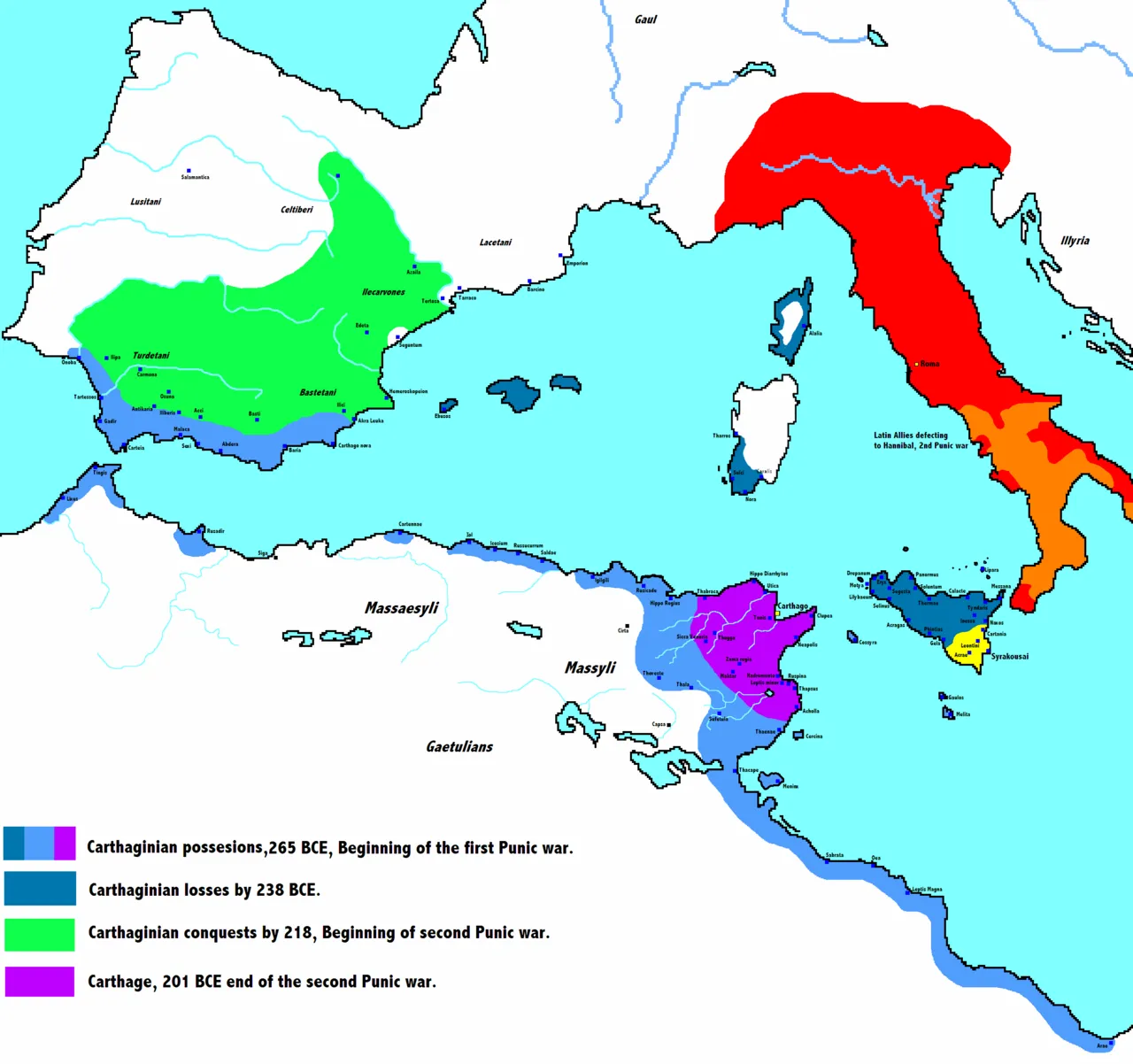
Nel 264 a.C. Roma e Cartagine erano due potenze in espansione che si trovarono inevitabilmente a contendersi lo stesso spazio. Roma aveva appena completato la conquista dell'Italia peninsulare con la sottomissione di Taranto e delle città magnogreche; Cartagine, fondata otto secoli prima dai Fenici, dominava il Mediterraneo occidentale con una rete commerciale che andava dalle Colonne d'Ercole alle coste della Sicilia, della Sardegna e della Corsica. Tra le due potenze si frapponeva la Sicilia, divisa fra città greche, possedimenti cartaginesi a ovest e il regno di Siracusa a est. Era una polveriera pronta ad esplodere.
In 264 BC Rome and Carthage were two expanding powers inevitably destined to compete for the same space. Rome had just completed the conquest of peninsular Italy with the submission of Tarentum and the Magna Graecia cities; Carthage, founded eight centuries earlier by the Phoenicians, dominated the western Mediterranean with a commercial network stretching from the Pillars of Hercules to the coasts of Sicily, Sardinia and Corsica. Between the two powers lay Sicily, divided among Greek cities, Carthaginian holdings to the west, and the kingdom of Syracuse to the east. It was a powder keg ready to explode.
La scintilla fu Messina. Nel 288 a.C. un gruppo di mercenari italici al servizio di Siracusa, i Mamertini ("figli di Marte"), aveva preso con la forza la città sullo stretto, massacrando gli abitanti maschi e fondando una signoria predatoria. Quando nel 265 a.C. il re siracusano Gerone II li attaccò per liberare Messina, i Mamertini chiesero aiuto sia a Cartagine sia a Roma. Cartagine arrivò per prima e installò una guarnigione. I Mamertini, pentitisi, scrissero allora a Roma. Il senato romano esitò : era contradditorio difendere mercenari pirati, ma i comizi centuriati votarono l'intervento. La motivazione ufficiale era diversa: impedire che Cartagine controllasse lo stretto di Messina e si trovasse a meno di tre chilometri dalla Calabria. Era pretestuosa quanto si vuole, ma perfettamente coerente con la nuova politica espansionistica romana.
The spark was Messina. In 288 BC a group of Italic mercenaries serving Syracuse, the Mamertines ("sons of Mars") had seized the city on the strait by force, massacring the male population and establishing a predatory lordship. When in 265 BC the Syracusan king Hiero II attacked them to free Messina, the Mamertines asked for help from both Carthage and Rome. Carthage arrived first and installed a garrison. The Mamertines, regretful, then wrote to Rome. The Roman senate hesitated, defending pirate mercenaries was contradictory, but the centuriate assemblies voted for intervention. The official motive was different: to prevent Carthage from controlling the Strait of Messina and being less than three kilometres from Calabria. It was pretextual, certainly, but perfectly consistent with Rome's new expansionist policy.
02Le Forze in CampoThe Forces
Le due potenze erano profondamente asimmetriche. Roma disponeva di un esercito civico-tribale formidabile: ogni anno mobilitava quattro legioni regolari (~17.000 fanti pesanti e leggeri ciascuna più le ali italiche) per un totale tra i 60.000 e i 100.000 uomini in armi. La fanteria pesante manipolare, organizzata in hastati, principes e triarii, era addestrata al combattimento ravvicinato in formazione flessibile. Il punto debole era la marina: Roma possedeva pochissime navi da guerra e nessuna esperienza significativa di combattimento navale.
The two powers were profoundly asymmetric. Rome had a formidable civic-tribal army: every year it mobilised four regular legions (~17,000 heavy and light infantry each, plus the Italic alae) for a total of 60,000 to 100,000 men under arms. The manipular heavy infantry, organised in hastati, principes and triarii, was trained for close combat in flexible formation. The weak point was the navy: Rome had very few warships and no significant naval combat experience.
Cartagine era esattamente il contrario. La sua flotta era la più potente del Mediterraneo, basata sulla quinquereme (nave da guerra a cinque ordini di rematori, ~45 metri di lunghezza, 300 uomini di equipaggio) e su ammiragli di lunga esperienza che operavano da basi a Cartagine, in Sicilia (Lilibeo, Drepana, Panormo) e in Sardegna. L'esercito di terra era invece principalmente mercenario: Numidi, Iberici, Galli, Liguri, Greci, ciascuno con il proprio equipaggiamento e le proprie tradizioni di combattimento. Solo la cavalleria pesante e le guarnigioni di Cartagine stessa erano puniche di nascita. Era un esercito potente ma costoso e meno coeso di quello romano.
Carthage was the exact opposite. Its fleet was the most powerful in the Mediterranean, based on the quinquereme (a warship with five banks of rowers, ~45 metres long, 300 crew) and on long-experienced admirals operating from bases at Carthage, in Sicily (Lilybaeum, Drepana, Panormus), and in Sardinia. The land army, however, was primarily mercenary: Numidians, Iberians, Gauls, Ligurians, Greeks, each with their own equipment and combat traditions. Only the heavy cavalry and the garrisons of Carthage itself were Punic-born. It was a powerful army but expensive and less cohesive than Rome's.
03L'Andamento della GuerraThe Course of the War
La guerra si articolò in tre fasi distinte. Nella prima (264–260 a.C.), Roma sbarcò in Sicilia, liberò Messina, costrinse Siracusa a passare dalla parte romana e conquistò Agrigento dopo un assedio di sette mesi (262 a.C.). Capirono però che senza una flotta non avrebbero mai potuto cacciare Cartagine dalle città costiere occidentali dell'isola. Così nel 260 a.C., in soli sessanta giorni e usando una quinquereme cartaginese arenata come modello, costruì cento quinqueremi e venti triremi. Il console Gaio Duilio le condusse a Milazzo (Mylae) e (con l'invenzione del corvus, il ponte d'arrembaggio) vinse la prima grande battaglia navale della storia romana. Trentuno navi cartaginesi catturate, quattordici affondate, 7.000 prigionieri.
The war unfolded in three distinct phases. In the first (264–260 BC), Rome landed in Sicily, freed Messina, forced Syracuse to switch to the Roman side, and captured Agrigento after a seven-month siege (262 BC). They realised, however, that without a fleet they could never drive Carthage from the western coastal cities of the island. So in 260 BC, in just sixty days and using a stranded Carthaginian quinquereme as a model, Rome built a hundred quinqueremes and twenty triremes. The consul Gaius Duilius led them to Mylae and (with the invention of the corvus, the boarding bridge) won the first great naval battle in Roman history. Thirty-one Carthaginian ships captured, fourteen sunk, 7,000 prisoners.
Nella seconda fase (260–249 a.C.), Roma osò il colpo decisivo: invadere l'Africa. Nel 256 a.C. la flotta romana, comandata dai consoli Marco Atilio Regolo e Lucio Manlio Vulsone, batté quella punica al Capo Ecnomo, la più grande battaglia navale dell'antichità , con 330 navi romane contro 350 cartaginesi e circa 290.000 uomini totalmente impegnati, e sbarcò ottantamila uomini in Africa. Regolo si avvicinò alle mura di Cartagine. Ma fu battuto da Santippo, generale spartano assoldato dai Cartaginesi, che impiegò gli elefanti contro la fanteria romana. Regolo fu catturato. La flotta che andava a recuperare i superstiti naufragò in una tempesta presso Camarina: centomila uomini perirono. Roma riuscì a costruire altre 220 navi nel giro di tre mesi, ma queste pure naufragarono nel 253 a.C. Una catastrofe.
In the second phase (260–249 BC), Rome dared the decisive stroke: to invade Africa. In 256 BC the Roman fleet, commanded by the consuls Marcus Atilius Regulus and Lucius Manlius Vulso, defeated the Punic one at Cape Ecnomus (the largest naval battle of antiquity, with 330 Roman ships against 350 Carthaginian and roughly 290,000 men engaged in total) and landed eighty thousand men in Africa. Regulus approached the walls of Carthage. But he was defeated by Xanthippus, a Spartan general hired by the Carthaginians, who used elephants against the Roman infantry. Regulus was captured. The fleet sent to retrieve the survivors was wrecked in a storm off Camarina: one hundred thousand men perished. Rome managed to build another 220 ships within three months, but these too were wrecked in 253 BC. A catastrophe.
La terza fase (249–241 a.C.) fu la più lunga e logorante. Amilcare Barca, padre del futuro Annibale, condusse una guerriglia inafferrabile dalla rocca di Erice, in Sicilia occidentale, contro le forze romane. Roma non poteva sloggiarlo. Ma il fronte si decise sul mare: nel 241 a.C., dopo che lo stato romano era stato dissanguato finanziariamente, i privati cittadini più ricchi finanziarono di tasca propria la costruzione di duecento nuove quinqueremi. Il console Gaio Lutazio Catulo le condusse alle Egadi, e lì intercettò la flotta cartaginese di rifornimento. Cinquanta navi puniche affondate, settanta catturate, diecimila prigionieri. Cartagine, esausta finanziariamente, ordinò ad Amilcare di trattare. Era la fine.
The third phase (249–241 BC) was the longest and most grinding. Hamilcar Barca, father of the future Hannibal, conducted an elusive guerrilla war from the rock of Eryx in western Sicily against the Roman forces. Rome could not dislodge him. But the front was decided at sea: in 241 BC, after the Roman state had been financially bled, the wealthiest private citizens funded the construction of two hundred new quinqueremes from their own pockets. The consul Gaius Lutatius Catulus led them to the Aegates Islands, and there intercepted the Carthaginian supply fleet. Fifty Punic ships sunk, seventy captured, ten thousand prisoners. Carthage, financially exhausted, ordered Hamilcar to negotiate. It was the end.
04Le TatticheThe Tactics
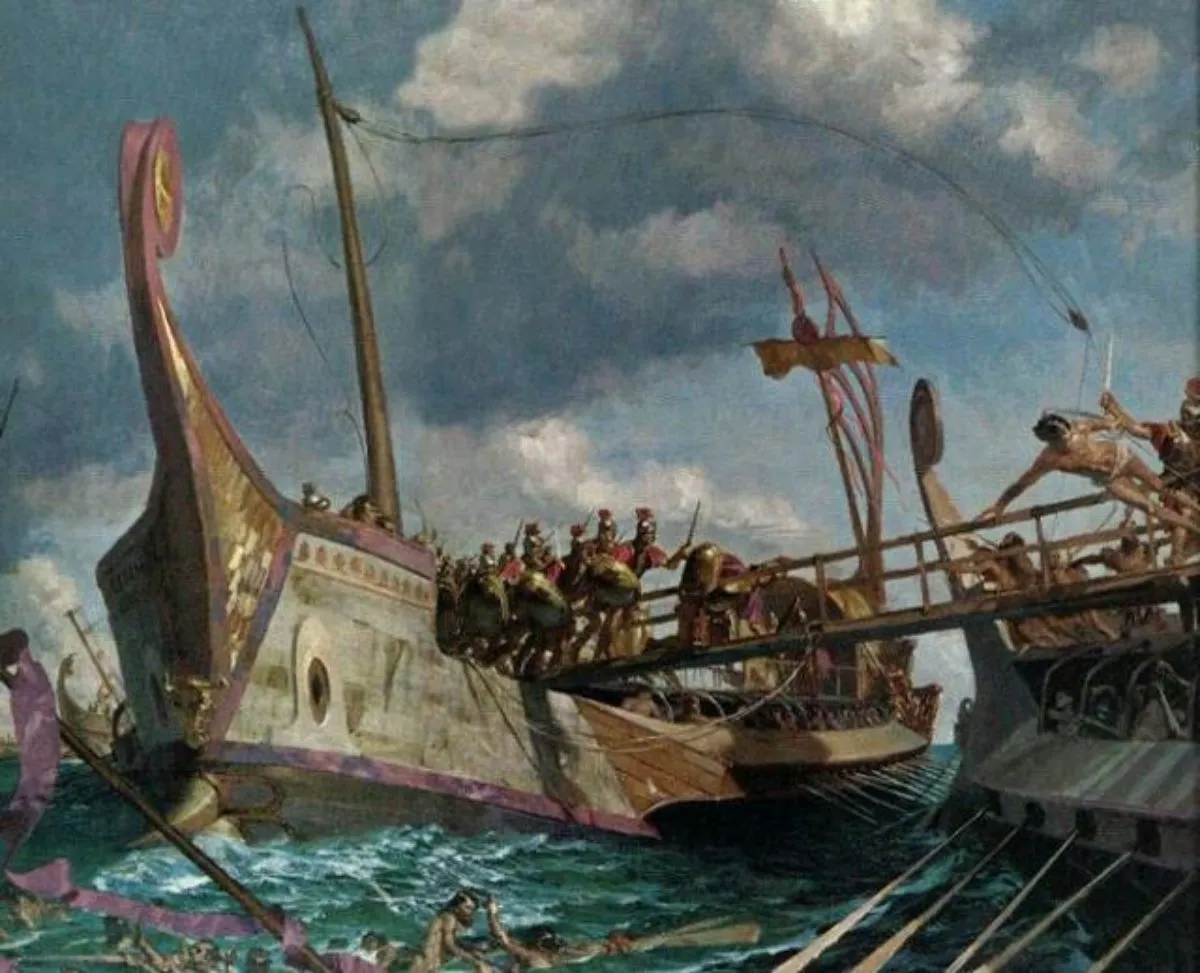
Il problema strategico fondamentale per Roma era questo: come trasformare un combattimento navale, dove i Cartaginesi erano superiori, in un combattimento terrestre, dove i Romani erano superiori? La risposta fu un dispositivo geniale, il corvus (in latino "corvo"). Si trattava di un ponte d'arrembaggio mobile, lungo circa undici metri e largo poco più di un metro, montato su un palo girevole sulla prua della nave romana. Quando una nave nemica si avvicinava, i Romani facevano cadere il corvus sul ponte avversario; un grosso "becco" di ferro all'estremità si conficcava nel legno, creando un ponte stabile attraverso il quale i legionari potevano caricare. Da quel momento, lo scontro navale diventava combattimento terrestre, e nella mischia ravvicinata, i fanti romani erano imbattibili.
Rome's fundamental strategic problem was this: how do you turn a naval engagement, where the Carthaginians were superior, into a land engagement, where the Romans were superior? The answer was a brilliant device, the corvus (Latin for "raven"). It was a mobile boarding bridge, about eleven metres long and a little over one metre wide, mounted on a swivel pole at the Roman ship's bow. When an enemy ship approached, the Romans dropped the corvus onto the enemy deck; a large iron "beak" at the tip drove into the wood, creating a stable bridge across which the legionaries could charge. From that moment, the naval clash became a land battle, and in close combat, Roman infantry were unbeatable.
Il corvus permise a Roma di vincere le prime grandi battaglie navali (Milazzo 260 a.C., Capo Ecnomo 256 a.C.), ma aveva un grave difetto: alterava il baricentro della nave, rendendola instabile in mare aperto. Le tempeste che distrussero le flotte romane nel 255 e 253 a.C. non erano accidenti: erano il prezzo del corvus. Dopo la seconda catastrofe, i Romani lo abbandonarono. Imparando dalla pratica, costruirono navi più leggere e veloci, addestrarono equipaggi nativi italici, e impararono a manovrare. Alle Egadi, nel 241 a.C., la flotta romana vinse senza più bisogno del corvus: era diventata, dopo vent'anni di guerra, una vera marina militare a tutti gli effetti.
The corvus allowed Rome to win the first great naval battles (Mylae 260 BC, Cape Ecnomus 256 BC), but it had a serious flaw: it altered the ship's centre of gravity, making it unstable on the open sea. The storms that destroyed the Roman fleets in 255 and 253 BC were not accidents: they were the price of the corvus. After the second catastrophe, the Romans abandoned it. Learning from practice, they built lighter and faster ships, trained native Italic crews, and learned to manoeuvre. At the Aegates Islands, in 241 BC, the Roman fleet won without needing the corvus, after twenty years of war, it had become a true navy in every respect.
Sul fronte terrestre, Roma applicò la sua dottrina manipolare classica: linee successive di hastati, principes e triarii, capaci di rilevarsi a vicenda durante il combattimento e di mantenere fresche riserve fino alla decisione. La cavalleria, scarsa, era il punto debole. Cartagine sfruttò questa debolezza con i suoi elefanti da guerra (a Tunisi nel 255 a.C., contro Regolo) e con la cavalleria numidica leggera. Ma sul lungo periodo, l'esercito mercenario cartaginese soffriva di mancanza di coesione e di costi proibitivi: ogni sconfitta significava licenziamento di mercenari e impossibilità di ricostituirli rapidamente.
On the land front, Rome applied its classic manipular doctrine: successive lines of hastati, principes, and triarii, capable of relieving each other during combat and maintaining fresh reserves until the decisive moment. Cavalry, scarce, was the weak point. Carthage exploited this weakness with its war elephants (at Tunis in 255 BC, against Regulus) and with light Numidian cavalry. But over the long term, Carthage's mercenary army suffered from lack of cohesion and prohibitive costs: every defeat meant dismissing mercenaries and an inability to quickly reconstitute them.
« Roma non era una potenza marittima. Eppure creò in sessanta giorni una flotta che batté quella che il Mediterraneo aveva temuto per secoli. La forza di Roma era la sua determinazione: ogni guerra, dopo ogni sconfitta, ricominciava da capo.» « Rome was not a sea power. Yet in sixty days she built a fleet that beat the one the Mediterranean had feared for centuries. Rome's strength was her determination: every war, after every defeat, began again from scratch.» — Polibio, Storie I, 20
05Le ConseguenzeThe Consequences
Il trattato di Lutazio (241 a.C.) impose a Cartagine condizioni dure ma non distruttive: l'evacuazione totale della Sicilia, la liberazione dei prigionieri romani senza riscatto, e un'indennità di 3.200 talenti d'argento (~84 tonnellate) da pagare in dieci anni. La Sicilia divenne la prima provincia romana, governata da un pretore con potere proconsolare e tassata con la decima, un modello che Roma ripeterà nei due secoli successivi. Tre anni dopo, approfittando della rivolta dei mercenari cartaginesi (la "Guerra senza tregua", 240–237 a.C.), Roma annetté con un atto di pura prepotenza la Sardegna e la Corsica, raddoppiando l'indennità .
The Treaty of Lutatius (241 BC) imposed harsh but not destructive terms on Carthage: total evacuation of Sicily, release of Roman prisoners without ransom, and an indemnity of 3,200 talents of silver (~84 tonnes) to be paid in ten years. Sicily became the first Roman province, governed by a praetor with proconsular power and taxed with the tithe: a model Rome would repeat over the following two centuries. Three years later, taking advantage of the Carthaginian Mercenary War (240–237 BC), Rome annexed Sardinia and Corsica with an act of pure highhandedness, doubling the indemnity.
Sul piano politico-militare, la guerra trasformò Roma. La città che nel 264 a.C. era una potenza regionale italica uscì nel 241 a.C. come prima potenza navale del Mediterraneo occidentale e prima potenza coloniale della storia romana. Le province sarebbero diventate il modello di governo dell'espansione futura. La gestione delle finanze pubbliche, sotto la pressione di una guerra ventennale, si raffinò : il tributum straordinario, le contribuzioni dei privati ricchi, l'aerarium militare. Anche la struttura sociale cambiò : i lunghi servizi militari trasformarono i piccoli proprietari terrieri in legionari professionali, contribuendo (sul lungo periodo) alla crisi agraria del II secolo.
On the political and military plane, the war transformed Rome. The city that in 264 BC was an Italic regional power emerged in 241 BC as the first naval power of the western Mediterranean and the first colonial power in Roman history. The provinces would become the model for governing future expansion. Public finance management, under the pressure of a twenty-year war, was refined: the extraordinary tributum, contributions from wealthy private citizens, the military aerarium. The social structure also changed: long military service transformed small landowners into professional legionaries, contributing (over the long term) to the agrarian crisis of the 2nd century.
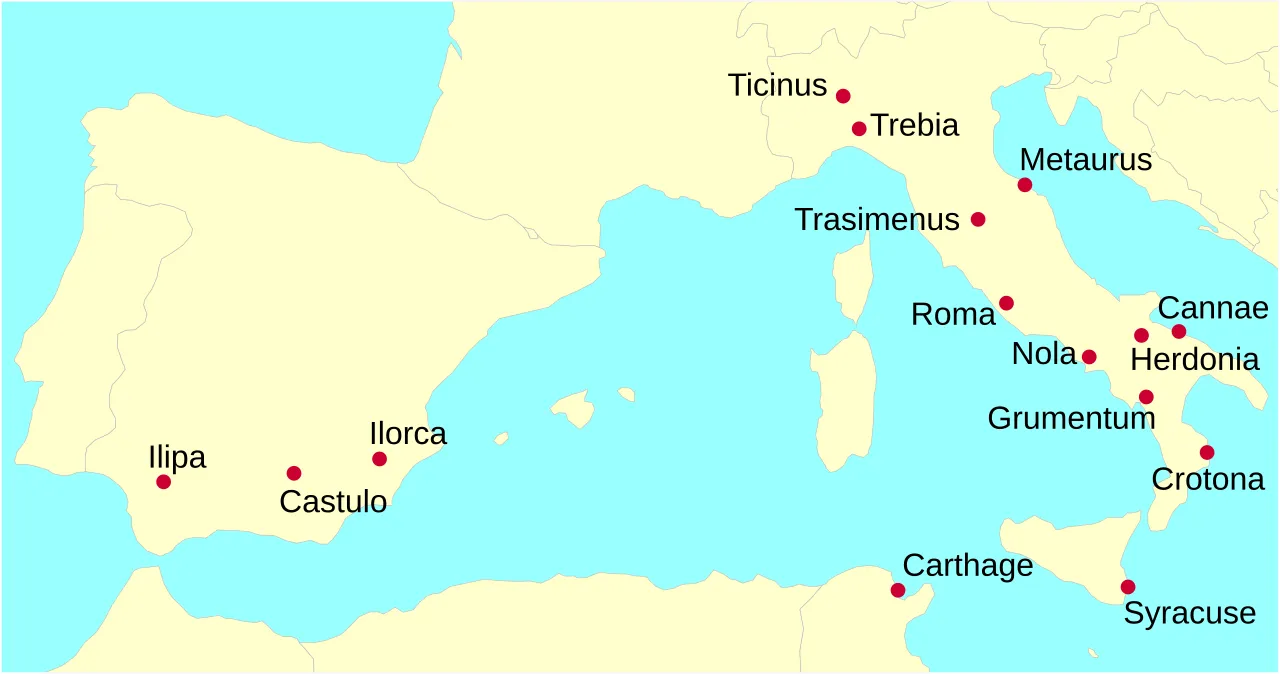
Cartagine uscì sconfitta ma non annientata. La perdita della Sicilia, della Sardegna e della Corsica fu compensata dall'espansione in Iberia, condotta proprio da Amilcare Barca e poi da suo genero Asdrubale e da suo figlio Annibale. La Spagna divenne il nuovo cuore economico e militare cartaginese: argento, mercenari celtiberi, basi commerciali. Quando Annibale, ventiseienne, prese il comando nel 221 a.C., la macchina punica era pronta a vendicare il padre. Diciotto anni dopo, attraversando le Alpi con quarantamila uomini e trentasette elefanti, avrebbe scatenato la Seconda Guerra Punica. La prima guerra non aveva risolto nulla: aveva solo posticipato la resa dei conti.
Carthage emerged defeated but not destroyed. The loss of Sicily, Sardinia and Corsica was offset by expansion into Iberia, led by Hamilcar Barca himself and then by his son-in-law Hasdrubal and his son Hannibal. Spain became the new economic and military heart of Carthage: silver, Celtiberian mercenaries, trading bases. When Hannibal, aged twenty-six, took command in 221 BC, the Punic machine was ready to avenge his father. Eighteen years later, crossing the Alps with forty thousand men and thirty-seven elephants, he would unleash the Second Punic War. The first war had resolved nothing: it had only postponed the reckoning.