01BiografiaBiography
Il giuramento di Baal
The oath of Baal
Annibale Barca nacque a Cartagine nel 247 a.C., in una città che ancora leccava le ferite della più lunga guerra mai combattuta. La Prima Guerra Punica si era da poco chiusa con la disfatta navale delle Egadi (241 a.C.): Cartagine aveva ceduto la Sicilia, pagato un'indennità schiacciante e, poco dopo, subito l'onta di vedersi strappare anche Sardegna e Corsica mentre era paralizzata dalla rivolta dei mercenari. Il padre di Annibale, Amilcare Barca, era l'unico generale uscito invitto da quel disastro: un uomo che della pace con Roma non faceva una conclusione, ma una tregua.
Hannibal Barca was born in Carthage in 247 BC, in a city still nursing the wounds of the longest war ever fought. The First Punic War had just ended with the naval rout of the Aegates Islands (241 BC): Carthage had ceded Sicily, paid a crushing indemnity and, soon after, suffered the disgrace of losing Sardinia and Corsica too while paralysed by the Mercenary Revolt. Hannibal's father, Hamilcar Barca, was the one general to emerge undefeated from that disaster: a man who saw peace with Rome not as a conclusion but as a truce.
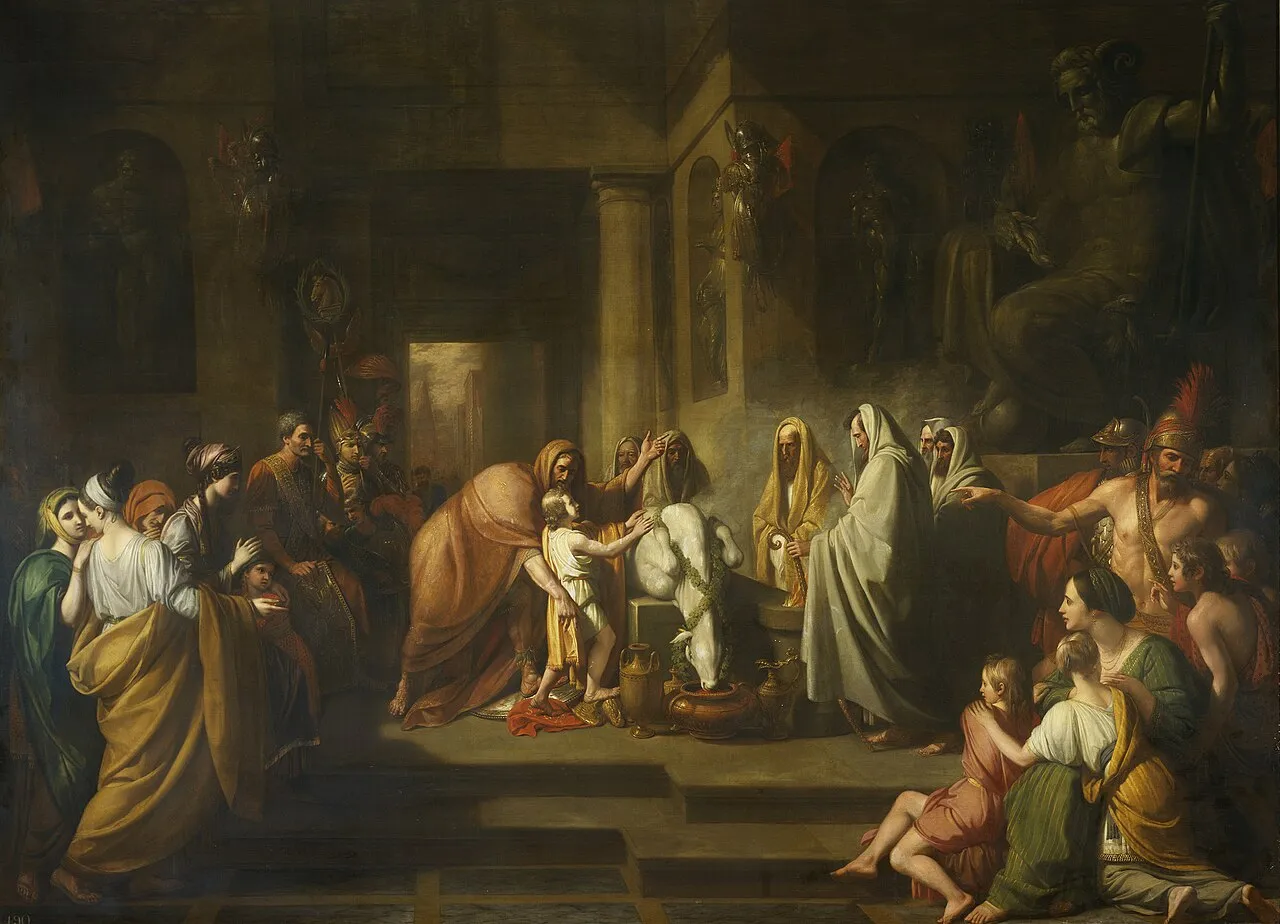
Su quel risentimento Annibale fu educato. Polibio, che raccolse la testimonianza dallo stesso Annibale ormai vecchio, narra che a nove anni il bambino supplicò il padre di condurlo con sé in Spagna. Amilcare lo portò davanti all'altare di Baal Hammon, gli pose la mano sulle vittime sacrificali e gli fece giurare che non sarebbe mai stato amico di Roma. Non un odio cieco, ma una missione: vendicare la patria e rovesciare l'equilibrio del Mediterraneo. Quel giuramento, vero o leggendario, fu la bussola di sessant'anni di vita.
On that resentment Hannibal was raised. Polybius, who gathered the testimony from the aged Hannibal himself, tells that at nine the boy begged his father to take him to Spain. Hamilcar led him before the altar of Baal Hammon, laid his hand on the sacrificial victims and made him swear that he would never be a friend of Rome. Not a blind hatred, but a mission: to avenge his homeland and overturn the balance of the Mediterranean. That oath, true or legendary, was the compass of sixty years of life.
L'impero di Spagna e l'ascesa al comando
The empire of Spain and the rise to command
Dal 237 a.C. Amilcare trasformò l'Iberia nel serbatoio della riscossa cartaginese: sottomise le tribù del sud, sfruttò le inesauribili miniere d'argento della Sierra Morena, che secondo Polibio rendevano tonnellate di metallo al giorno, e arruolò una fanteria iberica durissima e una temibile cavalleria celtibera. Alla sua morte (229 a.C.) il genero Asdrubale il Bello proseguì l'opera, fondò Qart Hadasht (la « Città Nuova» , l'odierna Cartagena) e ne fece la capitale di un dominio più ricco di quanto Cartagine avesse mai posseduto in Sicilia.
From 237 BC Hamilcar turned Iberia into the reservoir of Carthaginian revenge: he subdued the southern tribes, exploited the inexhaustible silver mines of the Sierra Morena, which by Polybius's account yielded tonnes of metal a day, and recruited a hardened Iberian infantry and a fearsome Celtiberian cavalry. On his death (229 BC) his son-in-law Hasdrubal the Fair carried on the work, founded Qart Hadasht (the « New City» , modern Cartagena) and made it the capital of a dominion richer than anything Carthage had ever held in Sicily.
In quegli accampamenti Annibale divenne uomo e soldato. Imparò a parlare le lingue dei mercenari, a marciare e patire con loro, a comandare prima ancora di governare. A diciotto anni guidava la cavalleria; a venticinque era il braccio destro di Asdrubale. Quando nel 221 a.C. il cognato cadde sotto il pugnale di uno schiavo celtibero, l'esercito lo acclamò comandante per spontanea volontà , superando ogni esitazione del senato cartaginese. Aveva ventisei anni, e in pugno la più potente macchina militare dell'Occidente.
In those camps Hannibal became a man and a soldier. He learned the tongues of the mercenaries, marched and suffered with them, learned to command before he learned to govern. At eighteen he led the cavalry; at twenty-five he was Hasdrubal's right hand. When in 221 BC his brother-in-law fell to a Celtiberian slave's dagger, the army acclaimed him commander by spontaneous will, overriding every hesitation of the Carthaginian senate. He was twenty-six, with the most powerful military machine of the West in his grip.
Sagunto e la grande traversata
Saguntum and the great crossing
Annibale non cercava un compromesso, ma la guerra. Nel 219 a.C. assediò Sagunto, città iberica sotto protezione romana: otto mesi d'assedio feroce, poi il saccheggio e la distruzione. Era il casus belli calcolato. Mentre a Roma si discuteva ancora se rispondere in Spagna o sbarcare in Africa, Annibale aveva già scelto il teatro più audace: l'Italia stessa. Nella primavera del 218 a.C. lasciò Nova Carthago con un esercito colossale: circa 90.000 fanti, 12.000 cavalieri e 37 elefanti, e puntò a nord, verso i Pirenei e il Rodano.
Hannibal sought no compromise, but war. In 219 BC he besieged Saguntum, an Iberian city under Roman protection: eight months of ferocious siege, then sack and destruction. It was the calculated casus belli. While Rome still debated whether to respond in Spain or land in Africa, Hannibal had already chosen the boldest theatre of all: Italy itself. In spring 218 BC he left Nova Carthago with a colossal army (some 90,000 infantry, 12,000 cavalry and 37 elephants) and struck north, toward the Pyrenees and the Rhone.
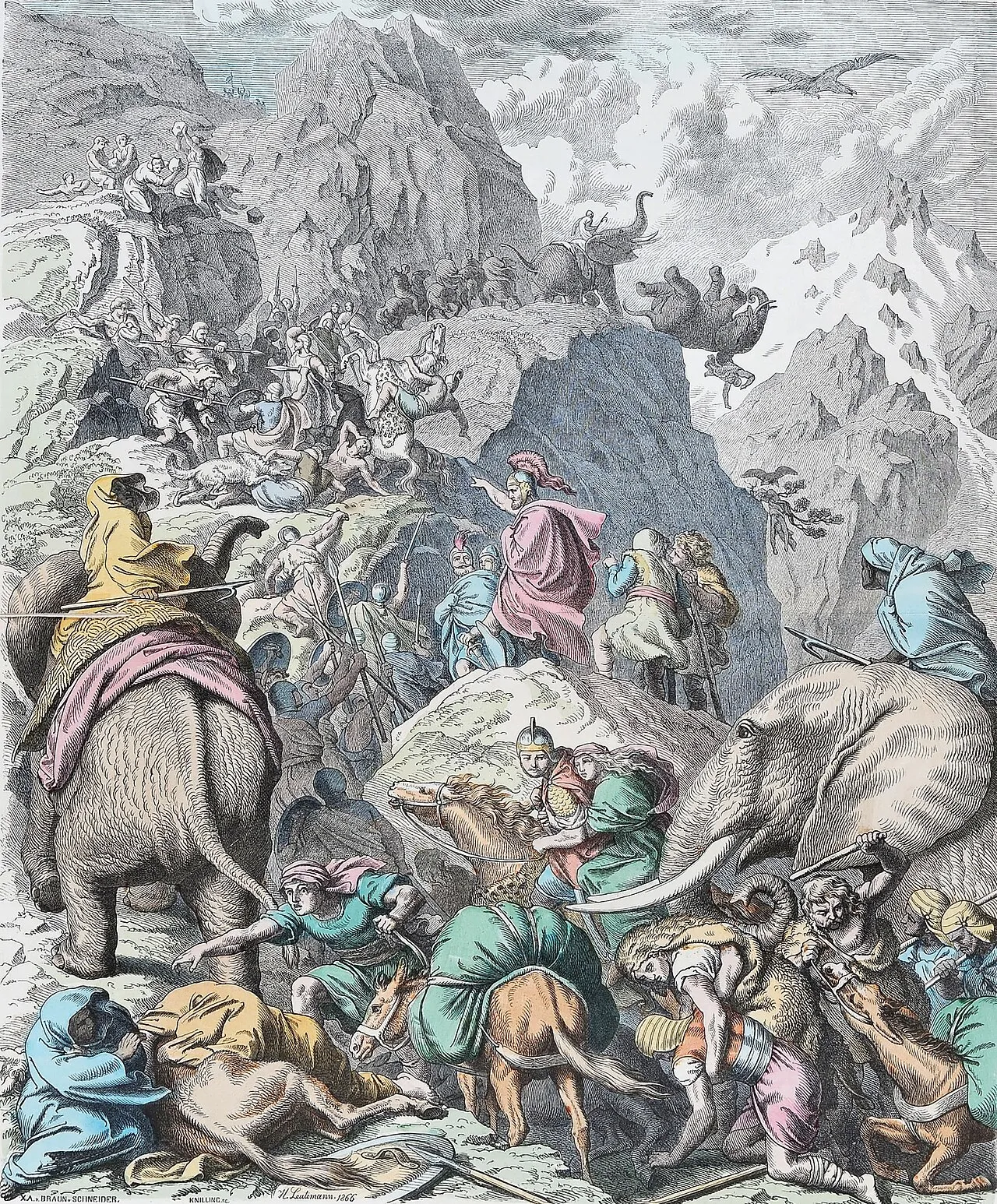
La traversata del Rodano, con gli elefanti spinti sul fiume su zattere mascherate da terraferma, fu solo il preludio. L'impresa che lo consegnò alla leggenda fu il valico delle Alpi, in autunno inoltrato: quindici giorni di gole gelate, frane, valanghe e imboscate dei montanari Allobrogi. Le fonti antiche descrivono sentieri ridotti a lastre di ghiaccio, uomini e muli inghiottiti dai precipizi, un passaggio aperto nella roccia col fuoco e l'aceto. Annibale scese nella pianura padana con forse metà dell'esercito e una manciata di pachidermi, ma con l'arma decisiva intatta: nessuno, a Roma, aveva creduto possibile ciò che era appena accaduto.
The crossing of the Rhone, with the elephants floated across on rafts disguised as solid ground, was only the prelude. The feat that gave him to legend was the passage of the Alps, in late autumn: fifteen days of frozen gorges, landslides, avalanches and the ambushes of the Allobrogian mountaineers. The ancient sources describe paths reduced to sheets of ice, men and mules swallowed by the precipices, a passage opened through the rock with fire and vinegar. Hannibal came down onto the plain of the Po with perhaps half his army and a handful of pachyderms, but with the decisive weapon intact: no one in Rome had believed possible what had just happened.
« Aut viam inveniam aut faciam » — « O troverò una strada, o me la aprirò .» « Aut viam inveniam aut faciam » — « I shall either find a way or make one.» Massima attribuita ad Annibale di fronte alle AlpiMaxim attributed to Hannibal before the Alps
I sedici anni in Italia
The sixteen years in Italy
Ciò che seguì fu, insieme, il più lungo dei trionfi e la più sterile delle vittorie. In tre anni Annibale annientò una dopo l'altra le armate consolari: il Ticino e la Trebbia nel 218, il Trasimeno nel 217, e infine Canne nel 216, la più grande catastrofe militare della storia romana. Eppure la Città non si piegò . Roma rifiutò di trattare perfino dopo Canne, arruolò schiavi e adolescenti, ricostituì legioni dal nulla e affidò la propria salvezza alla pazienza di Quinto Fabio Massimo, il « Temporeggiatore» , che intuì la verità più scomoda: Annibale era imbattibile in campo aperto, ma poteva essere logorato dal tempo, dalla distanza e dalla fame.
What followed was at once the longest of triumphs and the most sterile of victories. In three years Hannibal annihilated the consular armies one after another: the Ticinus and the Trebia in 218, Trasimene in 217, and finally Cannae in 216, the greatest military catastrophe in Roman history. Yet the City did not bend. Rome refused to negotiate even after Cannae, enlisted slaves and boys, rebuilt legions from nothing, and entrusted its survival to the patience of Quintus Fabius Maximus, the « Delayer» , who grasped the most uncomfortable truth: Hannibal was unbeatable in open field, but could be worn down by time, distance and hunger.
Zama, l'esilio e la morte
Zama, exile and death
Privato dei rinforzi, il fratello Asdrubale, sceso dalla Spagna, fu intercettato e ucciso al Metauro nel 207 a.C., e la sua testa gettata nell'accampamento di Annibale, il Cartaginese restò inchiodato nel Mezzogiorno, invitto ma sempre più solo. Fu Roma a mutare il gioco: nel 204 a.C. il giovane Scipione portò la guerra in Africa. Richiamato in patria dopo sedici anni, Annibale affrontò il suo unico vero pari a Zama nel 202 a.C. Per la prima e ultima volta fu sconfitto: la cavalleria numidica di Massinissa, l'arma che lo aveva reso invincibile, quel giorno galoppava per Roma.
Deprived of reinforcements (his brother Hasdrubal, come down from Spain, was intercepted and killed at the Metaurus in 207 BC, and his head flung into Hannibal's camp) the Carthaginian remained nailed to the south, unbeaten yet ever more alone. It was Rome that changed the game: in 204 BC the young Scipio carried the war into Africa. Recalled home after sixteen years, Hannibal faced his one true equal at Zama in 202 BC. For the first and last time he was defeated: Massinissa's Numidian cavalry, the weapon that had made him invincible, that day galloped for Rome.
La pace fu spietata, ma Annibale non era finito. Eletto sufeta, risanò le finanze di Cartagine e colpì l'aristocrazia corrotta, che per vendetta lo denunciò ai Romani. Costretto alla fuga, divenne l'esule più temuto del Mediterraneo: stratega alla corte di Antioco III di Siria, poi del re Prusia di Bitinia, sempre inseguito dagli emissari di una Roma che non gli perdonava di esistere. Quando l'estradizione divenne inevitabile, nel 183 a.C., a sessantaquattro anni, scelse l'ultima libertà e bevve il veleno che custodiva nell'anello. « Liberiamo i Romani (disse, secondo la tradizione) dall'angoscia di un vecchio.»
The peace was merciless, but Hannibal was not finished. Elected suffete, he healed Carthage's finances and struck at the corrupt aristocracy, which in revenge denounced him to the Romans. Forced to flee, he became the most feared exile of the Mediterranean: strategist at the court of Antiochus III of Syria, then of King Prusias of Bithynia, ever hunted by the agents of a Rome that could not forgive him for existing. When extradition became inevitable, in 183 BC, at sixty-four, he chose a last freedom and drank the poison he kept in his ring. « Let us free the Romans (he said, by tradition) from the anxiety of an old man.»
02Battaglie e CampagneBattles and Campaigns
Una guerra lampo lunga sedici anni
A lightning war sixteen years long
La campagna d'Italia di Annibale è tra le più straordinarie della storia militare: un esercito straniero che, isolato in territorio nemico, senza rifornimenti sicuri e in costante inferiorità numerica, tenne in scacco per sedici anni la maggiore potenza del Mediterraneo. Ogni anno Roma schierava nuove legioni; per anni Annibale trovò il modo di annientarle. La sequenza che segue è il diario di quel duello impossibile.
Hannibal's Italian campaign is among the most extraordinary in military history: a foreign army that, isolated in enemy territory, without secure supply and in constant numerical inferiority, held the greatest power of the Mediterranean in check for sixteen years. Every year Rome fielded new legions; for years Hannibal found the way to annihilate them. The sequence that follows is the diary of that impossible duel.
- 219 a.C. Assedio di Sagunto — Otto mesi sotto le mura della città alleata di Roma. Quando cadde, fu saccheggiata e distrutta: Annibale aveva acceso di proposito la miccia. Roma proclamò il casus belli: cominciava la Seconda Guerra Punica. Siege of Saguntum — Eight months beneath the walls of Rome's allied city. When it fell, it was sacked and destroyed: Hannibal had deliberately lit the fuse. Rome proclaimed the casus belli: the Second Punic War had begun.
- 218 a.C. Traversata delle Alpi — Quindici giorni fra valanghe, tormente e gli agguati dei montanari. Annibale perse metà dell'esercito sui passi gelati, ma calò nella pianura padana là dove nessuno lo attendeva: la sorpresa che capovolse la guerra. Alpine crossing — Fifteen days through avalanches, storms and the ambushes of the mountain tribes. Hannibal lost half his army on the frozen passes, but descended onto the plain of the Po where none awaited him: the surprise that overturned the war.
- 218 a.C. Battaglia del Ticino — Primo sangue in Italia. La cavalleria numidica spazzò via quella romana; il console Publio Cornelio Scipione, ferito, fu tratto in salvo dal figlio sedicenne: il futuro vincitore di Zama. Battle of the Ticinus — First blood in Italy. The Numidian cavalry swept the Roman horse away; the wounded consul Publius Cornelius Scipio was carried to safety by his sixteen-year-old son: the future victor of Zama.
- 218 a.C. Battaglia della Trebbia — Annibale attirò i Romani a guadare il fiume gelato all'alba, digiuni e intirizziti. Imboscata sui fianchi, fanteria al centro: 40.000 uomini annientati. Il console Sempronio Longo fuggì con pochi superstiti. Battle of the Trebia — Hannibal lured the Romans to ford the icy river at dawn, fasting and numb with cold. Ambush on the flanks, infantry at the centre: 40,000 men annihilated. Consul Sempronius Longus fled with a few survivors.
- 217 a.C. Battaglia del Trasimeno — L'imboscata perfetta. Nella nebbia del mattino, lungo le rive del lago, il console Flaminio condusse le legioni in una trappola mortale: 15.000 caduti, 6.000 prigionieri, lo stesso Flaminio ucciso. La più vasta imboscata dell'antichità . Battle of Lake Trasimene — The perfect ambush. In the morning fog, along the lake shore, consul Flaminius led the legions into a deadly trap: 15,000 dead, 6,000 prisoners, Flaminius himself slain. The greatest ambush of antiquity.
- 216 a.C. Battaglia di Canne — Il capolavoro assoluto. 50.000 Cartaginesi contro 86.000 Romani. Disposta la fanteria a mezzaluna, Annibale lasciò cedere il centro e fece ruotare le ali; la cavalleria chiuse la sacca alle spalle. In un solo giorno oltre 50.000 Romani perirono, il console Emilio Paolo fra loro. Il doppio avvolgimento di Canne si studia ancora in ogni accademia militare. Battle of Cannae — The absolute masterpiece. 50,000 Carthaginians against 86,000 Romans. Drawing his infantry into a crescent, Hannibal let the centre give way and wheeled the wings inward; the cavalry closed the pocket from the rear. In a single day over 50,000 Romans perished, consul Aemilius Paulus among them. The double envelopment of Cannae is still studied in every military academy.
- 215–212 a.C. Defezioni italiche — Capua, Taranto, Siracusa e gran parte del Mezzogiorno passarono ad Annibale; Filippo V di Macedonia si alleò con Cartagine. Roma parve sull'orlo dell'abisso. Ma le colonie latine non tradirono, e quella fedeltà salvò la Repubblica. Italian defections — Capua, Tarentum, Syracuse and much of the south went over to Hannibal; Philip V of Macedon allied with Carthage. Rome seemed on the edge of the abyss. But the Latin colonies did not betray, and that loyalty saved the Republic.
- 211 a.C. "Hannibal ad portas" — Per spezzare l'assedio romano di Capua, Annibale marciò sull'Urbe e si spinse a tre miglia dalle mura. Privo di macchine d'assedio, non poteva espugnarla. Ma il grido « Annibale alle porte!» restò per secoli sinonimo di terrore. "Hannibal ad portas" — To break the Roman siege of Capua, Hannibal marched on the City and came within three miles of the walls. Lacking siege engines, he could not take it. But the cry « Hannibal at the gates!» remained for centuries a byword for terror.
- 207 a.C. Battaglia del Metauro — Il fratello Asdrubale scese dalla Spagna con i rinforzi attesi da anni. Le legioni lo intercettarono e lo distrussero; la sua testa fu gettata nell'accampamento di Annibale. « Riconosco il destino di Cartagine» , disse. Era la fine della speranza. Battle of the Metaurus — His brother Hasdrubal came down from Spain with the reinforcements awaited for years. The legions intercepted and destroyed him; his head was flung into Hannibal's camp. « I recognise the fate of Carthage» , he said. It was the end of hope.
- 203 a.C. Richiamo in Africa — Mentre Scipione minacciava Cartagine, il senato richiamò Annibale dopo sedici anni in Italia. Lasciò la penisola invitto sul campo, costretto a partire non da una sconfitta, ma dalla strategia che aveva colpito la sua patria alle spalle. Recalled to Africa — While Scipio threatened Carthage, the senate recalled Hannibal after sixteen years in Italy. He left the peninsula unbeaten in the field, forced to depart not by a defeat, but by the strategy that had struck his homeland at its back.
- 202 a.C. Battaglia di Zama — Lo scontro decisivo, e l'unico che Annibale perse. Scipione l'Africano rivolse contro di lui le sue stesse tattiche; la cavalleria numidica di Massinissa, ora alleata di Roma, travolse i fianchi punici. Cartagine perdette la guerra e l'egemonia sul Mediterraneo occidentale. Battle of Zama — The decisive clash, and the only one Hannibal lost. Scipio Africanus turned Hannibal's own tactics against him; Massinissa's Numidian cavalry, now allied with Rome, overwhelmed the Punic flanks. Carthage lost the war and its hegemony over the western Mediterranean.
Canne: l'anatomia di un massacro
Cannae: the anatomy of a massacre
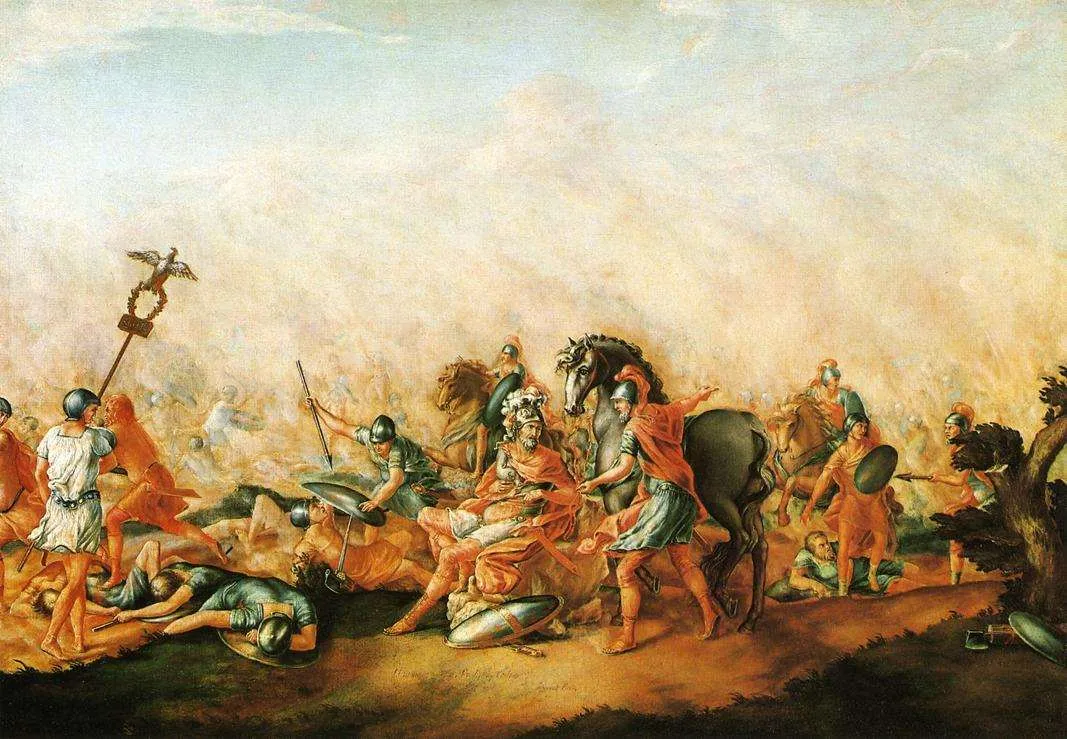
Vale la pena fermarsi su Canne, perché nessuna battaglia ha mai concentrato tanta morte in così poco tempo. Il 2 agosto 216 a.C. il console Varrone schierò ottantaseimila uomini in una massa compatta, sperando di sfondare il centro cartaginese con il peso puro. Era esattamente ciò che Annibale desiderava. Il centro celto-iberico arretrò lentamente, risucchiando i Romani in una sacca; i veterani africani sui fianchi ruotarono verso l'interno; la cavalleria, travolta l'ala romana, chiuse la trappola alle spalle. In poche ore l'esercito più grande mai schierato da Roma fu compresso su sé stesso, così serrato da non poter più alzare le spade.
It is worth pausing on Cannae, for no battle ever concentrated so much death in so little time. On 2 August 216 BC consul Varro drew up eighty-six thousand men in a compact mass, hoping to break the Carthaginian centre by sheer weight. It was precisely what Hannibal wanted. The Celtic-Iberian centre fell back slowly, sucking the Romans into a pocket; the African veterans on the flanks wheeled inward; the cavalry, having broken the Roman wing, closed the trap from the rear. Within hours the largest army Rome ever fielded was compressed upon itself, so tightly packed it could no longer raise its swords.
Le cifre antiche sfiorano l'incredibile: fino a cinquantamila morti in un solo pomeriggio, fra loro il console Emilio Paolo, due questori, ventinove tribuni militari e ottanta senatori. In un giorno era caduto un quinto della classe dirigente romana. Eppure Roma rifiutò perfino di riscattare i prigionieri: nessuna trattativa, nessuna resa. Fu allora che il comandante della cavalleria, Maarbale, esortò invano Annibale a marciare subito sull'Urbe, prima che Roma potesse riprendersi.
The ancient figures verge on the incredible: up to fifty thousand dead in a single afternoon, among them the consul Aemilius Paulus, two quaestors, twenty-nine military tribunes and eighty senators. In one day a fifth of Rome's ruling class had fallen. Yet Rome refused even to ransom the prisoners: no negotiation, no surrender. It was then that the cavalry commander, Maharbal, urged Hannibal in vain to march at once on the City, before Rome could recover.
« Vincere sai, Annibale; sfruttare la vittoria non sai. » « You know how to win a victory, Hannibal; you do not know how to use one. » Maarbale ad Annibale dopo Canne (Tito Livio, XXII, 51Maharbal to Hannibal after Cannae) Livy, XXII, 51
03Strategia e Genio MilitareStrategy and Military Genius
L'arte di leggere il nemico
The art of reading the enemy
Il genio di Annibale non stava in una formula, ma nell'adattamento. Nessuna delle sue grandi battaglie somiglia a un'altra, perché ognuna nasceva dallo studio paziente del terreno e dell'uomo che aveva di fronte. Al Trasimeno trasformò la nebbia del mattino e una strettoia fra i colli e il lago nella più grande imboscata dell'antichità . Alla Trebbia fece combattere i Romani digiuni, infreddoliti e bagnati, dopo averli attirati a guadare un fiume gelato all'alba. Conosceva il carattere di ogni console, l'impulsività di Flaminio, la baldanza di Varrone, e lo adoperava come un'arma.
Hannibal's genius lay not in a formula but in adaptation. No two of his great battles are alike, for each was born of patient study of the ground and of the man before him. At Trasimene he turned the morning fog and a defile between hills and lake into the greatest ambush of antiquity. At the Trebia he made the Romans fight fasting, frozen and soaked, after luring them to ford an icy river at dawn. He knew the character of each consul (the impulsiveness of Flaminius, the bravado of Varro) and wielded it as a weapon.
La sua superiorità era anche psicologica. Sapeva quando mostrarsi e quando sparire, quando offrire battaglia e quando negarla, e diffondeva il terrore prima ancora dello scontro. A Canne ribaltò la logica stessa della guerra antica: invece di rinforzare il centro, lo dispose più debole e sporgente, certo che i Romani vi si sarebbero riversati, e che, riversandosi, sarebbero entrati nella trappola che li avrebbe inghiottiti.
His superiority was psychological too. He knew when to show himself and when to vanish, when to offer battle and when to deny it, and spread terror before the clash had even begun. At Cannae he overturned the very logic of ancient warfare: instead of strengthening the centre, he made it weaker and protruding, certain the Romans would pour into it, and that, pouring in, they would enter the trap that would swallow them.
« Primo andava in battaglia, ultimo lasciava il campo a combattimento concluso. » « First he went into battle, last he left the field when the fighting was done. » Tito Livio, su Annibale (Ab Urbe Condita XXI, 4Livy, on Hannibal) Ab Urbe Condita XXI, 4
Cavalleria e fanteria: l'esercito di Babele
Cavalry and infantry: the army of Babel
L'arma decisiva era la cavalleria numidica: cavalieri leggeri, senza sella né morso, capaci di fingere la fuga e di rovesciarsi all'improvviso sul nemico. Era la cavalleria a vincere le battaglie di Annibale, accerchiando un'armata consolare dopo l'altra. La fanteria, invece, era un mosaico improbabile (Libici, Cartaginesi, Iberici, Galli, Liguri) popoli che non condividevano né lingua né dei.
The decisive weapon was the Numidian cavalry: light horsemen without saddle or bit, able to feign flight and wheel suddenly upon the enemy. It was the cavalry that won Hannibal's battles, encircling one consular army after another. The infantry, by contrast, was an improbable mosaic (Libyans, Carthaginians, Iberians, Gauls, Ligurians) peoples sharing neither language nor gods.
A tenere insieme quel Babele bastavano il carisma del comandante e una disciplina di ferro: sedici anni in territorio nemico, senza una via di rifornimento sicura, senza un solo ammutinamento documentato. Dopo Canne, Annibale riarmò i suoi veterani africani con le corazze, gli scudi e le spade tolte ai legionari caduti: combatté Roma, letteralmente, con le armi di Roma.
To hold that Babel together, the commander's charisma and an iron discipline sufficed: sixteen years in enemy territory, without a secure supply line, without a single documented mutiny. After Cannae, Hannibal re-armed his African veterans with the cuirasses, shields and swords stripped from the fallen legionaries: he fought Rome, literally, with the weapons of Rome.
Il limite: una guerra che non poteva vincere
The limit: a war he could not win
Eppure un limite, uno solo, gli fu fatale: non possedeva le macchine d'assedio per espugnare Roma, né una flotta che gli garantisse i rifornimenti. E senza prendere la Città , ogni vittoria campale restava sterile. Roma poteva perdere cinquantamila uomini in un giorno e schierarne altrettanti l'anno seguente: la sua forza non erano le legioni, ma la rete di alleanze italiche e una riserva di cittadini-soldati che pareva inesauribile.
Yet one limit, and one alone, proved fatal: he had no siege engines to storm Rome, nor a fleet to secure his supplies. And without taking the City, every field victory remained sterile. Rome could lose fifty thousand men in a day and field as many the next year: its strength lay not in the legions but in the web of Italic alliances and a reserve of citizen-soldiers that seemed inexhaustible.
La scommessa di Annibale, sgretolare quella rete spingendo gli alleati italici alla defezione, fallì . Capua, Taranto e gran parte del Mezzogiorno passarono dalla sua parte, ma il cuore latino dell'Italia non lo tradì . Così il più grande tattico della storia si ritrovò condannato a vagare per il sud, vincitore di ogni battaglia e prigioniero della propria vittoria. Fu questa, non Zama, la radice ultima della sua sconfitta.
Hannibal's wager, to crumble that web by driving the Italic allies to defect, failed. Capua, Tarentum and much of the south came over to him, but the Latin heart of Italy did not betray. And so the greatest tactician in history found himself condemned to wander the south, victor of every battle and prisoner of his own victory. This, not Zama, was the ultimate root of his defeat.
04Eredita e Giudizio StoricoLegacy and Historical Judgement
Il più grande, dopo Alessandro
The greatest, after Alexander
La storia militare lo colloca quasi all'unanimità fra i più grandi condottieri di ogni tempo, secondo forse al solo Alessandro Magno. La sua fama lo precedeva ovunque. Si racconta che, già esule alla corte di Antioco, interrogato su chi fosse il più grande generale di sempre, rispondesse: « Alessandro, poi Pirro, e infine io» . Quando Scipione, presente, gli domandò cosa avrebbe detto se avesse vinto a Zama, Annibale ribatté : « Allora avrei posto me stesso davanti ad Alessandro» — ammettendo, con una battuta, l'unica sconfitta della sua vita.
Military history places him almost unanimously among the greatest commanders of all time, second perhaps only to Alexander the Great. His fame preceded him everywhere. It is told that, already in exile at the court of Antiochus, asked who was the greatest general of all time, he answered: « Alexander, then Pyrrhus, and finally myself» . When Scipio, present, asked what he would have said had he won at Zama, Hannibal retorted: « Then I would have placed myself before Alexander» — admitting, with a quip, the one defeat of his life.
Gli antichi lo studiarono con un misto di terrore e ammirazione. Polibio ne fece il protagonista tragico delle sue Storie; Livio, pur romano fino al midollo, gli riconobbe un'audacia e una lucidità quasi sovrumane. Per i Romani, Annibale non fu mai un semplice avversario: fu il Nemico, il metro con cui misurare ogni nemico futuro.
The ancients studied him with a mixture of terror and admiration. Polybius made him the tragic protagonist of his Histories; Livy, Roman to the marrow, still granted him an almost superhuman daring and clarity. For the Romans, Hannibal was never a mere adversary: he was the Enemy, the measure by which every future foe would be judged.
Il trauma che forgiò Roma
The trauma that forged Rome
Roma vinse la guerra, ma ne uscì cambiata per sempre. Per generazioni «Hannibal ad portas» restò il monito con cui si zittivano i bambini, il nome di un demone evocato dalle madri. Quel trauma forgiò il carattere imperiale dell'Urbe: la professionalizzazione delle legioni, una disciplina spietata, una diplomazia senza scrupoli, la volontà di non lasciare mai più sopravvivere un rivale.
Rome won the war, but emerged from it changed forever. For generations «Hannibal ad portas» remained the warning with which children were silenced, the name of a demon invoked by mothers. That trauma forged the imperial character of the City: the professionalisation of the legions, a ruthless discipline, an unscrupulous diplomacy, the resolve never again to let a rival survive.
Soprattutto, la paura di Annibale generò un'ossessione: che Cartagine non dovesse mai più risorgere. Fu il vecchio Catone a trasformarla in dottrina, chiudendo ogni discorso in senato con il celebre Carthago delenda est. Nel 146 a.C., una generazione dopo la morte di Annibale, l'ossessione si compì: Cartagine fu rasa al suolo, la popolazione sterminata o venduta, il suolo stesso maledetto. Annibale aveva perduto la guerra; la sua ombra fece cancellare la sua patria dalla faccia della terra.
Above all, the fear of Hannibal bred an obsession: that Carthage must never rise again. It was old Cato who turned it into doctrine, closing every senate speech with the famous Carthago delenda est. In 146 BC, a generation after Hannibal's death, the obsession was fulfilled: Carthage was razed, its people slaughtered or sold, its very soil cursed. Hannibal had lost the war; his shadow had his homeland wiped from the face of the earth.
Canne, da Schlieffen ai giorni nostri
Cannae, from Schlieffen to today
Nessuna battaglia ha avuto una vita postuma più lunga di Canne. Il suo doppio avvolgimento, annientare il nemico accerchiandolo invece di sfondarlo, è rimasto il sogno di ogni stratega. Il feldmaresciallo Alfred von Schlieffen ne fece il modello dichiarato del suo piano d'invasione della Francia nel 1914; nelle accademie si studia ancora oggi « una Canne» come l'ideale della vittoria di annientamento.
No battle has had a longer afterlife than Cannae. Its double envelopment, annihilating the enemy by encircling rather than breaking him, has remained the dream of every strategist. Field Marshal Alfred von Schlieffen made it the declared model of his 1914 plan for the invasion of France; in the academies a « Cannae» is still studied as the ideal of the battle of annihilation.
Eisenhower la evocò pensando alla Normandia; durante la Guerra del Golfo del 1991 i comandanti americani parlarono apertamente di voler infliggere « una Canne» all'esercito iracheno. Il nome di Annibale è così divenuto sinonimo di genio puro, di vittoria contro ogni probabilità , di una mente capace di abbracciare l'intero campo di battaglia come un giocatore di scacchi domina la scacchiera.
Eisenhower invoked it with Normandy in mind; during the 1991 Gulf War American commanders spoke openly of wishing to inflict a « Cannae» on the Iraqi army. The name of Hannibal has thus become synonymous with pure genius, with victory against all odds, with a mind able to embrace the whole battlefield as a chess player commands the board.
« Expende Hannibalem: quot libras in duce summo invenies? » — « Pesa Annibale: quante libbre troverai in quel sommo condottiero?» « Expende Hannibalem: quot libras in duce summo invenies? » — « Weigh Hannibal: how many pounds will you find in that greatest of generals?» Giovenale, Satire X, sulla vanità della gloria umanaJuvenal, Satire X, on the vanity of human glory
Il prezzo del genio
The price of genius
Eppure pagò il prezzo del proprio genio. Morì esule, lontano dalla patria, costretto a sapere che Cartagine sarebbe stata condannata dai Romani che era stato a un passo dal piegare. La sua tomba in Bitinia non è mai stata ritrovata. Ma la sua leggenda non si è mai spenta: ogni volta che un esercito più piccolo travolge uno più grande, ogni volta che l'ingegno ha la meglio sulla forza bruta, l'ombra di Annibale è ancora lì .
Yet he paid the price of his own genius. He died in exile, far from home, forced to know that Carthage would be condemned by the very Romans he had come within a step of breaking. His tomb in Bithynia has never been found. But his legend has never died: every time a smaller army overwhelms a greater one, every time wit prevails over brute force, the shadow of Hannibal is still there.