01Le CauseThe Causes
La Seconda Guerra Punica non fu un nuovo conflitto: fu la continuazione della prima. Nel 241 a.C., dopo la disfatta navale delle Egadi, Cartagine aveva firmato un trattato umiliante: cessione della Sicilia, indennità di 3.200 talenti d'argento, divieto di reclutare mercenari nei domini romani. Tre anni dopo, mentre Cartagine era paralizzata dalla rivolta dei mercenari (240–237 a.C.) raccontata da Polibio come la guerra inespiabile, Roma approfittò del momento di debolezza per strappare anche Sardegna e Corsica (238 a.C.), imponendo un'ulteriore indennità di 1.200 talenti. Per i Cartaginesi quell'annessione fu più bruciante della perdita della Sicilia: il senato romano si era rivelato per quello che era, una potenza predatoria che onorava i patti soltanto quando le conveniva.
The Second Punic War was not a new conflict: it was the continuation of the first. In 241 BC, after the naval defeat at the Aegates Islands, Carthage had signed a humiliating treaty: cession of Sicily, 3,200 talents of silver indemnity, a ban on recruiting mercenaries in Roman domains. Three years later, while Carthage was paralysed by the Mercenary Revolt (240–237 BC) Polybius would call the Truceless War, Rome exploited the moment of weakness to seize Sardinia and Corsica too (238 BC), imposing a further 1,200 talents. For the Carthaginians, that annexation burned worse than the loss of Sicily: the Roman senate had revealed itself as a predatory power that honoured treaties only when it suited.
Amilcare Barca, l'unico generale uscito invitto dai venti anni di guerra siciliana, individuò la soluzione: costruire da zero un nuovo impero in Iberia per finanziare la riscossa. Nel 237 a.C. sbarcò a Gades (Cadice) con un esercito personale e il figlio adolescente Annibale, e in nove anni di campagne sottomise le tribù del sud della penisola fino al Tago. Sfruttò le ricchissime miniere d'argento di Sierra Morena (rese poi celebri da Polibio: tonnellate di metallo al giorno), arruolò fanteria pesante iberica e cavalleria celtibera, fondò basi commerciali sulla costa. Quando morì in una scaramuccia (229 a.C.) gli successe il genero Asdrubale "il Bello", che fondò Qart Hadasht, la "Città Nuova", la futura Cartagena, come capitale della nuova provincia. In vent'anni, la potenza barcide in Spagna superava quella che Cartagine aveva avuto in Sicilia all'apice.
Hamilcar Barca, the only general who had emerged undefeated from twenty years of Sicilian war, identified the solution: build from scratch a new empire in Iberia to finance the revenge. In 237 BC he landed at Gades (Cadiz) with a personal army and his adolescent son Hannibal, and in nine years of campaigning subdued the tribes of the southern peninsula as far as the Tagus. He exploited the immensely rich silver mines of the Sierra Morena (later celebrated by Polybius: tonnes of metal a day), recruited Iberian heavy infantry and Celtiberian cavalry, founded trading bases on the coast. When he died in a skirmish (229 BC) he was succeeded by his son-in-law Hasdrubal "the Fair", who founded Qart Hadasht: the "New City", future Cartagena, as capital of the new province. In twenty years, Barcid power in Spain exceeded anything Carthage had held in Sicily at its peak.
Roma si accorse della minaccia con ritardo. Quando si decise a stipulare il trattato dell'Ebro (226 a.C.), che fissava quel fiume come limite settentrionale dell'espansione cartaginese in cambio del riconoscimento implicito del dominio barcide a sud, il dado era ormai tratto. Annibale, ventiseienne, prese il comando dell'esercito di Spagna nel 221 a.C. dopo l'assassinio di Asdrubale per mano di uno schiavo celtibero. Secondo Polibio (III, 11), il padre Amilcare, prima della partenza per la Spagna, lo aveva condotto bambino di nove anni davanti all'altare di Baal e gli aveva fatto giurare odio eterno contro Roma. Quel giuramento, vero o leggendario, è rimasto come il nodo morale della guerra.
Rome noticed the threat late. By the time it decided to sign the Treaty of the Ebro (226 BC), fixing that river as the northern limit of Carthaginian expansion in exchange for implicit recognition of Barcid dominion to the south, the die was cast. Hannibal, twenty-six, took command of the Spanish army in 221 BC after Hasdrubal was assassinated by a Celtiberian slave. According to Polybius (III, 11), his father Hamilcar, before departing for Spain, had led him as a nine-year-old child before the altar of Baal and made him swear eternal hatred against Rome. That oath, true or legendary, has remained as the moral knot of the war.
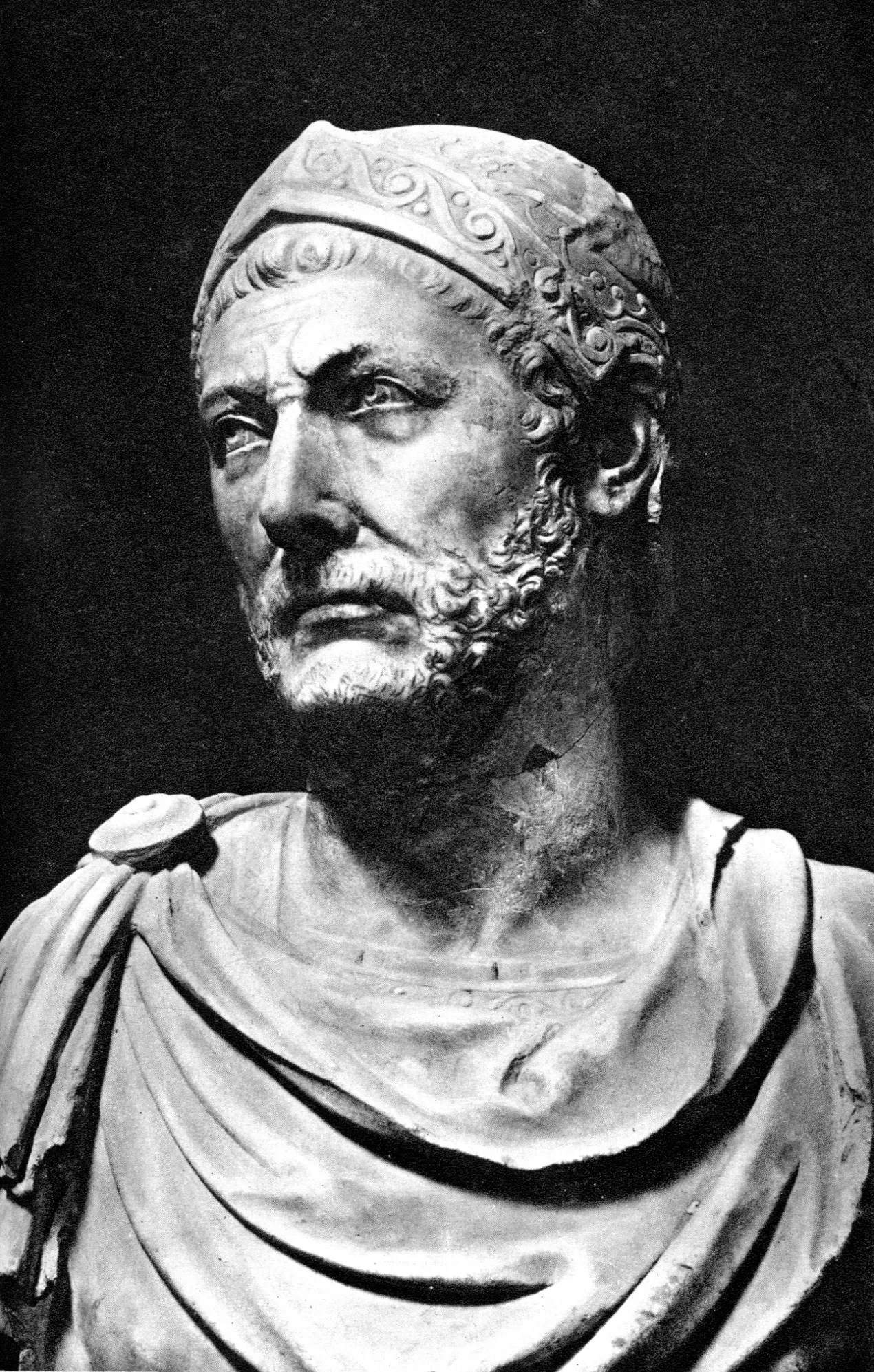
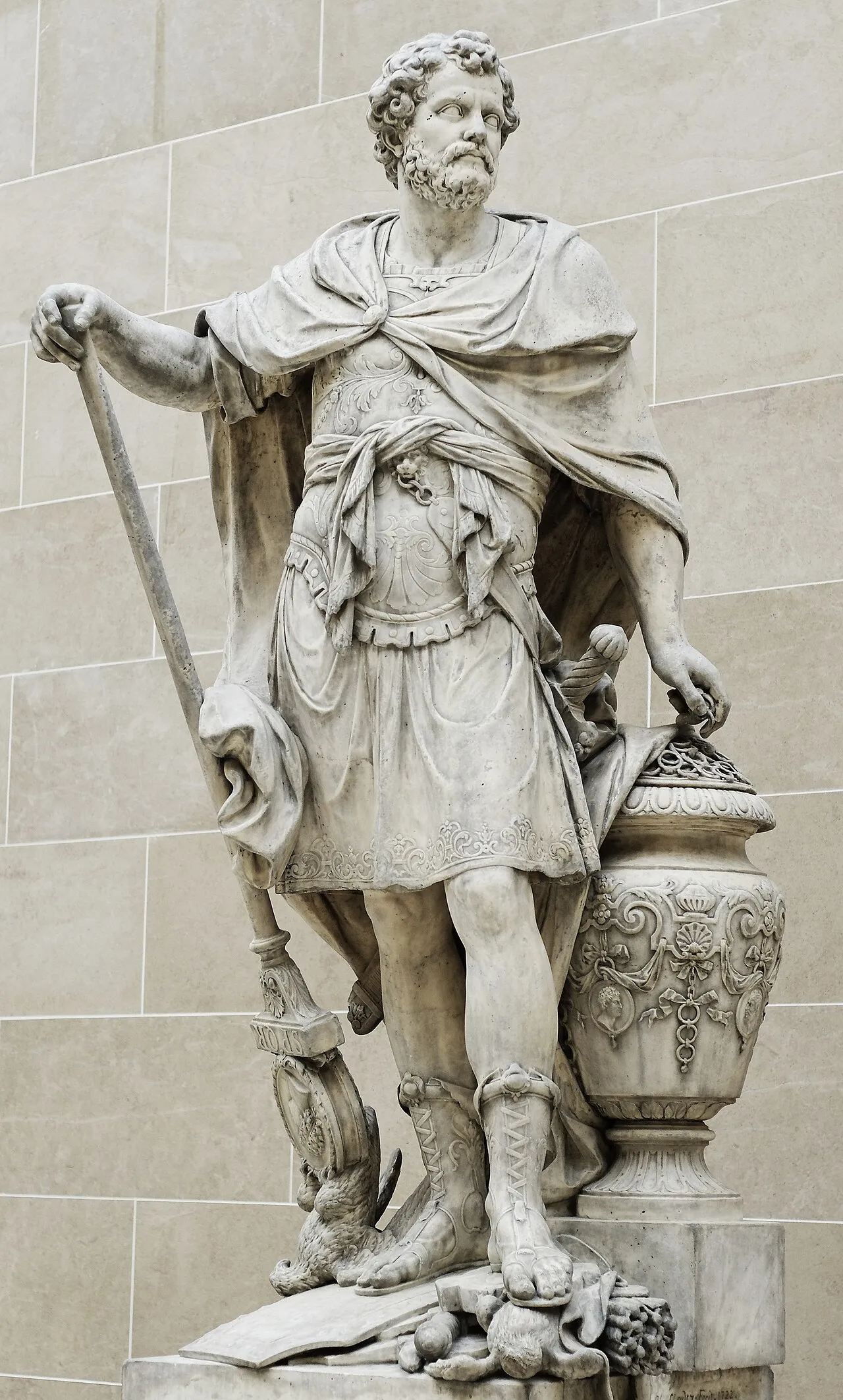
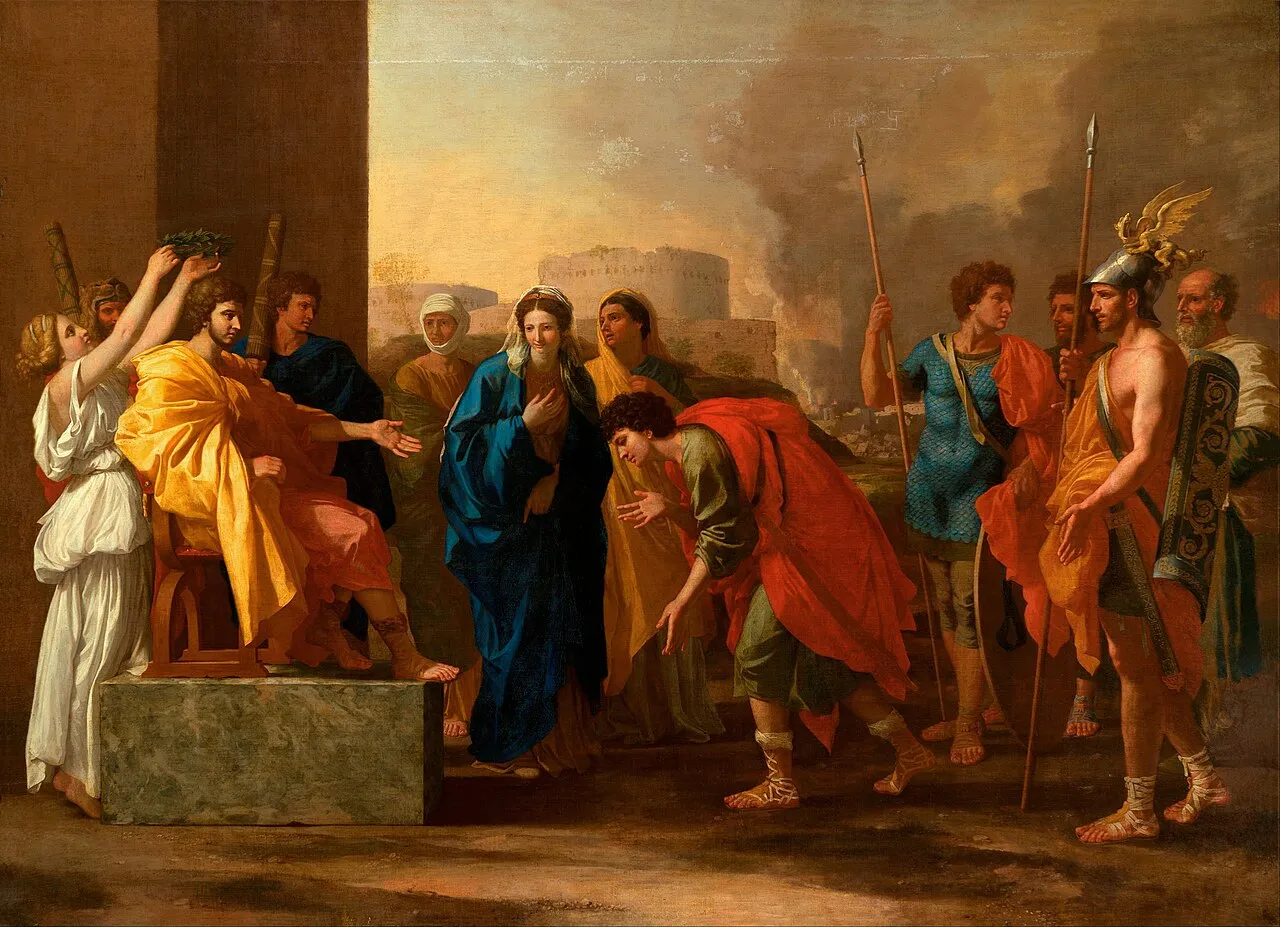
Annibale aspettò il pretesto. Lo trovò a Sagunto (219 a.C.), città iberica alleata di Roma situata a sud dell'Ebro, quindi nominalmente nella sfera cartaginese. L'assedio durò otto mesi: alla resa, la città fu rasa al suolo, i difensori massacrati o venduti come schiavi. Le ambascerie romane (prima a Sagunto durante l'assedio, poi a Cartagine) furono respinte. Nella primavera del 218 a.C. Quinto Fabio Massimo, in qualità di ambasciatore, si presentò al senato cartaginese, raccolse nella toga le due opzioni, "pace o guerra", e quando i Cartaginesi risposero "scegli tu", lasciò cadere le pieghe e disse: "Vi do la guerra". Iniziava il conflitto più lungo e più sanguinoso dell'antichità mediterranea.
Hannibal waited for the pretext. He found it at Saguntum (219 BC), an Iberian city allied with Rome located south of the Ebro, therefore nominally in the Carthaginian sphere. The siege lasted eight months: at the surrender, the city was razed, the defenders massacred or sold into slavery. Roman embassies (first to Saguntum during the siege, then to Carthage) were rebuffed. In spring 218 BC Quintus Fabius Maximus, as ambassador, appeared before the Carthaginian senate, gathered into his toga the two options, "peace or war", and when the Carthaginians answered "you choose", let the folds drop and declared: "I give you war". Thus began the longest and bloodiest conflict of Mediterranean antiquity.
02Le Forze in CampoThe Forces
All'inizio del conflitto, Roma poteva mobilitare un patrimonio umano senza paragone nel Mediterraneo. Il celebre formula togatorum conservato da Polibio (II, 24) elenca, per l'anno 225 a.C., tredici anni prima della guerra annibalica, circa 700.000 fanti e 70.000 cavalieri fra cittadini romani e alleati italici. Era un arsenale demografico che nessun altro stato mediterraneo poteva avvicinare. La fanteria pesante manipolare, ordinata in tre linee (hastati, principes, triarii) e armata di scudo curvo, gladio iberico e pilum, era stata raffinata in quarant'anni di guerre senza pausa: contro Sanniti, Galli cisalpini, Pirro, Cartagine. La legio di 4.200 uomini era più flessibile di qualunque falange ellenistica. Il punto debole restava la cavalleria: appena 300 cavalieri romani per legione, di qualità mediocre, integrati da alleati italici e galli.
At the start of the conflict, Rome could mobilise a human reservoir unmatched in the Mediterranean. The famous formula togatorum preserved by Polybius (II, 24) lists, for 225 BC, thirteen years before the Hannibalic war, about 700,000 infantry and 70,000 cavalry among Roman citizens and Italic allies. It was a demographic arsenal no other Mediterranean state could approach. The manipular heavy infantry, organised in three lines (hastati, principes, triarii) and armed with curved shield, Iberian gladius and pilum, had been refined in forty years of uninterrupted war: against Samnites, Cisalpine Gauls, Pyrrhus, Carthage. The legio of 4,200 men was more flexible than any Hellenistic phalanx. The weak point remained the cavalry: barely 300 Roman horsemen per legion, of mediocre quality, supplemented by Italic and Gallic allies.
L'organizzazione comando romana era invece il vero tallone d'Achille. Ogni anno il senato eleggeva due consoli con poteri militari pari; in caso di guerra grave, ciascuno comandava un esercito di due legioni romane più un equivalente contingente alleato (~20.000 uomini in totale); se i due consoli operavano insieme, il comando si alternava di giorno in giorno. Era una struttura concepita per impedire tirannie: nella prassi militare diventò un disastro. Annibale costruì la sua campagna italiana sfruttando sistematicamente l'avvicendamento del comando e l'inesperienza dei consoli che cambiavano ogni dodici mesi, mentre lui restava in campo per quindici anni consecutivi.
Roman command structure was instead the real Achilles' heel. Each year the senate elected two consuls with equal military powers; in a serious war, each commanded an army of two Roman legions plus an equivalent allied contingent (~20,000 men total); if the two consuls operated together, command alternated day by day. It was a structure designed to prevent tyrannies: in military practice it became a disaster. Hannibal built his Italian campaign on systematically exploiting the alternation of command and the inexperience of consuls who changed every twelve months, while he remained in the field for fifteen consecutive years.
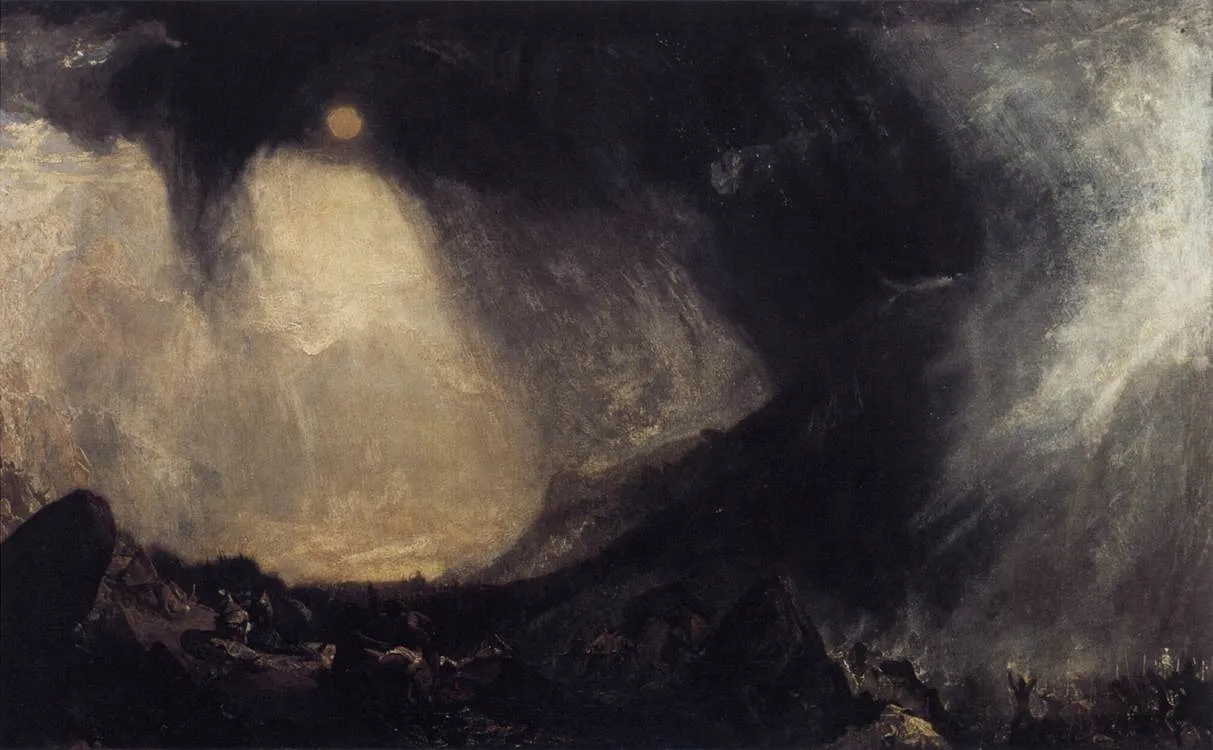
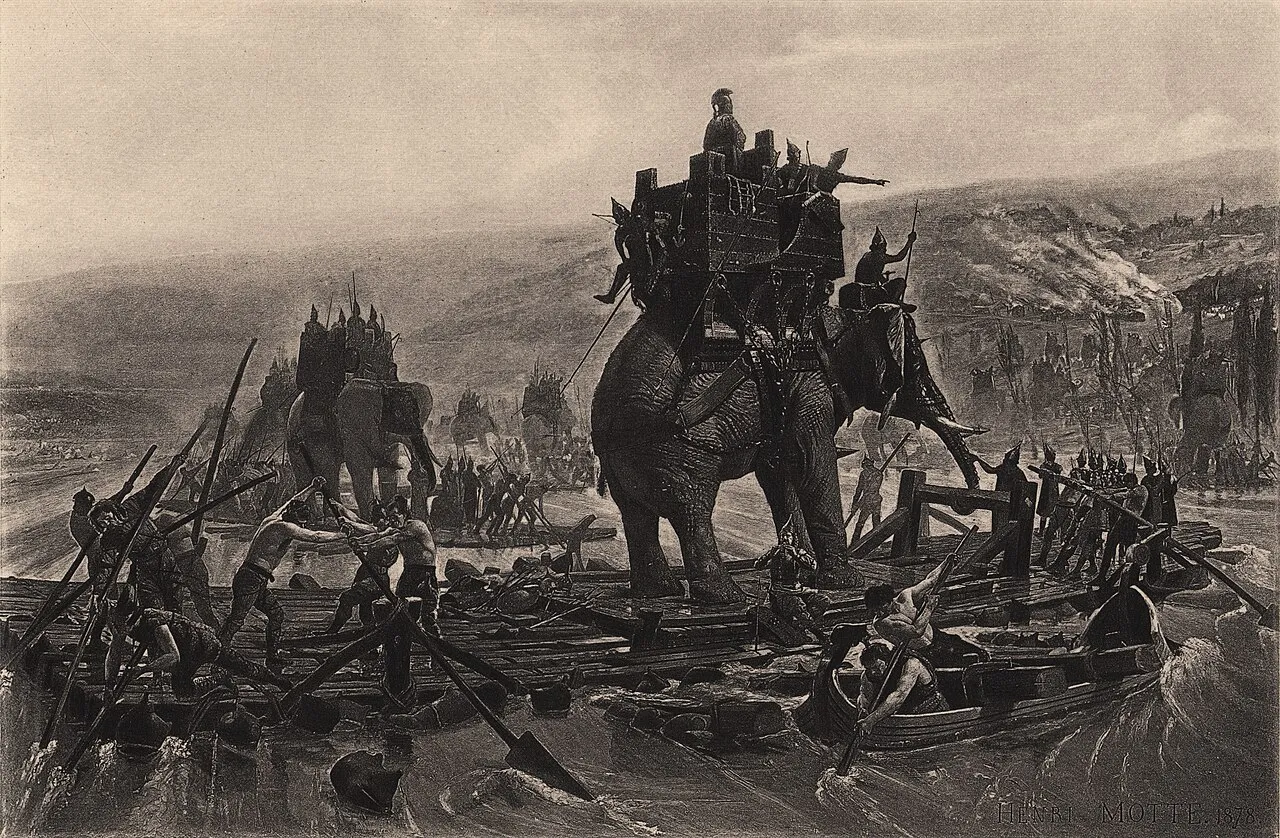
Annibale portò in Italia un esercito multietnico, modellato sul lungo apprendistato iberico: la fanteria pesante africana (libio-fenici equipaggiati alla maniera ellenistica con sarissa o lancia lunga, poi riarmati con equipaggiamento romano predato), gli iberici con tunica bianca a bordo rosso e falcata, i celtiberi con la spada doppia funzione (la futura gladius hispaniensis che i Romani avrebbero adottato), i balearici frombolieri letali a duecento metri, e soprattutto i numidi: cavalleria leggera senza paragone, capace di scaramucce, finte ritirate, inseguimenti coordinati. Polibio (III, 35) registra l'esercito che lasciò Cartagena nella primavera del 218 a.C.: 90.000 fanti e 12.000 cavalieri. Lasciando guarnigioni in Spagna sotto il fratello Asdrubale, Annibale si presentò al passaggio dei Pirenei con 50.000 fanti e 9.000 cavalieri. Al Rodano erano 38.000 fanti e 8.000 cavalieri. Sceso dalle Alpi dopo il drammatico passaggio invernale: 20.000 fanti e 6.000 cavalieri, con pochi elefanti superstiti. In sei mesi aveva perso metà dei suoi uomini, ma chi era arrivato era veterano.
Hannibal brought to Italy a multi-ethnic army shaped by long Iberian apprenticeship: the African heavy infantry (Libyo-Phoenicians equipped Hellenistic-style with sarissa or long spear, later re-armed with looted Roman gear), the Iberians with white tunic bordered in red and curved falcata, the Celtiberians with the dual-purpose sword (the future gladius hispaniensis the Romans would adopt), the Balearic slingers lethal at two hundred metres, and above all the Numidians: light cavalry unrivalled, capable of skirmishing, feigned retreats, coordinated pursuit. Polybius (III, 35) records the army that left Cartagena in spring 218 BC: 90,000 infantry and 12,000 cavalry. Leaving garrisons in Spain under his brother Hasdrubal, Hannibal reached the Pyrenees crossing with 50,000 infantry and 9,000 cavalry. At the Rhone they were 38,000 infantry and 8,000 cavalry. Descended from the Alps after the dramatic winter crossing: 20,000 infantry and 6,000 cavalry, with few surviving elephants. In six months he had lost half his men, but those who arrived were veterans.
In Italia, il bacino di reclutamento di Annibale si ampliò : i Galli cisalpini (Boi, Insubri, Cenomani) appena sottomessi da Roma nel 222 a.C., insorsero a migliaia. Dopo Canne (216 a.C.), si aggiunsero le defezioni italiche: Capua, gran parte del Sannio e della Lucania, Bruttium, le città greche di Crotone e Locri, e in seguito Taranto (212 a.C.). Solo la Magna Grecia tirrenica e la dorsale dei Latini e degli Etruschi rimasero fedeli a Roma: e fu questa fedeltà , non la genialità militare romana, a vincere la guerra.
In Italy, Hannibal's recruitment pool widened: the Cisalpine Gauls (Boii, Insubres, Cenomani) only just subdued by Rome in 222 BC, rose by the thousands. After Cannae (216 BC) came the Italian defections: Capua, much of Samnium and Lucania, Bruttium, the Greek cities of Crotone and Locri, and later Tarentum (212 BC). Only Tyrrhenian Magna Graecia and the spine of Latins and Etruscans remained loyal to Rome: and it was this loyalty, not Roman military genius, that won the war.
03L'Andamento della GuerraThe Course of the War
Fase I · Il dominio di Annibale (218–216 a.C.)
Phase I · Hannibal's domination (218–216 BC)
Sceso dalle Alpi nel novembre del 218 a.C., Annibale sconfisse subito i Romani in due scontri ravvicinati. Al Ticino (fine novembre 218 a.C.), in uno scontro fra cavallerie nella pianura padana, la cavalleria numidica avvolse quella romana e ferì gravemente il console Publio Cornelio Scipione, padre del futuro Africano. Secondo Polibio (X, 3) fu proprio il figlio diciassettenne, presente come ufficiale, a salvargli la vita riportandolo al campo. Tre settimane dopo, all'alba di una giornata gelida di dicembre 218 a.C., il console Tiberio Sempronio Longo si fece attirare ad attraversare il fiume Trebbia in piena: i suoi soldati arrivarono sulla riva opposta intirizziti, a stomaco vuoto, e furono presi alle spalle da un contingente di 2.000 uomini guidato dal fratello di Annibale, Magone, nascosto in un'ansa del torrente. Su 40.000 Romani, solo 10.000 si aprirono la strada e si salvarono.
Descended from the Alps in November 218 BC, Hannibal immediately defeated the Romans in two quick engagements. At the Ticinus (late November 218 BC), a cavalry clash in the Po plain, Numidian cavalry enveloped the Roman horse and seriously wounded the consul Publius Cornelius Scipio, father of the future Africanus. According to Polybius (X, 3) it was his seventeen-year-old son, present as an officer, who saved his life by carrying him back to camp. Three weeks later, at dawn on an icy December day in 218 BC, consul Tiberius Sempronius Longus let himself be lured across the swollen Trebia: his soldiers reached the far bank numb and on empty stomachs, and were taken in the rear by a 2,000-man force led by Hannibal's brother Mago, hidden in a stream's bend. Of 40,000 Romans, only 10,000 cut their way out.
L'estate seguente, il nuovo console Caio Flaminio (popolare riformatore, vincitore degli Insubri, ma temperamento impulsivo) inseguì Annibale lungo il Trasimeno. Il 21 giugno 217 a.C., in una mattinata di fitta nebbia, la colonna romana in marcia fu intrappolata fra le acque del lago e le colline a nord, dove Annibale aveva nascosto l'intero esercito durante la notte. Trasimeno fu un massacro: 15.000 morti, fra cui lo stesso Flaminio trafitto da un cavaliere insubre; 6.000 si arresero, vendetta poi liberata se latini ma trattenuta se romani. Era la prima volta nella sua storia che Roma vedeva un console cadere in battaglia e un intero esercito consolare annientato lontano dalla città.
The next summer, new consul Gaius Flaminius (popular reformer, victor over the Insubres, but impulsive temperament) pursued Hannibal along Lake Trasimene. On 21 June 217 BC, in a morning of thick fog, the marching Roman column was trapped between the lake's waters and the hills to the north, where Hannibal had concealed his entire army overnight. Trasimene was a massacre: 15,000 dead, including Flaminius himself run through by an Insubrian horseman; 6,000 surrendered, later freed if Latin but held if Roman. It was the first time in Rome's history a consul fell in battle and an entire consular army was annihilated far from the city.
Il senato proclamò la dictatura: Quinto Fabio Massimo Verrucoso, anziano patrizio di sessantenne, ricevette pieni poteri. Il suo magister equitum era Marco Minucio Rufo, ostile alla sua strategia di logoramento. Mentre Fabio inseguiva Annibale a distanza senza dargli mai battaglia, la pressione politica a Roma cresceva: l'opinione pubblica accusava il dittatore di codardia. Nel 216 a.C. il senato decise di abbandonare la strategia fabiana e mobilitò l'esercito più grande mai schierato dalla repubblica: otto legioni, raddoppiate nel numero (5.000 anziché 4.200 uomini ciascuna), affiancate da un equivalente contingente alleato. Comandanti: i consoli Lucio Emilio Paolo (patrizio cauto) e Caio Terenzio Varrone (homo novus impetuoso). Totale: circa 86.000 uomini contro i 50.000 di Annibale.
The senate proclaimed a dictatorship: Quintus Fabius Maximus Verrucosus, an elderly patrician of sixty, received full powers. His magister equitum was Marcus Minucius Rufus, hostile to his strategy of attrition. While Fabius shadowed Hannibal without ever giving battle, political pressure in Rome grew: public opinion accused the dictator of cowardice. In 216 BC the senate decided to abandon the Fabian strategy and mobilised the largest army the republic had ever fielded: eight legions, doubled in size (5,000 instead of 4,200 men each), flanked by an equivalent allied contingent. Commanders: consuls Lucius Aemilius Paullus (cautious patrician) and Gaius Terentius Varro (impetuous homo novus). Total: about 86,000 men against Hannibal's 50,000.
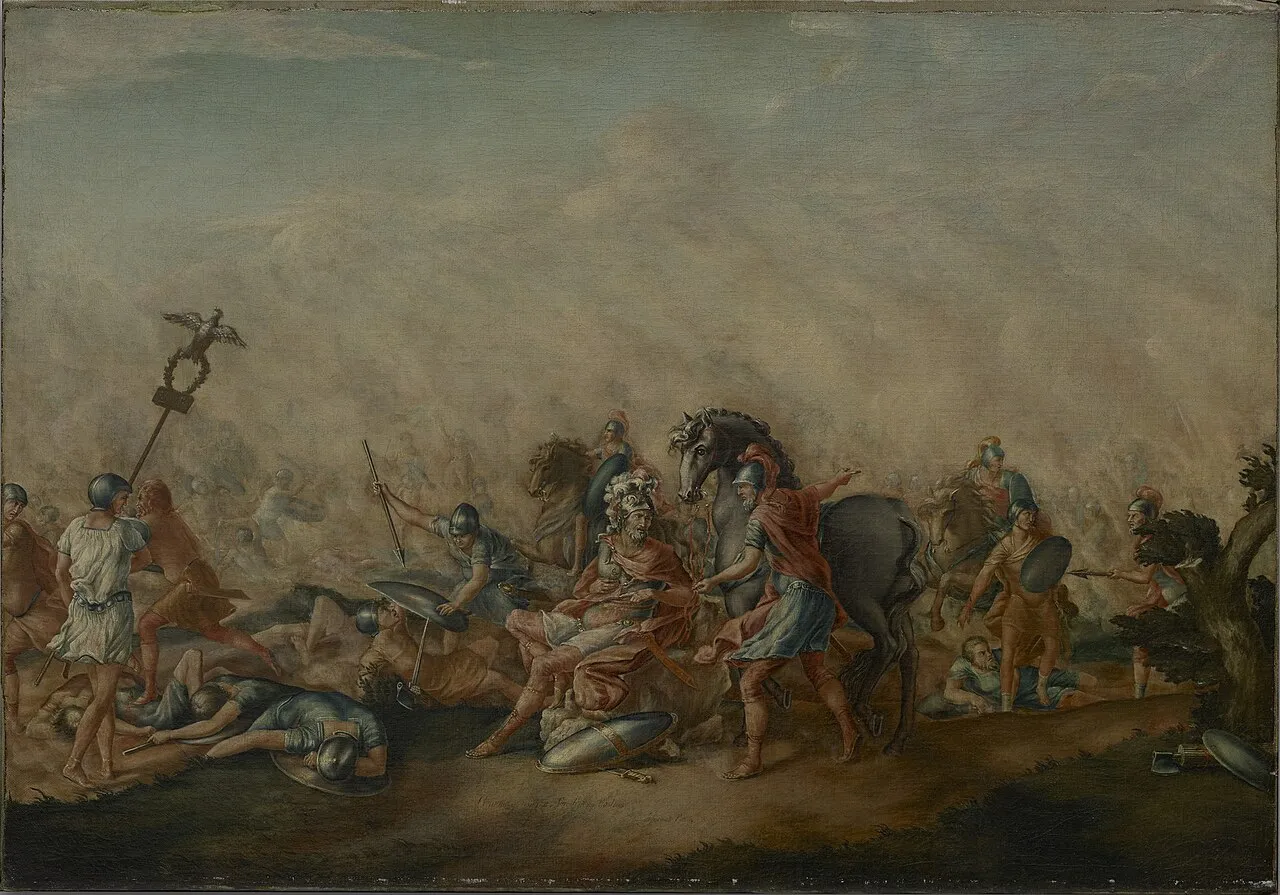
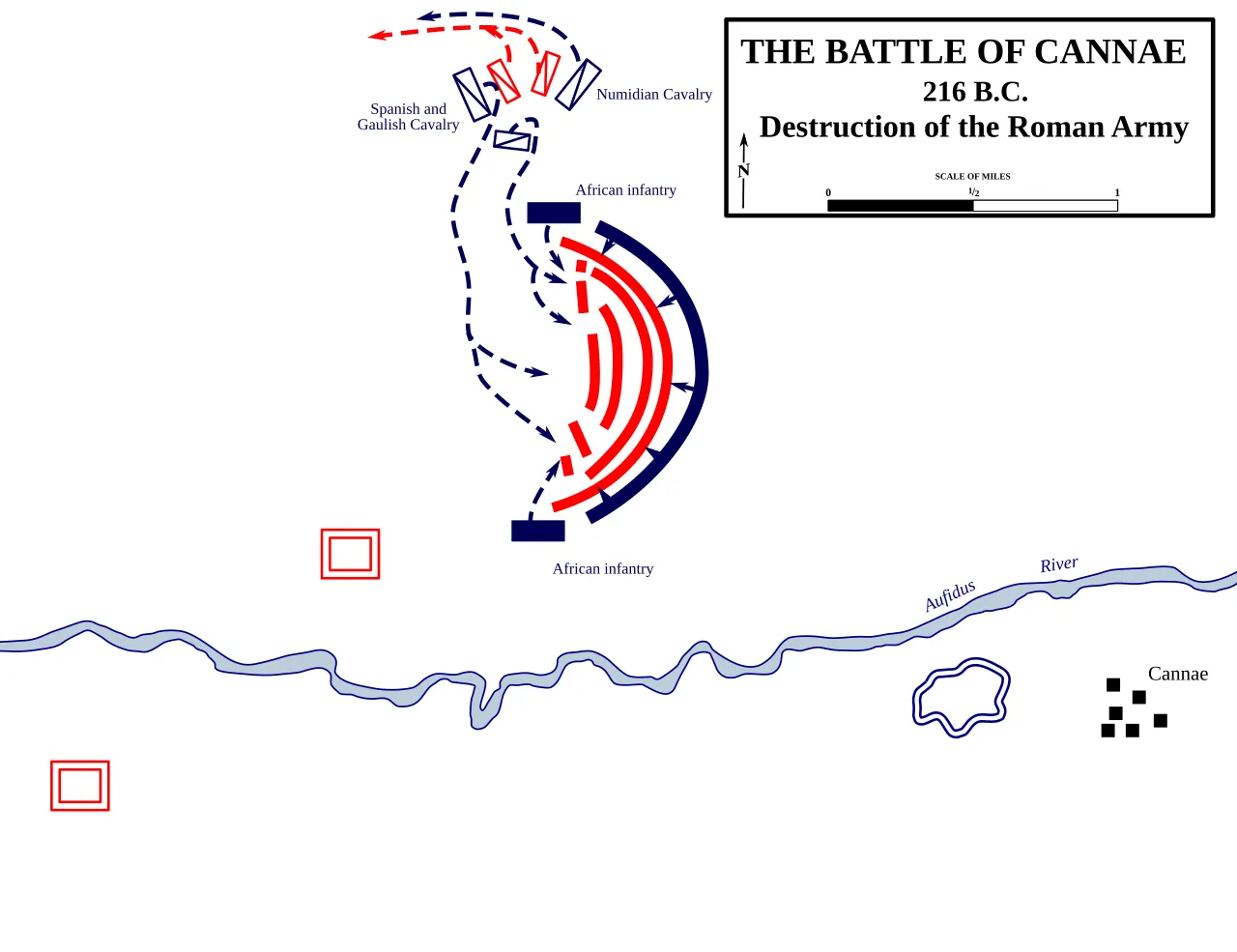
Il 2 agosto 216 a.C., presso il villaggio apulo di Canne sul fiume Ofanto, fu il giorno di comando di Varrone. Annibale dispose un fronte convesso: al centro, Iberici e Galli in formazione assottigliata; sui fianchi, gli Africani veterani in colonna profonda; cavalleria pesante a sinistra sotto Asdrubale, numidica a destra sotto Maarbale. I Romani, accecati dalla loro stessa superiorità numerica, caricarono il centro punico: questo cedette gradualmente, formando una sacca. Intanto la cavalleria di Asdrubale travolse quella romana sull'ala sinistra, girò alle spalle dell'intero schieramento, e attaccò la cavalleria alleata sull'ala destra spazzandola via. Gli Africani, fermi sui fianchi, ruotarono verso l'interno. La sacca si chiuse. Per otto ore i Romani, schiacciati spalla contro spalla, furono massacrati senza poter manovrare. Polibio (III, 117) registra 70.000 morti; Livio (XXII, 49) ne conta 50.000. Cadde il console Paolo, due ex-consoli, due questori, 29 tribuni militari, 80 senatori. Varrone si salvò con 70 cavalieri.
On 2 August 216 BC, near the Apulian village of Cannae on the Aufidus river, it was Varro's day of command. Hannibal arranged a convex front: at the centre, Iberians and Gauls in thinned formation; on the wings, African veterans in deep column; heavy cavalry on the left under Hasdrubal, Numidian on the right under Maharbal. The Romans, blinded by their own numerical superiority, charged the Punic centre: it gradually gave way, forming a pocket. Meanwhile Hasdrubal's cavalry overwhelmed the Roman cavalry on the left wing, swung behind the whole formation, and struck the allied cavalry on the right wing, sweeping it away. The Africans, still on the wings, pivoted inwards. The pocket closed. For eight hours the Romans, crushed shoulder to shoulder, were slaughtered unable to manoeuvre. Polybius (III, 117) records 70,000 dead; Livy (XXII, 49) counts 50,000. Consul Paullus fell, two former consuls, two quaestors, 29 military tribunes, 80 senators. Varro saved himself with 70 cavalry.
Dopo Canne, il comandante della cavalleria Maarbale supplicò Annibale di marciare immediatamente su Roma: "Fra cinque giorni cenerai in Campidoglio". Annibale rifiutò . Maarbale, secondo Livio (XXII, 51), gli rispose: "Vincere scis, Hannibal, victoria uti nescis" ("Sai vincere, Annibale, ma non sai usare la vittoria"). Era forse il più grande errore strategico della sua carriera: Annibale sperava nella defezione degli alleati italici e in una pace negoziata. Roma rifiutò ogni negoziato.
After Cannae, cavalry commander Maharbal begged Hannibal to march at once on Rome: "In five days you will dine on the Capitol". Hannibal refused. Maharbal, according to Livy (XXII, 51), replied: "Vincere scis, Hannibal, victoria uti nescis" ("You know how to win, Hannibal, but not how to use the victory"). It was perhaps the greatest strategic error of his career: Hannibal hoped for Italic defections and a negotiated peace. Rome refused all negotiation.
Fase II · La resistenza romana (215–210 a.C.)
Phase II · The Roman recovery (215–210 BC)
Roma rispose con misure di sopravvivenza estrema: schiavi liberati e armati (due legioni di volones), seconda dictatura per Marco Giunio Pera, sacrifici umani, due Galli e due Greci sepolti vivi nel Foro Boario, per placare gli dei dopo i terribili presagi. Le legioni furono raddoppiate da quattro a venticinque; il bilancio passò interamente all'economia di guerra. Lo scenario si frammentò su quattro fronti: Italia centro-meridionale, Sicilia, Spagna, Macedonia.
Rome responded with extreme survival measures: slaves freed and armed (two legions of volones), a second dictatorship under Marcus Junius Pera, even human sacrifice, two Gauls and two Greeks buried alive in the Forum Boarium, to placate the gods after dire omens. Legions were multiplied from four to twenty-five; the budget shifted entirely to war economy. The theatre splintered across four fronts: central-southern Italy, Sicily, Spain, Macedonia.
In Italia, dopo le defezioni di Capua e di parte del Sannio, la guerra divenne posizionale. Il proconsole Marco Claudio Marcello, soprannominato dai contemporanei "la spada di Roma", batté Annibale tre volte a Nola (215, 214, 213 a.C.): le prime sconfitte tattiche subite dal Cartaginese in Italia. Capua fu riconquistata nel 211 a.C. dopo lungo assedio (i senatori filo-punici si avvelenarono in massa). Per costringere i Romani ad abbandonare l'assedio, Annibale tentò una marcia diretta su Roma: arrivò a tre miglia dalle mura, scese il colle del Tuscolo, ma trovò le legioni schierate e nessun panico in città. Tornò indietro: Hannibal ad portas sarebbe rimasto come monito proverbiale, ma non come azione decisiva.
In Italy, after the defections of Capua and parts of Samnium, the war became positional. Proconsul Marcus Claudius Marcellus, called by contemporaries "the sword of Rome", defeated Hannibal three times at Nola (215, 214, 213 BC): the Carthaginian's first tactical defeats in Italy. Capua was retaken in 211 BC after a long siege (the pro-Punic senators poisoned themselves en masse). To force the Romans to abandon the siege, Hannibal attempted a direct march on Rome: he came within three miles of the walls, descended the Tusculum hill, but found the legions drawn up and no panic in the city. He turned back: Hannibal ad portas would remain as proverbial warning, but not as decisive action.
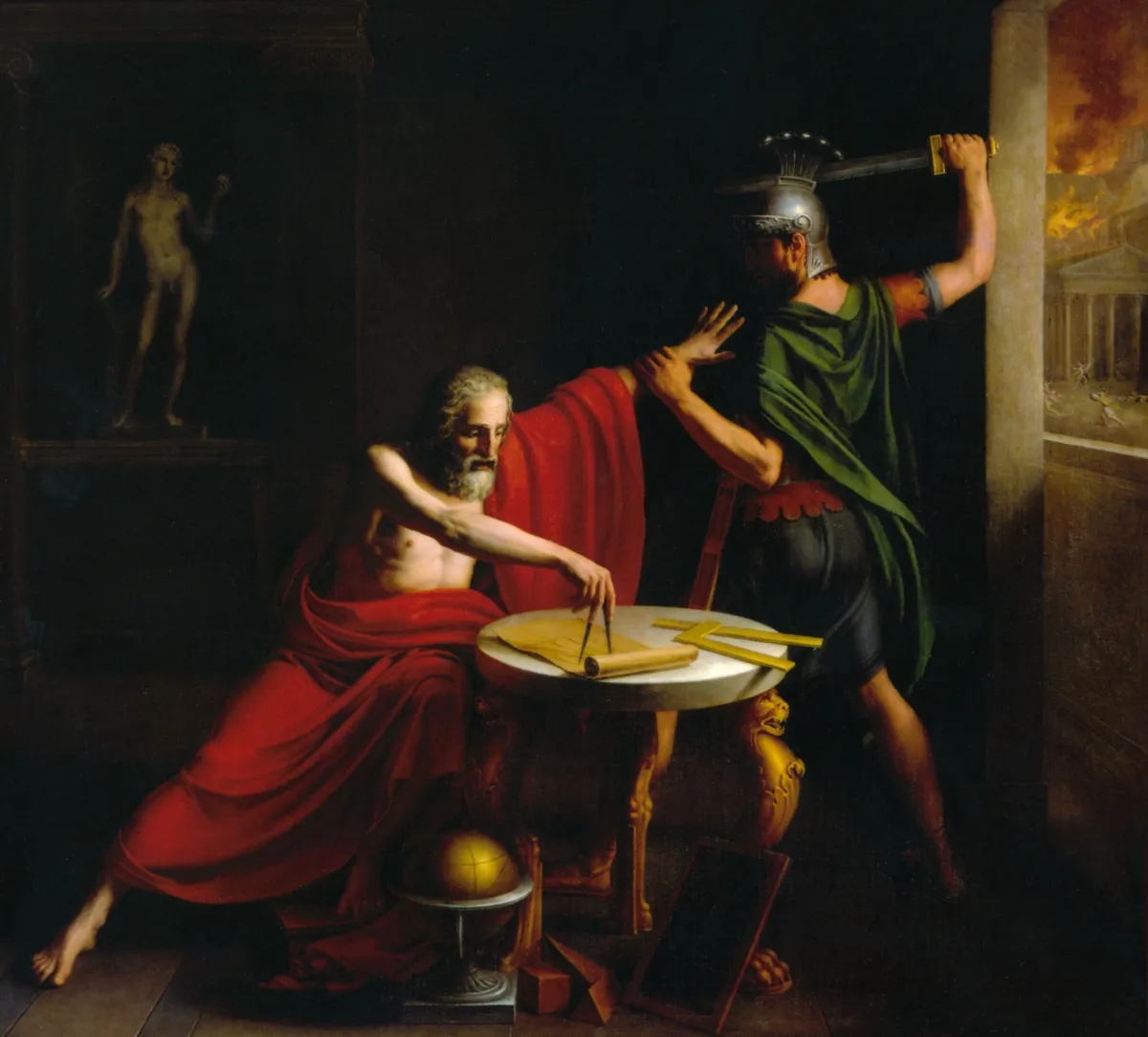
In Sicilia, la morte del fedelissimo re Gerone II di Siracusa (215 a.C.) aprì la porta a un'alleanza punica. Marcello assediò la città dal 213 al 212 a.C.: due anni durante i quali le macchine di guerra del settantenne Archimede (baliste, gru ribaltatrici, "manus ferrea") tennero lontana la flotta romana. La città cadde per tradimento durante una festa; Archimede fu ucciso da un legionario mentre tracciava figure geometriche sulla sabbia, contro l'ordine di Marcello che lo voleva risparmiato. La Sicilia tornò interamente romana.
In Sicily, the death of the loyal King Hiero II of Syracuse (215 BC) opened the door to a Punic alliance. Marcellus besieged the city from 213 to 212 BC: two years during which the war machines of the seventy-year-old Archimedes (ballistas, tipping cranes, the "iron hand") kept the Roman fleet at bay. The city fell to treachery during a festival; Archimedes was killed by a legionary while tracing geometric figures in the sand, against Marcellus's explicit order that he be spared. Sicily returned entirely Roman.
In Spagna, i fratelli Publio e Gneo Cornelio Scipione tennero in scacco per anni Asdrubale Barca, fratello di Annibale, impedendogli di portare rinforzi in Italia. Ma nel 211 a.C. caddero entrambi in due battaglie successive nell'alto Bétis (l'attuale Guadalquivir): un disastro che lasciò Roma senza comando in Iberia. Nessun magistrato anziano si offrì volontario per il comando: il rischio era troppo grande. Solo il giovane Publio Cornelio Scipione, figlio del console caduto, ventiquattrenne, privo di esperienza consolare, si presentò all'assemblea popolare nel 210 a.C. e ottenne il comando proconsolare con voto plebiscitario. Era una scelta irrituale, addirittura incostituzionale: ma Roma non aveva alternative.
In Spain, the brothers Publius and Gnaeus Cornelius Scipio held Hannibal's brother Hasdrubal Barca in check for years, preventing him from bringing reinforcements to Italy. But in 211 BC both fell in two successive battles in the upper Baetis (modern Guadalquivir): a disaster that left Rome without command in Iberia. No senior magistrate volunteered for the command: the risk was too great. Only young Publius Cornelius Scipio, son of the fallen consul, twenty-four years old, with no consular experience, presented himself to the popular assembly in 210 BC and was granted proconsular command by acclamation. It was an irregular choice, even unconstitutional: but Rome had no alternative.
Fase III · La svolta in Spagna (209–206 a.C.)
Phase III · The Spanish turn (209–206 BC)
Scipione sbarcò in Iberia con 10.000 fanti e 1.000 cavalieri freschi e una visione strategica nuova. Nella primavera del 209 a.C., con un colpo di mano spettacolare, conquistò Cartagena, la capitale e il principale arsenale punico in Iberia, in un solo giorno. Sapeva da informatori locali che la laguna a nord della città si svuotava per qualche ora con la marea bassa: lanciò un assalto principale dalla parte fortificata mentre cinquecento veterani attraversavano la laguna a guado e scalavano le mura indifese alle spalle. Cadde l'enorme tesoro di guerra cartaginese, 18 navi da guerra, 600 catapulte, 10.000 prigionieri. Scipione liberò gli ostaggi iberici tenuti in città dai Punici e li rispedì alle loro tribù: divenne improvvisamente un alleato credibile per le popolazioni indigene, e non un altro conquistatore.
Scipio landed in Iberia with 10,000 fresh infantry and 1,000 cavalry and a new strategic vision. In spring 209 BC, with a spectacular coup de main, he captured Cartagena: the capital and main Punic arsenal in Iberia, in a single day. He knew from local informants that the lagoon north of the city emptied for a few hours at low tide: he launched a main assault against the fortified front while five hundred veterans waded across the lagoon and scaled the undefended walls from behind. He took the enormous Carthaginian war treasury, 18 warships, 600 catapults, 10,000 prisoners. Scipio freed the Iberian hostages held in the city by the Carthaginians and sent them back to their tribes: he became overnight a credible ally for indigenous peoples, not yet another conqueror.
Nel 208 a.C. batté Asdrubale a Becula in una battaglia di manovra; nel 206 a.C. lo scontro decisivo di Ilipa consacrò Scipione come il primo generale romano capace di emulare Annibale sul piano tattico. Schierò gli alleati italici al centro, debolmente, e i veterani romani sui fianchi, in profondità. Quando i Punici caricarono il centro fragile, i fianchi romani avanzarono diagonalmente e li avvolsero. Era Canne riveduta. Asdrubale fuggì in Gallia: stava per replicare la traversata delle Alpi del fratello, ma con un esercito fresco di 30.000 uomini per soccorrerlo in Italia.
In 208 BC he defeated Hasdrubal at Baecula in a battle of manoeuvre; in 206 BC the decisive clash at Ilipa consecrated Scipio as the first Roman general capable of matching Hannibal tactically. He arrayed Italic allies at the centre, weakly, and Roman veterans on the wings, in depth. When the Carthaginians charged the fragile centre, the Roman wings advanced diagonally and enveloped them. It was Cannae reversed. Hasdrubal fled to Gaul: he was about to repeat his brother's Alpine crossing, but with a fresh 30,000-man army to relieve him in Italy.
Il 22 giugno 207 a.C., sul fiume Metauro nelle Marche, il console Caio Claudio Nerone compì una delle più audaci marce della storia militare romana: spostò 7.000 dei suoi migliori uomini dal sud Italia (dove fronteggiava Annibale) fino al nord, in sette giorni, percorrendo 400 km di marcia forzata, per congiungersi al collega Marco Livio Salinatore. Insieme intercettarono Asdrubale prima che potesse unirsi al fratello: 56.000 Romani contro 30.000 Punici. Asdrubale cadde combattendo. La sua testa, mozzata e portata a sud, fu lanciata da una palizzata romana nel campo di Annibale presso Canusio. Annibale la riconobbe e disse, secondo Livio (XXVII, 51): "Riconosco la sorte di Cartagine". Era la fine della speranza punica.
On 22 June 207 BC, on the Metaurus river in the Marche, consul Gaius Claudius Nero performed one of the boldest marches in Roman military history: he moved 7,000 of his best men from southern Italy (where he faced Hannibal) to the north, in seven days, covering 400 km of forced march, to join his colleague Marcus Livius Salinator. Together they intercepted Hasdrubal before he could join his brother: 56,000 Romans against 30,000 Carthaginians. Hasdrubal fell fighting. His head, severed and carried south, was thrown over a Roman palisade into Hannibal's camp at Canusium. Hannibal recognised it and said, according to Livy (XXVII, 51): "I see the fate of Carthage". It was the end of Punic hope.
Fase IV · La decisione in Africa (204–201 a.C.)
Phase IV · The decision in Africa (204–201 BC)
Tornato dalla Spagna a Roma trionfatore senza essere ancora stato console, Scipione si presentò candidato per il 205 a.C. Il senato, dominato dai fabiani, lo elesse console ma gli assegnò come provincia la Sicilia anziché l'Africa: voleva impedirgli un'avventura che avrebbe richiamato Annibale dall'Italia, troppo rischiosa secondo l'anziano Fabio Massimo. Scipione passò l'anno a Lilibeo (Marsala) addestrando le due legioni di volontari (le famigerate "legioni di Canne", composte dai superstiti della disfatta e relegate in Sicilia come punizione) e a costruire una flotta di 400 navi da trasporto.
Returned from Spain to Rome a triumphant general without yet having been consul, Scipio stood for election for 205 BC. The senate, dominated by Fabians, elected him consul but assigned Sicily as his province instead of Africa: it wanted to prevent an adventure that would recall Hannibal from Italy, too risky according to the elderly Fabius Maximus. Scipio spent the year at Lilybaeum (Marsala) training the two volunteer legions (the infamous "Cannae legions", made up of survivors of the disaster and exiled to Sicily as punishment) and building a fleet of 400 transport ships.
Nel 204 a.C., proconsole, Scipione sbarcò in Africa presso Utica con circa 25.000-30.000 uomini. La diplomazia preparò il colpo: Massinissa, principe massilio espropriato del trono dai filo-cartaginesi Massessili di re Siface, divenne suo alleato fedele e gli portò la cavalleria numidica, la stessa arma che aveva fatto la fortuna di Annibale, ora dalla parte romana. Nella primavera del 203 a.C., Scipione attaccò di notte i due campi cartaginesi accampati separatamente, appiccando il fuoco e annientando 40.000 uomini in poche ore. Poco dopo, alla battaglia delle Grandi Pianure, distrusse l'ultimo esercito punico in Africa.
In 204 BC, as proconsul, Scipio landed in Africa near Utica with about 25,000-30,000 men. Diplomacy prepared the blow: Massinissa, Massylian prince dispossessed by the pro-Carthaginian Massaesyli of king Syphax, became his faithful ally and brought the Numidian cavalry, the same weapon that had made Hannibal's fortune, now on the Roman side. In spring 203 BC, Scipio attacked at night the two Carthaginian camps pitched separately, setting fire and annihilating 40,000 men in a few hours. Shortly after, at the battle of the Great Plains, he destroyed the last Punic army in Africa.
Cartagine chiese la pace. Mentre i negoziati erano in corso, il senato cartaginese inviò un disperato appello ad Annibale: dopo quindici anni in Italia, l'ultimo difensore della patria fu richiamato. Imbarcatosi a Crotone nell'autunno del 203 a.C., sbarcò a Leptis Minor con circa 12.000 veterani italici; in patria reclutò mercenari liguri, celtiberi e africani, raggiungendo 36.000 fanti, 4.000 cavalieri e 80 elefanti da guerra. I negoziati saltarono.
Carthage sued for peace. While negotiations were under way, the Carthaginian senate sent a desperate appeal to Hannibal: after fifteen years in Italy, the homeland's last defender was recalled. Embarked from Crotone in autumn 203 BC, he landed at Leptis Minor with about 12,000 Italian veterans; at home he recruited Ligurian, Celtiberian and African mercenaries, reaching 36,000 infantry, 4,000 cavalry, and 80 war elephants. Negotiations collapsed.
Il 19 ottobre 202 a.C. nella pianura interna africana presso Zama Regia (le coordinate esatte sono dibattute fra Zama Maior e Naraggara), i due più grandi generali del mondo antico si incontrarono per la prima e ultima volta. Secondo Livio (XXX, 30) si incontrarono soli, con un interprete, fra le linee schierate, prima della battaglia: Annibale propose una pace generosa per Roma; Scipione rifiutò. Poi si separarono. Scipione (circa 29.000 fanti, 6.000 cavalieri romani e numidici di Massinissa) dispose i manipoli in colonne separate da corridoi: quando Annibale lanciò la carica degli ottanta elefanti, gli animali si infilarono nei corridoi e furono finiti dagli astati. La cavalleria romano-numidica travolse i fianchi punici e li inseguì lontano dal campo. La fanteria pesante si scontrò in pareggio; ma quando Massinissa tornò sul campo e attaccò alle spalle, fu Canne rovesciata. Cartagine perse 20.000 morti e 20.000 prigionieri. Annibale fuggì verso Hadrumetum con pochi cavalieri. Era la fine.
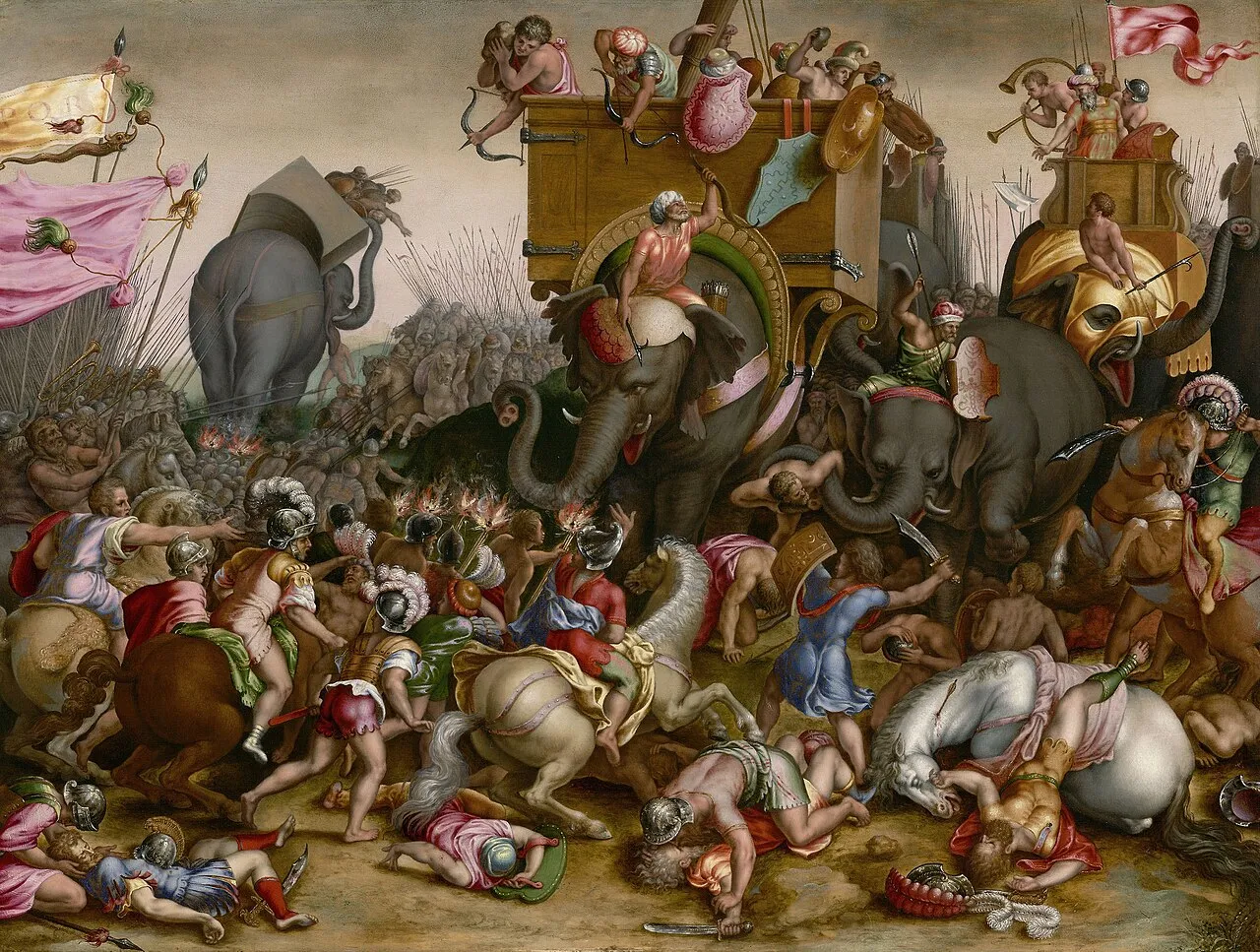
On 19 October 202 BC in the African interior plain near Zama Regia (the exact coordinates are debated between Zama Maior and Naraggara), the two greatest generals of the ancient world met for the first and last time. According to Livy (XXX, 30) they met alone, with an interpreter, between the deployed lines before the battle: Hannibal proposed a generous peace for Rome; Scipio refused. They parted. Scipio (about 29,000 infantry, 6,000 Roman and Massinissa's Numidian cavalry) arranged his maniples in columns separated by corridors: when Hannibal launched the eighty-elephant charge, the animals threaded into the corridors and were finished off by the hastati. Roman-Numidian cavalry overwhelmed the Punic flanks and pursued them off the field. The heavy infantry clashed in stalemate; but when Massinissa returned to the field and attacked from behind, it was Cannae reversed. Carthage lost 20,000 dead and 20,000 prisoners. Hannibal fled to Hadrumetum with a few cavalry. It was the end.
04Le TatticheThe Tactics
Il genio di Annibale era la flessibilità tattica. Ogni battaglia fu diversa: alla Trebbia usò un'imboscata sul fianco con la fanteria leggera africana mentre il grosso dell'esercito attirava i Romani in mezzo a un fiume gelido. Al Trasimeno applicò la classica imboscata alpina, intrappolando un esercito di 25.000 uomini fra le montagne e il lago. Ma il capolavoro fu Canne. Annibale dispose la sua fanteria in una linea convessa: i Galli e gli Iberici al centro, deliberatamente più deboli, gli Africani veterani sui fianchi. Quando i Romani caricarono il centro, esso cedette lentamente formando una sacca; gli Africani sui fianchi non si mossero. Intanto la cavalleria pesante di Asdrubale travolse l'ala sinistra romana, girò alle spalle, e attaccò alle spalle quella destra. Quando si chiuse l'accerchiamento, gli ottantamila Romani erano chiusi in una sacca dalla quale non potevano uscire. La formazione manipolare non poteva manovrare. La carneficina durò otto ore. Ogni manuale militare moderno studia ancora Canne come esempio di doppio avvolgimento.
Hannibal's genius was tactical flexibility. Every battle was different: at the Trebia he used a flank ambush with African light infantry while the bulk of his army drew the Romans into a freezing river. At Trasimene he applied the classic Alpine ambush, trapping a 25,000-man army between mountains and the lake. But the masterpiece was Cannae. Hannibal arranged his infantry in a convex line: Gauls and Iberians at the centre, deliberately weaker, African veterans on the flanks. When the Romans charged the centre, it gave way slowly forming a pocket; the Africans on the flanks did not move. Meanwhile Hasdrubal's heavy cavalry overwhelmed the Roman left wing, swung behind, and attacked the right rear. When the encirclement closed, the eighty thousand Romans were locked in a pocket from which they could not escape. The manipular formation could not manoeuvre. The slaughter lasted eight hours. Every modern military manual still studies Cannae as the exemplar of double envelopment.
La risposta di Fabio Massimo fu rivoluzionaria nella sua semplicità : non combattere. Negare ad Annibale la battaglia decisiva. Privarlo dei rifornimenti seguendo a distanza, attaccando i suoi foraggiatori, evitando ogni terreno favorevole alla cavalleria nemica. Era una strategia umiliante per la dignità militare romana, ma fu l'unica che funzionò . Fabio comprese che Annibale, lontano da Cartagine, non poteva ricevere rinforzi e che il tempo lavorava contro di lui. Quando i Romani disubbidirono e gli diedero battaglia (Canne), persero. Quando obbedirono, vinsero (la lunga guerra di logoramento).
Fabius Maximus's response was revolutionary in its simplicity: do not fight. Deny Hannibal the decisive battle. Cut off his supplies by following from a distance, attacking his foragers, avoiding any terrain favourable to enemy cavalry. It was a strategy humiliating to Roman military dignity, but the only one that worked. Fabius understood that Hannibal, far from Carthage, could not receive reinforcements and that time was working against him. When the Romans disobeyed and gave him battle (Cannae), they lost. When they obeyed, they won (the long war of attrition).
Scipione, dal canto suo, comprese una cosa fondamentale: la vittoria di Annibale non si poteva ribaltare in Italia. Bisognava colpire Cartagine in casa, costringendola a richiamare il suo generale. Scipione studiò le tattiche di Annibale e le adattò : a Ilipa (206 a.C.) usò lui stesso un avvolgimento simile a Canne, dispiegando le truppe italiche al centro come "esca" e i veterani romani sui fianchi. A Zama, sapendo della superiorità degli elefanti cartaginesi, dispose i manipoli in colonne separate da corridoi: gli elefanti, lanciati alla carica, si ritrovarono a galoppare attraverso i corridoi vuoti senza causare danni, e furono poi finiti dalla cavalleria. La cavalleria romana e numidica di Massinissa, per una volta superiore a quella punica, ribaltò i fianchi. Annibale era stato battuto con le sue stesse armi.
Scipio, for his part, understood one fundamental thing: Hannibal's victory could not be overturned in Italy. Carthage had to be struck at home, forcing it to recall its general. Scipio studied Hannibal's tactics and adapted them: at Ilipa (206 BC) he himself used an envelopment similar to Cannae, deploying Italic troops at the centre as "bait" and Roman veterans on the flanks. At Zama, knowing the superiority of the Carthaginian elephants, he arranged the maniples in columns separated by corridors: the elephants, launched at the charge, found themselves galloping through empty corridors without causing damage, and were then finished off by the cavalry. Roman cavalry and Massinissa's Numidian cavalry, for once superior to Punic cavalry, turned the flanks. Hannibal had been beaten with his own weapons.
Sul piano strategico, la guerra rivelò i limiti del concetto annibalico. La sua scommessa, provocare la defezione degli alleati italici di Roma per disgregarne il sistema, era razionale ma irrealizzabile. Il nomen Latinum, costruito in tre secoli di colonizzazione, di matrimoni misti, di partecipazione comune al bottino di guerra, si rivelò più coeso di qualunque trattato. Annibale, inoltre, non aveva strumenti di assedio adeguati: non poté mai prendere Roma, né le grandi colonie latine come Spoleto, Casilino o Casinum. Senza siege train, senza linea di rifornimento sicura dall'Iberia o dall'Africa, dopo Canne la sua vittoria tattica perfetta divenne strategicamente sterile. Era condannato a vagare per il sud Italia in attesa di rinforzi che non arrivarono mai.
Strategically, the war exposed the limits of Hannibal's concept. His wager, to provoke defection of Rome's Italic allies to disintegrate the system, was rational but unworkable. The nomen Latinum, built over three centuries of colonisation, of intermarriage, of shared participation in war booty, proved more cohesive than any treaty. Hannibal, moreover, lacked adequate siege equipment: he could never take Rome, nor the great Latin colonies like Spoleto, Casilinum, or Casinum. Without a siege train, without a secure supply line from Iberia or Africa, after Cannae his perfect tactical victory became strategically sterile. He was condemned to wander southern Italy waiting for reinforcements that never came.
Roma, dal canto suo, aprì un'innovazione fondamentale: la moltiplicazione dei teatri di guerra. Mentre Fabio temporeggiava in Italia, gli Scipioni combattevano in Spagna, Marcello in Sicilia, e una piccola flotta operava nell'Adriatico contro Filippo V di Macedonia (Prima Guerra Macedonica, 214–205 a.C.). Annibale, vincitore in ogni singola battaglia campale fino a Zama, non poteva essere ovunque. La guerra annibalica fu il momento in cui Roma scoprì di poter combattere su più fronti contemporaneamente: una capacità logistica e organizzativa che nessun altro stato mediterraneo possedeva.
Rome, for its part, opened a fundamental innovation: the multiplication of war theatres. While Fabius delayed in Italy, the Scipios fought in Spain, Marcellus in Sicily, and a small fleet operated in the Adriatic against Philip V of Macedon (First Macedonian War, 214–205 BC). Hannibal, victorious in every single pitched battle until Zama, could not be everywhere. The Hannibalic war was the moment when Rome discovered it could fight on multiple fronts simultaneously: a logistical and organisational capacity no other Mediterranean state possessed.
« Non solo non ho saputo conquistare il mondo come vincitore, ma non sono riuscito nemmeno a salvare la mia patria come vinto.» « Not only have I failed to conquer the world as victor, but I have not even managed to save my homeland as the defeated.» — Annibale, dopo Zama (Tito Livio XXX, 30)
05Le ConseguenzeThe Consequences
Il trattato del 201 a.C. impose a Cartagine condizioni terribili. La città perse tutti i possedimenti extra-africani (Spagna, isole, basi commerciali); ridusse la flotta da guerra a soli dieci trireme di rappresentanza (le altre cinquecento, secondo Appiano, furono incendiate sotto gli occhi del senato cartaginese al largo del porto); perse il diritto di muovere guerra anche in Africa senza autorizzazione romana; consegnò cento ostaggi delle famiglie nobili (età fra 14 e 30 anni); si obligò a pagare un'indennità di 10.000 talenti d'argento (circa 262 tonnellate, l'equivalente di circa due anni di entrate dello stato romano) in cinquanta annualità di 200 talenti ciascuna; cedette infine alla Numidia di Massinissa tutti i territori che il re potesse rivendicare come "ancestrali" (clausola ambigua che Massinissa avrebbe sfruttato per cinquant'anni come pretesto di continue annessioni).
The treaty of 201 BC imposed terrible conditions on Carthage. The city lost all extra-African possessions (Spain, islands, trading bases); its war fleet was reduced to ten ceremonial triremes (the other five hundred, according to Appian, were burned before the Carthaginian senate's eyes off the harbour); it lost the right to wage war even in Africa without Roman authorisation; surrendered one hundred hostages from noble families (aged 14 to 30); committed to pay an indemnity of 10,000 talents of silver (about 262 tonnes, the equivalent of roughly two years of Roman state revenue) in fifty annual instalments of 200 talents each; finally ceded to Massinissa's Numidia all territories the king could claim as "ancestral" (an ambiguous clause Massinissa would exploit for fifty years as pretext for continual annexations).
La sorte personale dei due protagonisti fu paradossalmente parallela. Annibale, eletto suffeta (capo civile) di Cartagine nel 196 a.C., avviò una riforma anti-oligarchica che, riducendo i privilegi dei "centoquattro" giudici, permise alla città di pagare l'indennità in soli dieci anni. La sua popolarità e l'efficienza dell'amministrazione spaventarono il senato romano, che chiese la sua estradizione. Annibale fuggì nel 195 a.C. presso Antioco III di Siria, da cui fu ricevuto come consigliere. Combatté senza successo nella guerra siriaca contro Roma, partecipando alla battaglia navale dell'Eurimedonte (190 a.C.) e assistendo da distanza alla disfatta di Magnesia. Esule poi presso il re Prusia di Bitinia, fu raggiunto da una richiesta di consegna romana nel 183 a.C. Per non cadere in mani nemiche, si suicidò col veleno a Libyssa (oggi presso Gebze, Turchia), pronunciando secondo Plutarco la frase: "Liberiamo i Romani da una lunga angoscia, dato che non hanno la pazienza di aspettare la morte di un vecchio odiato".
The personal fate of the two protagonists was paradoxically parallel. Hannibal, elected suffete (civil chief) of Carthage in 196 BC, launched an anti-oligarchic reform that, by curbing the privileges of the "Hundred and Four" judges, enabled the city to pay the indemnity in just ten years. His popularity and administrative efficiency alarmed the Roman senate, which demanded his extradition. Hannibal fled in 195 BC to Antiochus III of Syria, who received him as adviser. He fought unsuccessfully in the Syrian war against Rome, taking part in the naval battle of the Eurymedon (190 BC) and witnessing from a distance the defeat at Magnesia. Exiled later to King Prusias of Bithynia, he was reached by a Roman extradition demand in 183 BC. Rather than fall into enemy hands, he committed suicide by poison at Libyssa (today near Gebze, Turkey), uttering according to Plutarch the words: "Let us free the Romans of a long anxiety, since they have not the patience to wait for an old hated man's death".
Anche Scipione l'Africano ebbe una fine amara. Dopo Zama fu acclamato per la prima volta col cognomen Africanus, primo cognome onorifico romano legato a una conquista territoriale: un modello che Roma avrebbe replicato per secoli. Console di nuovo nel 194 a.C., poi membro della delegazione che combatté Antioco III a Magnesia (190 a.C.) come legatus al fianco del fratello Lucio, che assunse a sua volta il cognomen Asiaticus. Ma la sua eredità politica si infranse contro la rivalità con Catone il Censore. Nel 187 a.C. fu accusato in tribunale di malversazione nei fondi della guerra siriaca: rifiutò di difendersi formalmente, ricordò al popolo dal Foro che quel giorno era l'anniversario di Zama e salì al Campidoglio per offrire un sacrificio, e l'assemblea lo seguì abbandonando il processo. Disgustato, si ritirò nella villa di Liternum in Campania, dove morì nel 183 a.C. Lo stesso anno di Annibale. La leggenda, raccontata da Tito Livio, vuole che lasciasse l'iscrizione tombale: "Ingrata patria, ne ossa quidem mea habebis" ("Patria ingrata, non avrai nemmeno le mie ossa").
Scipio Africanus too came to a bitter end. After Zama he was first acclaimed with the cognomen Africanus, the first honorific Roman cognomen tied to territorial conquest: a model Rome would replicate for centuries. Consul again in 194 BC, then member of the delegation that fought Antiochus III at Magnesia (190 BC) as legatus alongside his brother Lucius, who took in turn the cognomen Asiaticus. But his political legacy crashed against rivalry with Cato the Censor. In 187 BC he was charged with embezzlement of Syrian war funds: he refused to defend himself formally, reminded the people from the Forum that that day was the anniversary of Zama, and climbed to the Capitol to offer sacrifice, and the assembly followed him, abandoning the trial. Disgusted, he retired to his villa at Liternum in Campania, where he died in 183 BC. The same year as Hannibal. Legend, told by Livy, has it he left the tomb inscription: "Ingrata patria, ne ossa quidem mea habebis" ("Ungrateful homeland, you shall not have even my bones").
Per Roma, la guerra fu trasformatrice. Cinquecentomila italici morti in diciassette anni di guerra continuata (su una popolazione totale stimata in 3,5 milioni: il 14% caduto); intere generazioni di senatori spazzate via a Canne; il piccolo possidente dell'Italia centro-meridionale rovinato dalle requisizioni e dal passaggio degli eserciti, dando inizio a quella concentrazione fondiaria nei latifundia che sarebbe stata il dramma sociale del II secolo, il problema che avrebbe ucciso i Gracchi e portato a Mario, Silla, infine alla guerra civile cesariana. La grande disponibilità di schiavi prigionieri (oltre 250.000 venduti durante e dopo la guerra) accelerò la sostituzione del lavoro contadino libero con quello servile.
For Rome, the war was transformative. Five hundred thousand Italics dead in seventeen years of continuous war (out of a total estimated population of 3.5 million: 14% fallen); entire generations of senators swept away at Cannae; the small landholder of central-southern Italy ruined by requisitions and the passage of armies, triggering that land concentration in latifundia which would be the social drama of the 2nd century, the problem that would kill the Gracchi and lead to Marius, Sulla, finally to Caesar's civil war. The vast availability of enslaved prisoners (over 250,000 sold during and after the war) accelerated the replacement of free peasant labour with servile.
Ma la repubblica imperiale era nata. Roma controllava le due nuove province di Hispania Citerior e Ulterior (creazione formale nel 197 a.C.), e disponeva di Sicilia, Sardegna, Corsica e una zona di protettorato sull'Africa proconsolare; la flotta dominava il Mediterraneo occidentale incontrastata; le entrate del provincialismo (argento iberico, grano siciliano, tributi numidi) finanziavano un esercito permanente. Sul piano culturale, l'occupazione della Sicilia e della Magna Grecia trasportò a Roma decine di migliaia di volumi greci, statue, opere d'arte: la captatio Graeciae, la "Roma conquistata dalla Grecia conquistata" di cui scriverà Orazio (Epistulae II, 1, 156), cominciò col bottino di Marcello a Siracusa.
But the imperial republic was born. Rome controlled the two new provinces of Hispania Citerior and Ulterior (formal creation 197 BC), and held Sicily, Sardinia, Corsica and a protectorate zone over proconsular Africa; the fleet dominated the western Mediterranean unchallenged; provincial revenues (Iberian silver, Sicilian grain, Numidian tributes) funded a standing army. Culturally, the occupation of Sicily and Magna Graecia carried to Rome tens of thousands of Greek scrolls, statues, artworks: the captatio Graeciae, the "Rome conquered by conquered Greece" of which Horace would write (Epistulae II, 1, 156), began with Marcellus's booty from Syracuse.
Sul piano strategico, Roma aveva imparato due lezioni che avrebbe applicato per quattro secoli. Prima: nessun nemico, per quanto geniale, può vincere contro una potenza con riserve illimitate di uomini e tempo. Seconda: la guerra non si vince sul fronte avversario, ma colpendo il cuore del nemico. Cinquantacinque anni dopo Zama, Catone il Censore, che da giovane tribuno militare aveva combattuto a Zama, avrebbe chiuso ogni discorso in senato con le parole "ceterum censeo Carthaginem esse delendam", "del resto, sostengo che Cartagine va distrutta". La Terza Guerra Punica sarebbe arrivata nel 149 a.C. per cancellare definitivamente la rivale dalla storia, tre anni di assedio condotti dal nipote adottivo del vincitore di Zama, Publio Cornelio Scipione Emiliano. Quando le mura caddero (146 a.C.) e la città bruciò per diciassette giorni, lui stesso pianse, citando i versi di Omero su Troia: temeva che lo stesso destino prima o poi sarebbe toccato a Roma.
Strategically, Rome had learned two lessons it would apply for four centuries. First: no enemy, however brilliant, can win against a power with unlimited reserves of men and time. Second: war is not won on the enemy front, but by striking at the enemy's heart. Fifty-five years after Zama, Cato the Censor, who as a young military tribune had fought at Zama, would end every senate speech with the words "ceterum censeo Carthaginem esse delendam", "moreover, I hold that Carthage must be destroyed". The Third Punic War would come in 149 BC to definitively erase the rival from history, three years of siege led by the adoptive grandson of the victor of Zama, Publius Cornelius Scipio Aemilianus. When the walls fell (146 BC) and the city burned for seventeen days, he himself wept, quoting Homer's verses on Troy: he feared the same fate would one day fall on Rome.