01BiografiaBiography
Il figlio del re proibito
The son of the forbidden king
Vercingetorige nacque intorno all'82 a.C. nel cuore della Gallia, figlio di Celtillo, principe degli Arverni, la tribù più potente del paese. Era un'eredità magnifica e maledetta: il padre aveva osato sognare la corona di tutta la Gallia, e per quell'ambizione i suoi stessi pari lo avevano messo a morte. Il sospetto della regalità , per i Galli, gelosi delle loro libertà tribali, l'accusa più infamante, pesò sul figlio fin dalla culla. Ma ciò che avrebbe dovuto spegnerlo, lo forgiò .
Vercingetorix was born around 82 BC in the heart of Gaul, son of Celtillus, prince of the Arverni, the most powerful tribe in the land. His was a magnificent and accursed inheritance: his father had dared to dream of the crown of all Gaul, and for that ambition his own peers had put him to death. The suspicion of kingship (to the Gauls, jealous of their tribal liberties, the most infamous of charges) weighed on the son from the cradle. But what should have extinguished him forged him instead.
Cresciuto fra i nobili guerrieri arverni, il giovane conosceva Roma meglio di chiunque altro: aveva cavalcato come ausiliario al fianco delle legioni di Giulio Cesare durante le prime campagne galliche. Aveva studiato dall'interno la macchina che un giorno avrebbe affrontato: la disciplina del castrum, il muro di scudi, il pilum scagliato a comando. Imparava le tattiche del nemico mentre il nemico credeva di essersene fatto un alleato. Nessun capo gallico aveva mai conosciuto Roma così da vicino, e nessuno l'avrebbe odiata con altrettanta lucidità .
Raised among the noble Arvernian warriors, the young man knew Rome better than anyone: he had ridden as an auxiliary beside the legions of Julius Caesar during the early Gallic campaigns. He had studied from within the very machine he would one day face: the discipline of the castrum, the wall of shields, the pilum hurled on command. He learned the enemy's tactics while the enemy believed it had won an ally. No Gallic chieftain had ever known Rome so closely, and none would hate her with such clarity.
Una sola voce
One single voice
L'occasione venne con l'inverno del 53–52 a.C. Cesare era stato richiamato al di là delle Alpi dalla crisi seguita a Roma all'assassinio di Clodio; le legioni svernavano disperse, lontane dal loro generale. Vercingetorige colse l'attimo e fece l'impossibile: convinse tribù che per secoli si erano dilaniate (Arverni, Edui, Senoni, Carnuti, Bituri, Pictoni, Cadurci) a riconoscere un unico comando. Quasi quaranta popoli si raccolsero sotto il suo stendardo. Per la prima volta nella storia, la Gallia parlò con una sola voce.
The chance came with the winter of 53–52 BC. Caesar had been recalled beyond the Alps by the crisis that followed the assassination of Clodius in Rome; his legions wintered scattered, far from their general. Vercingetorix seized the moment and achieved the impossible: he persuaded tribes that for centuries had torn one another apart (Arverni, Aedui, Senones, Carnutes, Bituriges, Pictones, Cadurci) to acknowledge a single command. Almost forty peoples gathered beneath his banner. For the first time in history, Gaul spoke with one voice.
Lo acclamarono re a Gergovia, la capitale arverna. Ma egli non volle essere soltanto un re: volle essere il legislatore di una guerra nuova. Impose ostaggi alle città , fissò contingenti di fanti e di cavalieri, punì il tradimento con il fuoco e la mutilazione. Dove i Galli avevano sempre combattuto come una folla di eroi, egli forgiò un esercito.
They acclaimed him king at Gergovia, the Arvernian capital. But he would not be merely a king: he meant to be the lawgiver of a new kind of war. He imposed hostages on the cities, fixed levies of foot and horse, and punished betrayal with fire and mutilation. Where the Gauls had always fought as a throng of heroes, he forged an army.
Terra bruciata
Scorched earth
La sua dottrina era un'eresia per l'orgoglio celtico: rifiutare la battaglia campale, dove il legionario non aveva rivali, per abbracciare la guerra di logoramento. Bruciare villaggi, raccolti e granai; affamare le legioni in marcia; non lasciare al nemico nulla da saccheggiare. In un solo giorno più di venti città dei Bituri furono date alle fiamme. Solo Avarico, la più bella, fu risparmiata sulle suppliche dei suoi abitanti. Fu un errore fatale. Cesare la cinse d'assedio nel cuore dell'inverno e la espugnò : dei suoi quarantamila abitanti ne uscirono vivi appena ottocento. Vercingetorige aveva avuto ragione, ma il prezzo della ragione fu un massacro.
His doctrine was a heresy to Celtic pride: to refuse the pitched battle, where the legionary had no equal, and embrace instead the war of attrition. Burn the villages, the harvests, the granaries; starve the marching legions; leave the enemy nothing to plunder. In a single day more than twenty cities of the Bituriges were given to the flames. Only Avaricum, the fairest, was spared at its inhabitants' pleading. It was a fatal mistake. Caesar besieged it in the dead of winter and stormed it: of its forty thousand inhabitants, scarcely eight hundred came out alive. Vercingetorix had been right, but the price of being right was a massacre.
Gergovia: la prima sconfitta di Cesare
Gergovia: Caesar's first defeat
Nella primavera del 52 a.C., sotto le mura della sua stessa capitale, Vercingetorige inflisse a Cesare ciò che nessuno gli aveva mai inflitto in otto anni di Gallia: una sconfitta in campo aperto. Un assalto romano mal coordinato si sfaldò contro la difesa arverna e si mutò in rotta: settecento legionari e quarantasei centurioni rimasero sul terreno. Per la prima volta, il proconsole dovette ordinare la ritirata. La notizia corse come fuoco nella stoppia: perfino gli Edui, l'ultima tribù fedele a Roma, ruppero l'alleanza e passarono alla rivolta. La Gallia intera era ormai in armi.
In the spring of 52 BC, beneath the walls of his own capital, Vercingetorix inflicted on Caesar what no one had inflicted in eight years of Gaul: a defeat in the open field. A poorly coordinated Roman assault broke against the Arvernian defence and turned to rout: seven hundred legionaries and forty-six centurions were left on the ground. For the first time, the proconsul had to order a retreat. The news ran like fire through stubble: even the Aedui, the last tribe loyal to Rome, broke the alliance and joined the revolt. All Gaul was now in arms.
« Non per le proprie necessità , ma per la libertà di tutti ho intrapreso questa guerra. » « I undertook this war not for my own needs, but for the liberty of all. » Vercingetorige ai capi galli (Cesare, De Bello Gallico VII, 89Vercingetorix to the Gallic chiefs) Caesar, Gallic War VII, 89
Alesia: la trappola si chiude
Alesia: the trap closes
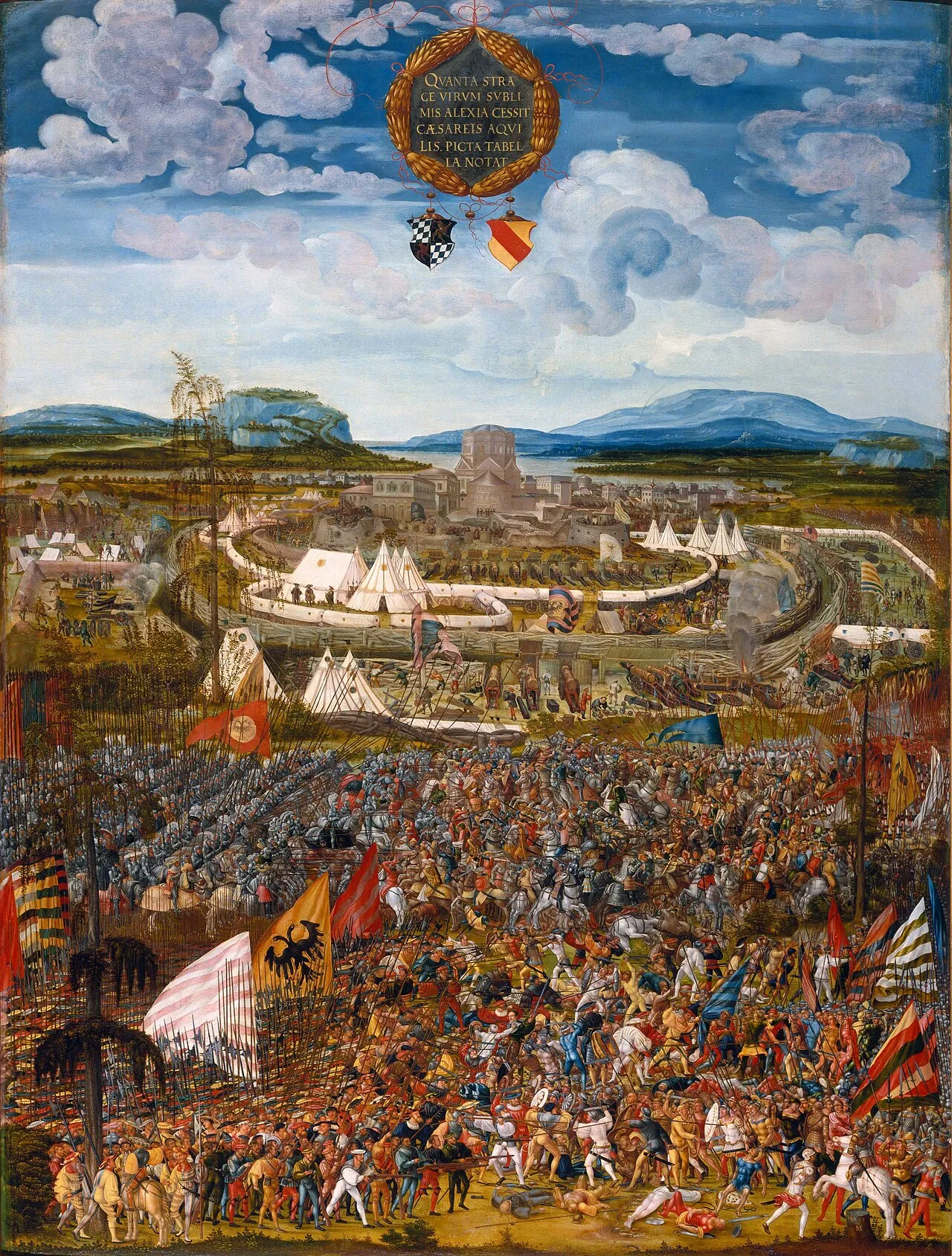
Fu l'ebbrezza della vittoria a tradirlo. Convinto di poter chiudere la guerra in un solo urto, lanciò la cavalleria gallica contro la colonna romana in marcia, e la cavalleria germanica al soldo di Cesare la travolse. Vercingetorige ripiegò con il grosso dell'esercito sull'altopiano fortificato di Alesia, deciso a tenervi Cesare inchiodato fino all'arrivo dei soccorsi. Cesare rispose con un capolavoro d'ingegneria che ancora oggi lascia attoniti: due cinte concentriche di fortificazioni, venticinque chilometri in tutto, una rivolta verso la città per affamarla, l'altra rivolta all'esterno per arginare l'esercito di soccorso. Fossati allagati, palizzate, trappole di ferro sepolte nel terreno. Cinquantamila legionari trasformarono una collina in una tomba.
It was the intoxication of victory that betrayed him. Convinced he could end the war in a single blow, he flung the Gallic cavalry against Caesar's marching column, and the Germanic horse in Caesar's pay overwhelmed it. Vercingetorix fell back with the bulk of his army onto the fortified plateau of Alesia, resolved to hold Caesar pinned there until relief arrived. Caesar answered with a feat of engineering that astonishes still: two concentric rings of fortifications, twenty-five kilometres in all: one facing the city to starve it, the other facing outward to stem the relief army. Flooded ditches, palisades, iron traps buried in the earth. Fifty thousand legionaries turned a hill into a tomb.
L'ultima carica
The last charge
Per sei settimane Alesia resistette alla fame. Quando le scorte si esaurirono, Vercingetorige prese la decisione più straziante: scacciò dalle mura donne, vecchi e bambini, sperando che i Romani li lasciassero passare. Cesare non aprì le linee. Quelle creature si spensero di stenti nella terra di nessuno, fra le due cinte, sotto gli occhi dei loro. Poi giunse l'esercito di soccorso, quasi duecentocinquantamila uomini, a dar credito a Cesare stesso. Tre volte i Galli si scagliarono contro la cinta esterna; tre volte furono ricacciati. L'ultimo assalto, il più furioso, lo spezzò Cesare in persona, riconoscibile dal mantello rosso, alla testa delle riserve. Dall'alto del fortino, Vercingetorige vide la marea gallica infrangersi e ritirarsi. Era finita.
For six weeks Alesia held against starvation. When the stores ran dry, Vercingetorix made the most harrowing of decisions: he drove the women, the old and the children out of the walls, hoping the Romans would let them pass. Caesar did not open his lines. Those souls perished of hunger in the no man's land between the two ramparts, before the eyes of their own. Then the relief army came: nearly two hundred and fifty thousand men, if Caesar himself is to be believed. Three times the Gauls hurled themselves against the outer wall; three times they were thrown back. The last assault, the most furious, was broken by Caesar in person, known by his red cloak, at the head of the reserves. From his fort above, Vercingetorix watched the Gallic tide break and recede. It was over.
La resa: una scena scolpita nella storia
The surrender: a scene carved into history
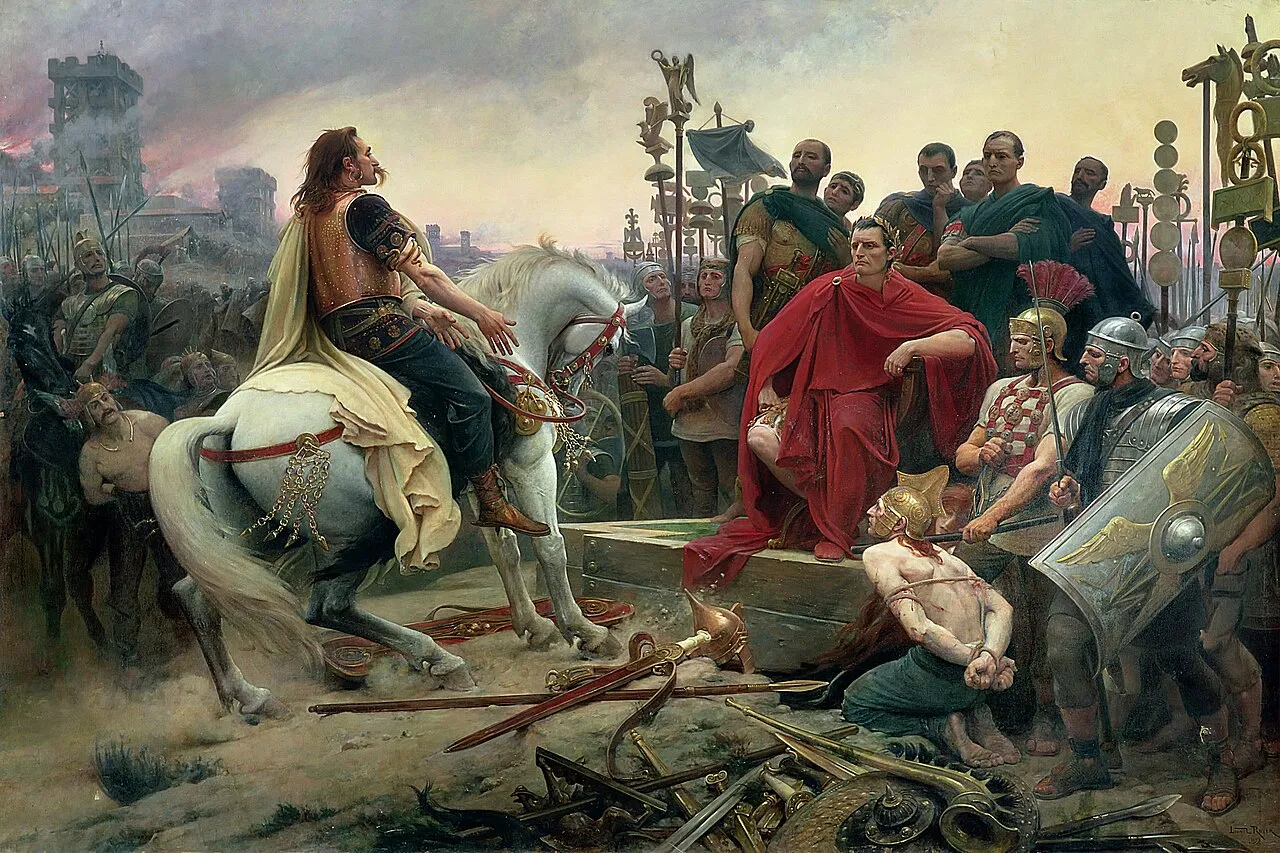
Il giorno dopo convocò l'assemblea dei capi e pronunciò poche parole: avrebbe consegnato sé stesso, vivo o morto, a chi voleva placare i vincitori. Il mattino della resa indossò le armi più belle, montò il cavallo da parata e galoppò giù dalle mura fino al campo romano. Davanti a Cesare, seduto e impassibile, compì un giro a cavallo, smontò , gettò le armi ai suoi piedi e si inginocchiò in silenzio. Cesare lo fece incatenare. Per sei anni rimase prigioniero a Roma, sepolto vivo nelle celle del Tulliano, in attesa di un solo giorno: quello del trionfo. Nel 46 a.C. fu trascinato in catene fra i carri del quadruplice trionfo di Cesare; e quella stessa sera, come imponeva il rito, fu strangolato nel buio del carcere. Aveva trentasei anni.
The next day he summoned the assembly of chiefs and spoke few words: he would surrender himself, alive or dead, to whoever wished to appease the victors. On the morning of the surrender he donned his finest arms, mounted his parade horse and galloped down from the walls to the Roman camp. Before Caesar, seated and impassive, he rode once around him, dismounted, threw his weapons at his feet and knelt in silence. Caesar had him chained. For six years he remained a prisoner in Rome, buried alive in the cells of the Tullianum, awaiting a single day: that of the triumph. In 46 BC he was dragged in chains among the chariots of Caesar's quadruple triumph; and that same evening, as the ritual demanded, he was strangled in the darkness of the prison. He was thirty-six years old.
02Battaglie e CampagneBattles and Campaigns
La campagna di Vercingetorige durò un solo anno, ma fu l'anno che decise il destino della Gallia. In pochi mesi un popolo da sempre diviso divenne nazione, sfiorò l'impensabile vittoria sul più grande generale di Roma e precipitò nella più celebre delle rese. Questa è la cronaca di quella corsa fulminea verso la gloria e la catastrofe.
Vercingetorix's campaign lasted a single year, but it was the year that decided the fate of Gaul. In a few months a people forever divided became a nation, came within reach of the unthinkable victory over Rome's greatest general, and plunged into the most famous of surrenders. This is the chronicle of that headlong rush toward glory and catastrophe.
- 53 a.C. Il giuramento dei Carnuti — Nel bosco sacro dei druidi i Carnuti giurano di accendere la rivolta. Cenabum, l'odierna Orlé ans, è assalita: ogni cittadino romano e ogni mercante italico viene trucidato. In poche ore il segnale corre da una tribù all'altra. La Gallia ha scelto la guerra. The oath of the Carnutes — In the sacred grove of the druids the Carnutes swear to kindle the revolt. Cenabum, modern Orlé ans, is stormed: every Roman citizen and Italian merchant is slaughtered. Within hours the signal races from tribe to tribe. Gaul has chosen war.
- 52 a.C. Proclamazione a Gergovia — Vercingetorige è acclamato re degli Arverni e comandante supremo della coalizione. Subito impone la sua legge: disciplina, ostaggi, terra bruciata. Per la prima volta le tribù lo seguono come un solo esercito, non come alleati riluttanti. Proclamation at Gergovia — Vercingetorix is acclaimed king of the Arverni and supreme commander of the coalition. At once he imposes his law: discipline, hostages, scorched earth. For the first time the tribes follow him as a single army, not as reluctant allies.
- 52 a.C. Caduta di Avarico — Contro il volere di Vercingetorige, la fiorente città dei Bituri viene difesa a oltranza. Cesare la espugna dopo venticinque giorni di assedio invernale e la abbandona al saccheggio: quarantamila morti, ottocento superstiti. La terra bruciata aveva ragione, e la lezione costa un fiume di sangue. Fall of Avaricum — Against Vercingetorix's will, the prosperous city of the Bituriges is defended to the last. Caesar storms it after twenty-five days of winter siege and gives it to the sack: forty thousand dead, eight hundred survivors. Scorched earth had been right, and the lesson costs a river of blood.
- 52 a.C. Battaglia di Gergovia — La vittoria gallica. Cesare assalta la capitale arverna, ma la difesa coordinata di Vercingetorige sgretola l'attacco: settecento legionari e quarantasei centurioni cadono. È la prima sconfitta tattica di Cesare in Gallia. Gli Edui, suoi ultimi fedeli, defezionano l'indomani. Battle of Gergovia — The Gallic victory. Caesar assaults the Arvernian capital, but Vercingetorix's coordinated defence shatters the attack: seven hundred legionaries and forty-six centurions fall. It is Caesar's first tactical defeat in Gaul. The Aedui, his last loyalists, defect the next day.
- 52 a.C. Lo scontro di cavalleria — L'errore fatale. Inseguendo la vittoria, Vercingetorige assale la colonna romana in marcia presso Alise-Sainte-Reine. Ma la cavalleria germanica al soldo di Roma, di gran lunga superiore, travolge quella gallica. Vercingetorige ripiega nella fortezza di Alesia: esattamente dove Cesare lo voleva. The cavalry clash — The fatal error. Chasing victory, Vercingetorix attacks the Roman marching column near Alise-Sainte-Reine. But the Germanic cavalry in Roman pay, far superior, routs the Gallic horse. Vercingetorix withdraws into the fortress of Alesia: exactly where Caesar wanted him.
- 52 a.C. Assedio di Alesia — Il capolavoro ingegneristico di Roma. Cesare erige venticinque chilometri di fortificazioni: una cinta interna verso la città , una esterna contro i soccorsi. Trincee inondate, palizzate, fosse irte di punte di ferro (gli stimuli). Per sei settimane né gli ottantamila assediati né i duecentocinquantamila dell'esercito di soccorso riescono a sfondare. Siege of Alesia — Rome's engineering masterpiece. Caesar raises twenty-five kilometres of fortifications: an inner ring facing the city, an outer one against the relief. Flooded trenches, palisades, pits bristling with iron spikes (the stimuli). For six weeks neither the eighty thousand besieged nor the two hundred and fifty thousand of the relief army can break through.
- 52 a.C. La resa di Vercingetorige — Fallito il terzo assalto esterno, il capo arverno cavalca incontro a Cesare in armatura cerimoniale, getta le armi ai suoi piedi e si arrende. Cesare lo fa incatenare. La conquista della Gallia è compiuta: Roma annette un territorio vasto quanto l'Italia. The surrender of Vercingetorix — The third outer assault having failed, the Arvernian chief rides out to Caesar in ceremonial armour, throws his weapons at his feet and surrenders. Caesar has him chained. The conquest of Gaul is complete: Rome annexes a territory as vast as Italy.
- 46 a.C. Trionfo ed esecuzione — Sei anni di prigionia nel Carcere Tulliano. Esibito in catene davanti al popolo durante il quadruplice trionfo di Cesare, per la Gallia, l'Egitto, il Ponto e l'Africa. Quella stessa sera, come voleva il rito, viene strangolato nel sotterraneo del carcere. Aveva trentasei anni. Triumph and execution — Six years of imprisonment in the Tullianum. Paraded in chains before the people during Caesar's quadruple triumph, for Gaul, Egypt, Pontus and Africa. That same evening, as ritual demanded, he is strangled in the prison's underground chamber. He was thirty-six.
03Strategia e Genio MilitareStrategy and Military Genius
Il primo a capire Roma
The first to understand Rome
Vercingetorige fu il primo capo gallico a comprendere una verità spietata: lo scontro frontale con le legioni era una strada senza ritorno. La fanteria romana (disciplina, lorica, pilum e gladius) non aveva eguali in campo aperto, e la cavalleria germanica e iberica al servizio di Cesare surclassava quella celtica. La sua dottrina ribaltò secoli di tradizione guerriera: niente cariche eroiche, niente duelli, niente villaggi indifesi alle spalle. Solo logoramento, terra bruciata, sabotaggio. Costringere il gigante a battersi contro la fame e la distanza, non contro gli uomini.
Vercingetorix was the first Gallic leader to grasp a merciless truth: a frontal clash with the legions was a road of no return. The Roman infantry (discipline, lorica, pilum and gladius) had no equal in the open field, and the Germanic and Iberian cavalry in Caesar's service outclassed the Celtic. His doctrine overturned centuries of warrior tradition: no heroic charges, no duels, no defenceless villages at the rear. Only attrition, scorched earth, sabotage. To force the giant to fight against hunger and distance, not against men.
L'arma dell'unità
The weapon of unity
Ma il suo genio più grande fu politico, non militare. Per secoli i Galli si erano massacrati fra loro (Edui contro Arverni, Bituri contro Senoni, Carnuti contro Pictoni) e in quella discordia Roma aveva trovato la sua arma migliore. Vercingetorige seppe convincerli, con la parola e con la durezza, che solo l'unione poteva salvarli. Nessun gallo prima di lui c'era riuscito; nessuno dopo di lui ci avrebbe più provato. Quando si arrese, l'unità gallica morì con lui: nei secoli a venire sarebbe stata Roma, non i Galli, a tenere unito quel territorio.
But his greatest genius was political, not military. For centuries the Gauls had slaughtered one another (Aedui against Arverni, Bituriges against Senones, Carnutes against Pictones) and in that discord Rome had found her finest weapon. Vercingetorix knew how to convince them, by word and by harshness, that only union could save them. No Gaul before him had managed it; none after him would even try. When he surrendered, Gallic unity died with him: in the centuries to come it would be Rome, not the Gauls, that held that land together.
« Alla massima cura univa la massima severità nel comando. » « To the utmost diligence he joined the utmost severity of command. » Cesare su Vercingetorige (De Bello Gallico VII, 4Caesar on Vercingetorix) Gallic War VII, 4
Il limite: troppo tardi
The limit: too late
Il suo limite fu la geografia (una Gallia troppo vasta, troppo varia, priva di una capitale che la tenesse insieme) e fu il tempo. La rivolta scoppiò quando Cesare aveva già integrato otto legioni veterane, costruito strade, fortificato presidi, comprato fedeltà . Vercingetorige giunse un decennio troppo tardi, e dovette giocare tutto su una sola posta: Alesia. Se quella rivolta fosse divampata cinque anni prima, la storia d'Europa avrebbe forse parlato un'altra lingua.
His limit was geography (a Gaul too vast, too varied, lacking a capital to hold it together) and it was time. The revolt broke out when Caesar had already integrated eight veteran legions, built roads, fortified garrisons, bought loyalties. Vercingetorix came a decade too late, and had to stake everything on a single throw: Alesia. Had that revolt blazed up five years earlier, the history of Europe might have spoken another tongue.
04Eredita e Giudizio StoricoLegacy and Historical Judgement
La Gallia diventa Roma
Gaul becomes Rome
La sconfitta di Alesia chiuse l'indipendenza gallica e aprì cinque secoli di romanizzazione. La Gallia divenne, per un paradosso della storia, la provincia più romana dell'Impero: avrebbe dato a Roma generali, oratori, poeti, Ausonio, e perfino il sangue di imperatori. Lugdunum (Lione), Treviri, Reims, Bordeaux fiorirono come capitali culturali. La lingua celtica svanì in poche generazioni, sostituita da quel latino volgare da cui sarebbe nato il francese. L'uomo che aveva combattuto Roma per la libertà consegnò , sconfitto, la sua terra alla più completa delle assimilazioni.
The defeat at Alesia closed Gallic independence and opened five centuries of Romanisation. Gaul became, by a paradox of history, the most Roman province of the Empire: it would give Rome generals, orators, poets, Ausonius, and even the blood of emperors. Lugdunum (Lyon), Trier, Reims, Bordeaux flourished as cultural capitals. The Celtic tongue vanished within a few generations, replaced by the vulgar Latin from which French would be born. The man who had fought Rome for liberty handed his land, in defeat, to the most complete of assimilations.
Il mito ritrovato
The myth rediscovered
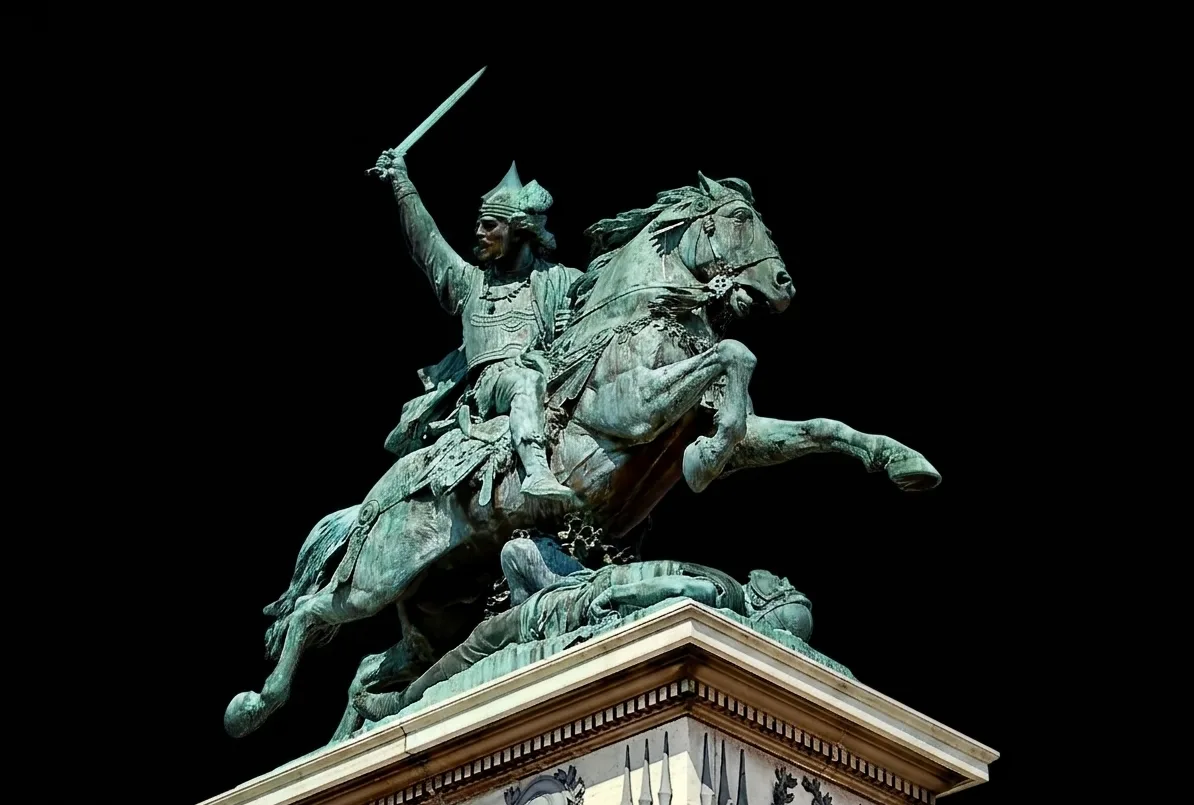
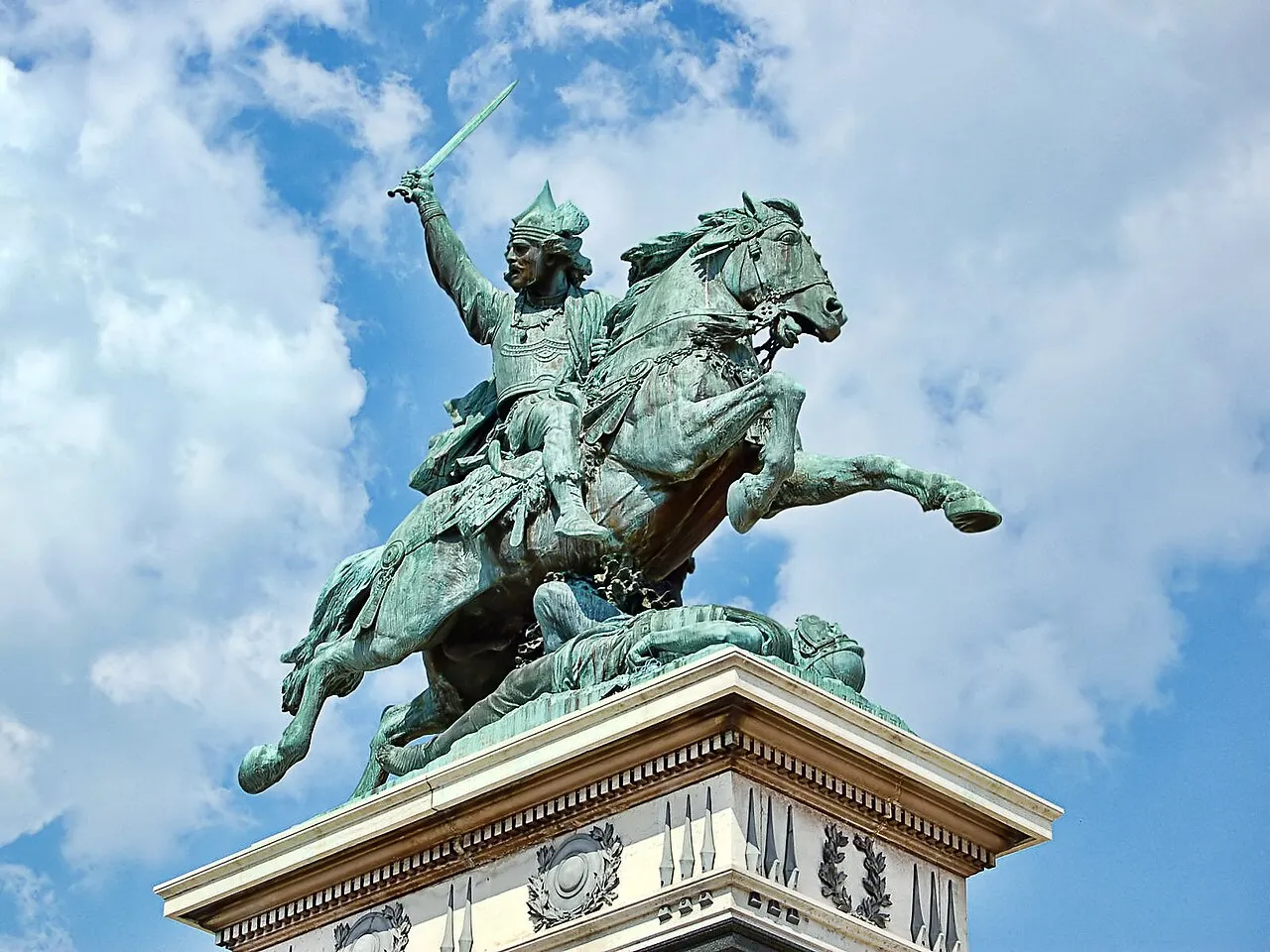
Per quasi due millenni Vercingetorige fu dimenticato. Cesare lo aveva confinato a comparsa nel De Bello Gallico: più grande il nemico, più grande la gloria del vincitore. Fu l'Ottocento a riesumarlo. Napoleone III, in cerca di un eroe fondatore per la Francia, fece innalzare la statua colossale di Aimé Millet sull'altopiano di Alesia (1865) e finanziò a Lionel Royer la grande tela della resa. Nacque così il primo eroe nazionale francese: ogni scolaro di Francia conosce quel volto fiero, anche se la storiografia odierna vi riconosce, in gran parte, un'invenzione romantica.
For nearly two millennia Vercingetorix was forgotten. Caesar had confined him to a walk-on part in the De Bello Gallico: the greater the enemy, the greater the victor's glory. It was the nineteenth century that exhumed him. Napoleon III, seeking a founding hero for France, raised Aimé Millet's colossal statue on the plateau of Alesia (1865) and financed Lionel Royer's great canvas of the surrender. Thus was born France's first national hero: every French schoolchild knows that proud face, even if modern scholarship sees in it, largely, a Romantic invention.
Il giudizio della storia
History's judgement
Il giudizio degli storici è oggi più sobrio, e più grande. Vercingetorige non fu un sognatore romantico né un patriota nel senso moderno: fu un capo politico di acutezza rarissima, il primo nella sua società a misurare l'esatta portata della minaccia romana. La sua tragedia fu di esser giunto troppo tardi, e di aver dovuto scommettere tutto, una volta sola, su un esito che dipendeva da troppi fattori. Ma il suo nome resta come il simbolo di una verità scomoda per Roma: la Gallia non fu pacificata, fu spezzata. E il prezzo lo pagò lui, nel buio umido del Tulliano, sei anni dopo aver gettato le armi ai piedi del vincitore.
Historians' judgement today is soberer, and greater. Vercingetorix was no Romantic dreamer, nor a patriot in the modern sense: he was a political leader of rare acuteness, the first in his society to measure the exact scale of the Roman threat. His tragedy was to have come too late, and to have had to wager everything, just once, on an outcome that depended on too many factors. But his name endures as the symbol of a truth uncomfortable for Rome: Gaul was not pacified, it was broken. And he paid the price, in the damp darkness of the Tullianum, six years after throwing his weapons at the victor's feet.