01BiografiaBiography
Il principe delle steppe
The prince of the steppes
Attila nacque intorno al 406 d.C. nella stirpe regia degli Unni, popolo nomade, verosimilmente di ceppo turco-mongolo, che dalle steppe dell' Asia si era riversato sulla pianura pannonica nel corso del IV secolo. Il padre Mundzuk era fratello dei re Ruga e Octar; lo zio Ruga, sovrano unico dal 432, designò eredi Attila e il fratello Bleda. Da bambino il futuro flagello visse fra i Romani come ostaggio, secondo una prassi diplomatica consueta: i giovani principi barbari crescevano alla corte del nemico e ne assorbivano lingua, costumi e arte militare. Così Attila imparò il latino e il gotico, il calcolo e la diplomazia, e insieme, nelle steppe, l' arco composito e il laccio. Conobbe Roma dall' interno molto prima di imparare a temerla, e a farsi temere.
Attila was born around 406 AD into the royal lineage of the Huns, a nomadic people, probably of Turco-Mongolic stock, that from the steppes of Asia had poured onto the Pannonian plain during the fourth century. His father Mundzuk was brother of the kings Ruga and Octar; his uncle Ruga, sole sovereign from 432, named Attila and his brother Bleda as heirs. As a child the future scourge lived among the Romans as a hostage, by a customary diplomatic practice: young barbarian princes grew up at the enemy' s court, absorbing its language, customs and art of war. So Attila learned Latin and Gothic, calculation and diplomacy, and, in the steppes, the composite bow and the lasso. He knew Rome from within long before he learned to fear it, and to make himself feared.
Due re, un trono solo
Two kings, a single throne
Nel 434 d.C., alla morte di Ruga, Attila e Bleda salirono insieme al trono. Il primo atto dei due fratelli fu piegare l' Impero d' Oriente al Trattato di Margus (435): Costantinopoli accettava di raddoppiare il tributo annuo, da 350 a 700 libbre d' oro, e di riconsegnare i profughi unni che avevano cercato asilo entro i suoi confini. Era una capitolazione travestita da accordo. Per dieci anni i due re regnarono fianco a fianco; poi, nel 445 d.C., Bleda fu assassinato, secondo Prisco di Panion, per mano dello stesso Attila. Rimasto signore unico, Attila dominò un impero che si stendeva ormai dal Reno al Volga e inghiottiva decine di popoli vassalli: Ostrogoti, Gepidi, Eruli, Alani, Sarmati. Nessun barbaro, prima di lui, aveva mai unificato un' area così vasta.
In 434 AD, on Ruga' s death, Attila and Bleda ascended the throne together. The two brothers' first act was to bend the Eastern Empire to the Treaty of Margus (435): Constantinople agreed to double the annual tribute, from 350 to 700 pounds of gold, and to hand back the Hunnic fugitives who had sought asylum within its borders. It was a capitulation disguised as an agreement. For ten years the two kings reigned side by side; then, in 445 AD, Bleda was murdered, according to Priscus of Panion, by Attila' s own hand. Sole lord at last, Attila ruled an empire that now stretched from the Rhine to the Volga and swallowed dozens of vassal peoples: Ostrogoths, Gepids, Heruls, Alans, Sarmatians. No barbarian before him had ever unified an area so vast.
L'industria del terrore
The industry of terror
La politica di Attila verso Roma fu, fin dal principio, una sola: l' estorsione eretta a sistema. Nel 441 e nel 447 rovesciò i Balcani come una marea, radendo al suolo settanta città dell' Impero d' Oriente (Sirmium, Naissus, Serdica, Filippopoli) e annientando per due volte le armate di Costantinopoli, al Chersoneso e sul fiume Utus. L' imperatore Teodosio II, asserragliato dietro le formidabili mura della capitale, le uniche che gli Unni non sapessero espugnare, firmò nel 447 una pace che era una resa: tributo annuo triplicato a 2100 libbre d' oro, una fascia di terra lungo il Danubio profonda cinque giorni di marcia, riscatti rovinosi per i prigionieri. Quell' anno l' ambasciatore Prisco di Panion raggiunse il campo del re: la sua relazione, giunta a noi in frammenti, resta la più viva testimonianza su Attila e sul suo accampamento di legno, vasto come una città .
Attila' s policy toward Rome was, from the start, a single one: extortion raised to a system. In 441 and 447 he rolled over the Balkans like a tide, razing seventy cities of the Eastern Empire (Sirmium, Naissus, Serdica, Philippopolis) and twice annihilating the armies of Constantinople, at the Chersonese and on the river Utus. Emperor Theodosius II, walled up behind the formidable ramparts of the capital, the only ones the Huns could not storm, signed in 447 a peace that was a surrender: annual tribute trebled to 2100 pounds of gold, a strip of land along the Danube five days' march deep, ruinous ransoms for prisoners. That year the envoy Priscus of Panion reached the king' s camp: his account, come down to us in fragments, remains the most vivid testimony on Attila and on his wooden camp, vast as a city.
« Dove passa il mio cavallo, l' erba non ricresce più . » « Where my horse has passed, the grass grows no more. » Detto attribuito ad Attila dalla tradizioneSaying attributed to Attila by tradition
L'anello di Onoria
Honoria's ring
La svolta verso l' Occidente fu, insieme, accidentale e grottesca. Nel 450 d.C. Giusta Grata Onoria, sorella dell' imperatore d' Occidente Valentiniano III, fu sorpresa in una relazione clandestina e condannata a sposare un anziano senatore. Disperata, fece recapitare di nascosto al re degli Unni il proprio anello, implorando aiuto. Attila scelse di leggere quel gesto come una proposta di nozze: pretese Onoria in moglie e, come dote, metà dell' Impero d' Occidente. Valentiniano rifiutò . Era esattamente il pretesto che cercava da tempo: spostare la guerra a Occidente, dove l' oro era più denso e i confini più fragili.
The pivot toward the West was at once accidental and grotesque. In 450 AD Justa Grata Honoria, sister of the western emperor Valentinian III, was caught in a clandestine affair and condemned to marry an elderly senator. In desperation, she secretly sent the king of the Huns her own ring, begging for help. Attila chose to read the gesture as a marriage proposal: he demanded Honoria as his wife and, as dowry, half of the Western Empire. Valentinian refused. It was exactly the pretext he had long sought: to move the war westward, where gold was denser and frontiers more fragile.
I Campi Catalaunici
The Catalaunian Plains
Nella primavera del 451 d.C. Attila attraversò il Reno alla testa di un esercito sterminato, forse centomila uomini: arcieri unni a cavallo, Ostrogoti, Gepidi, Eruli, Sciri, Burgundi assoggettati. Mise a ferro e fuoco Metz, Reims, Tongeren; devastò la Champagne; puntò su Orlé ans, contando sulla defezione degli Alani federati. Ad attenderlo c' era l' ultimo grande generale di Roma, Flavio Aezio, cresciuto anch' egli come ostaggio fra gli Unni, e amico personale di Attila negli anni giovanili. In pochi mesi Aezio costruì ciò che pareva impossibile: una coalizione di Romani d' Occidente, Visigoti del re Teodorico I, Alani di Sangiban, Burgundi fedeli e Franchi Salii. Nel giugno del 451, ai Campi Catalaunici presso Châ lons, due mondi si scontrarono in una delle più immani battaglie della tarda antichità : forse centocinquantamila uomini per parte e, secondo i cronisti, centosessantamila morti rimasti sul terreno.
In the spring of 451 AD Attila crossed the Rhine at the head of a vast army, perhaps a hundred thousand men: mounted Hunnic archers, Ostrogoths, Gepids, Heruls, Scirians, subjected Burgundians. He put Metz, Reims and Tongeren to the torch; devastated Champagne; struck at Orlé ans, counting on the defection of the Alan federates. Awaiting him was the last great general of Rome, Flavius Aetius, himself raised as a hostage among the Huns, and Attila' s personal friend in their younger years. In a few months Aetius built what had seemed impossible: a coalition of Western Romans, Visigoths under king Theodoric I, Alans of Sangiban, loyal Burgundians and Salian Franks. In June 451, on the Catalaunian Plains near Châ lons, two worlds collided in one of the most immense battles of late antiquity: perhaps a hundred and fifty thousand men a side and, the chroniclers say, a hundred and sixty thousand dead left upon the field.
L' esito fu indeciso sul campo, ma decisivo nella storia. Il re Teodorico I cadde nella mischia; il figlio Torismondo dovette precipitarsi in patria per assicurarsi il trono visigoto. Aezio, prudentissimo, lasciò che Attila ripiegasse oltre il Reno con l' esercito ancora intatto: temeva che, annientati gli Unni, i Visigoti diventassero troppo potenti. Per la prima volta in quindici anni di guerra, Attila aveva incontrato un avversario che non poteva travolgere. Non fu una disfatta: fu qualcosa di più grave: la rivelazione del limite del suo potere.
The outcome was undecided on the field, but decisive in history. King Theodoric I fell in the fray; his son Thorismund had to rush home to secure the Visigothic throne. Aetius, ever cautious, let Attila fall back across the Rhine with his army still intact: he feared that, with the Huns destroyed, the Visigoths would grow too powerful. For the first time in fifteen years of war, Attila had met an adversary he could not overrun. It was not a defeat, it was something graver: the revelation of the limit of his power.
Il fuoco sull'Italia
Fire upon Italy
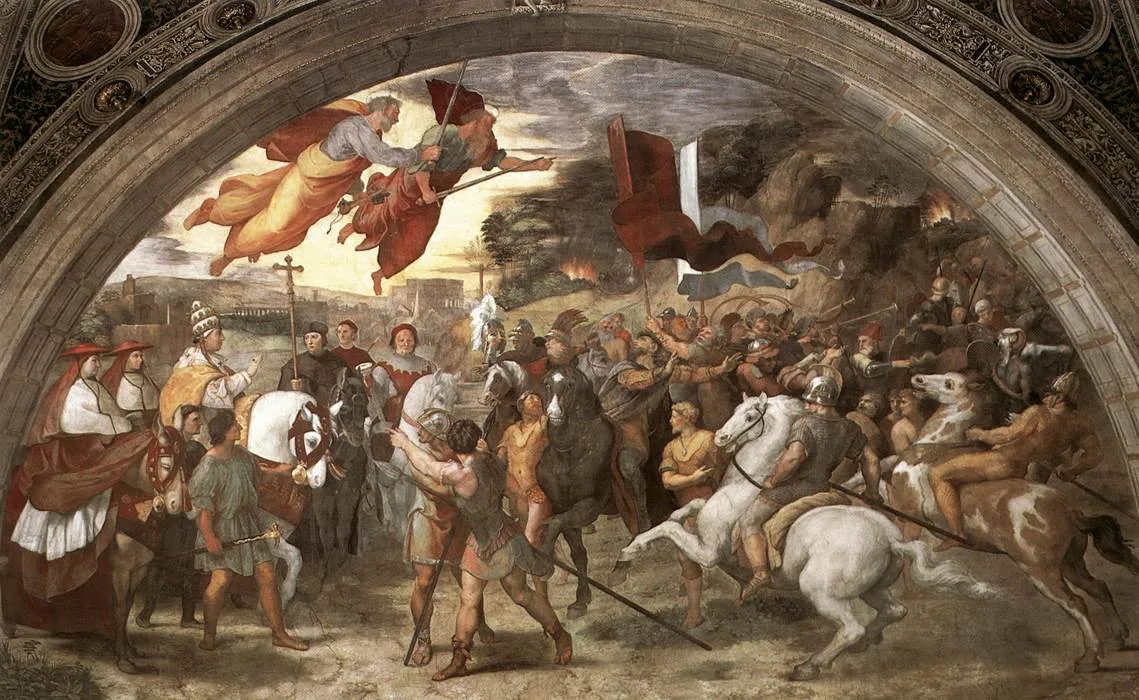
Nel 452 d.C. Attila ritentò , questa volta scendendo sull' Italia. Varcato il Brennero, pose l' assedio ad Aquileia, una delle quattro grandi città della penisola con Mediolanum, Ravenna e Roma. Resistette per settimane; poi fu spazzata via così radicalmente che i superstiti fuggirono nelle lagune dell' Adriatico, dove avrebbero gettato le fondamenta di Venezia: dalla distruzione di una città nacque la più serena delle repubbliche. Attila proseguì (Concordia, Altino, Padova, Vicenza, Verona, Brescia, Bergamo, Milano, Pavia) un' onda di fuoco attraverso la pianura padana, mentre la corte di Ravenna, paralizzata, non muoveva un dito. Ma sulle rive del Mincio, presso Mantova, qualcosa lo arrestò . La tradizione cattolica vuole che papa Leone Magno in persona, scortato da due senatori, gli sia andato incontro e lo abbia persuaso a desistere. La realtà fu più prosaica: la peste falciava il suo esercito, le scorte erano esaurite, l' armata orientale di Marciano risaliva il Danubio alle sue spalle e Aezio si era riorganizzato a sud. Attila trattò , intascò un riscatto e si ritirò .
In 452 AD Attila tried again, this time descending upon Italy. Crossing the Brenner, he laid siege to Aquileia, one of the four great cities of the peninsula alongside Mediolanum, Ravenna and Rome. It held out for weeks; then it was swept away so utterly that the survivors fled into the lagoons of the Adriatic, where they would lay the foundations of Venice: from the destruction of one city was born the most serene of republics. Attila pressed on (Concordia, Altino, Padua, Vicenza, Verona, Brescia, Bergamo, Milan, Pavia) a wave of fire across the Po valley, while the paralysed court of Ravenna lifted not a finger. But on the banks of the Mincio, near Mantua, something stopped him. Catholic tradition holds that Pope Leo the Great in person, escorted by two senators, went out to meet him and persuaded him to desist. The reality was more prosaic: plague was mowing down his army, supplies were exhausted, Marcian' s eastern army was coming up the Danube at his back, and Aetius had regrouped in the south. Attila negotiated, pocketed a ransom, and withdrew.
La notte di Ildico
The night of Ildico
Tornato in Pannonia, Attila già meditava una nuova guerra: stavolta contro l' Oriente, che sotto il nuovo imperatore Marciano aveva osato sospendere il tributo. Ma l' avvenire gli si chiuse in una sola notte. Nel 453 d.C. sposò una giovane sposa di nome germanico, Ildico. La notte delle nozze, dopo aver bevuto a lungo al banchetto, crollò nel sonno ubriaco; nel buio una emorragia, un vaso spezzato, forse, o l' eccesso di vino, lo soffocò nel suo stesso sangue. La sposa rimase muta accanto al cadavere fino all' alba. Quando le guardie sfondarono la porta, trovarono il flagello del mondo morto senza un graffio, ucciso dal proprio corpo. Aveva poco più di quarant' anni.
Back in Pannonia, Attila was already plotting a new war: this time against the East, which under the new emperor Marcian had dared to suspend the tribute. But the future closed on him in a single night. In 453 AD he married a young bride of Germanic name, Ildico. On the wedding night, after long drinking at the banquet, he collapsed into a drunken sleep; in the dark a haemorrhage (a burst vessel, perhaps, or the excess of wine) choked him in his own blood. The bride sat mute beside the corpse until dawn. When the guards broke down the door, they found the scourge of the world dead without a scratch, killed by his own body. He was little more than forty.
Funerali da re delle steppe
A steppe king's funeral
I funerali furono degni di un signore delle steppe. Il corpo fu esposto sotto una tenda di seta in mezzo alla pianura, mentre i guerrieri unni gli galoppavano intorno lacerandosi il volto con le lame, perché , scrive Giordane, « il più grande dei guerrieri non doveva essere pianto con lacrime di donne, ma col sangue degli uomini». Poi fu calato in una tripla bara: la prima d' oro, la seconda d' argento, la terza di ferro: l' oro per la sua maestà , l' argento per il suo splendore, il ferro per i regni che aveva spezzato. Gli schiavi che scavarono la fossa segreta furono uccisi subito dopo, perché nessuno potesse mai rivelarne il luogo. Come per Alarico, la tomba del re non è mai stata trovata.
The funeral was worthy of a lord of the steppes. The body was displayed beneath a silken tent in the middle of the plain, while the Hunnic warriors galloped around it gashing their faces with blades, for, Jordanes writes, « the greatest of warriors must not be mourned with women' s tears, but with the blood of men». Then he was lowered into a triple coffin: the first of gold, the second of silver, the third of iron: gold for his majesty, silver for his splendour, iron for the kingdoms he had broken. The slaves who dug the secret grave were killed immediately after, so that none could ever reveal the place. As with Alaric, the king' s tomb has never been found.
Senza Attila, il nulla
Without Attila, nothing
L' impero unno non sopravvisse al suo creatore. I figli di Attila (Ellac, Dengizich, Ernak) si spartirono il regno e subito presero a combattersi. Nel 454 d.C., un solo anno dopo la sua morte, i popoli germanici assoggettati insorsero sotto il re gepida Ardarico: alla battaglia del Nedao l' esercito unno fu travolto ed Ellac cadde. L' impero che si stendeva dal Reno al Volga si dissolse in pochi anni, come neve a primavera. Era stato l' impero di Attila in senso letterale: senza di lui, non era più nulla.
The Hunnic empire did not survive its creator. Attila' s sons (Ellac, Dengizich, Ernak) divided the kingdom and at once began to fight one another. In 454 AD, just one year after his death, the subjected Germanic peoples rose under the Gepid king Ardaric: at the battle of the Nedao the Hunnic army was overwhelmed and Ellac fell. The empire that stretched from the Rhine to the Volga dissolved within a few years, like snow in spring. It had been Attila' s empire in the literal sense: without him, it was nothing.
02Campagne e TrattatiCampaigns and Treaties
Vent'anni di tributo e di fuoco
Twenty years of tribute and fire
Per un' intera generazione la storia dei due imperi romani fu scandita dalle mosse di un solo uomo. Trattati strappati con la minaccia, città ridotte in cenere, eserciti imperiali annientati o comprati a peso d' oro: ogni anno portava il nome di Attila. La cronologia che segue ne ripercorre l' ascesa, dal primo patto capestro alla notte in cui tutto finì .
For an entire generation the history of the two Roman empires was marked by the moves of a single man. Treaties wrung by threat, cities reduced to ash, imperial armies annihilated or bought off with gold: every year bore the name of Attila. The chronology that follows retraces his rise, from the first crushing pact to the night when it all ended.
- 434 d.C. Ascesa al trono — Alla morte dello zio Ruga, Attila e Bleda salgono insieme al regno unno. Età stimata: 28 anni. Eredita un' orda già in espansione, ma ancora lontana dall' essere impero strutturato. Ascent to the throne — On uncle Ruga' s death, Attila and Bleda jointly ascend the Hunnic kingdom. Estimated age: 28. He inherits a horde already expanding, but still far from a structured empire.
- 435 d.C. Trattato di Margus — Imposto a Costantinopoli: tributo annuo raddoppiato a 700 libbre d' oro, restituzione dei rifugiati unni. Mercato libero franco-frontaliero. Roma firma e perde. Treaty of Margus — Imposed on Constantinople: annual tribute doubled to 700 pounds of gold, return of Hunnic refugees. Free cross-frontier market. Rome signs and loses.
- 441–442 d.C. Prima invasione dei Balcani — Pretesto: vescovo di Margus accusato di profanare tombe unne. Attila travolge Sirmium, Singidunum (Belgrado), Naissus, Filippopoli. L' esercito orientale è battuto. Tregua, tributo aumentato. First Balkan invasion — Pretext: bishop of Margus accused of desecrating Hunnic tombs. Attila overruns Sirmium, Singidunum (Belgrade), Naissus, Philippopolis. The Eastern army is beaten. Truce, increased tribute.
- 445 d.C. Assassinio di Bleda — Attila uccide il fratello e diviene unico re. La fonte (Prisco) è esplicita. Da questo momento concentra il potere, riforma l' esercito, costruisce il suo accampamento di legno in Pannonia: una capitale-città nomade. Murder of Bleda — Attila kills his brother and becomes sole king. The source (Priscus) is explicit. From this point he concentrates power, reforms the army, builds his wooden camp in Pannonia: a nomadic capital-city.
- 447 d.C. Seconda invasione dei Balcani — Settanta città orientali distrutte. Vittorie alla Chersoneso e al fiume Utus. Costantinopoli salva solo grazie alle mura teodosiane: gli Unni non sanno fare poliorcetica. Trattato umiliante: tributo triplicato a 2100 lb oro/anno. Second Balkan invasion — Seventy eastern cities destroyed. Victories at the Chersonese and the river Utus. Constantinople saved only by the Theodosian walls: the Huns lack siegecraft. Humiliating treaty: tribute trebled to 2100 lb gold a year.
- 449 d.C. Ambasceria di Prisco — Lo storico Prisco di Panion accompagna l' ambasceria orientale al campo unno. La sua relazione, sopravvissuta in frammenti, descrive Attila come uomo basso, dal petto largo, occhi piccoli, barba rada. Sobrio in mezzo a banchetti sfarzosi: beveva da coppa di legno, mangiava da piatto di legno, mentre i suoi nobili usavano oro. Priscus' s embassy — The historian Priscus of Panion accompanies the eastern embassy to the Hunnic camp. His report, surviving in fragments, describes Attila as short, broad-chested, small-eyed, sparsely bearded. Sober in the midst of lavish banquets: he drank from a wooden cup, ate from a wooden plate, while his nobles used gold.
- 450 d.C. L' anello di Onoria — Giusta Grata Onoria, sorella di Valentiniano III, manda ad Attila il proprio anello. Attila lo interpreta come proposta di matrimonio e pretende lei in moglie e metà dell' Impero d' Occidente come dote. Valentiniano rifiuta. Casus belli pronto. Honoria' s ring — Justa Grata Honoria, sister of Valentinian III, sends Attila her own ring. Attila reads it as a marriage proposal and demands her as wife and half the Western Empire as dowry. Valentinian refuses. Casus belli ready.
- 451 d.C., apr.– giu. Invasione della Gallia — Cento mila uomini attraversano il Reno. Metz, Reims, Tongres, Cambrai bruciate. Assedio di Orleans, sciolto dall' arrivo dell' esercito di Aezio. Inseguimento. Invasion of Gaul — A hundred thousand men cross the Rhine. Metz, Reims, Tongeren, Cambrai burned. Siege of Orleans broken by the arrival of Aetius' s army. Pursuit.
- 20 giu. 451 d.C. Battaglia dei Campi Catalaunici — Presso Chalons-en-Champagne. Coalizione di Aezio (Romani + Visigoti + Alani + Burgundi + Salii) contro Unni e vassalli germanici. Scontro epico e indeciso. Teodorico I dei Visigoti cade sul campo. Centosessantamila morti complessivi (Giordane). Attila si ritira al campo trincerato. Aezio, prudente, lo lascia andare. Battle of the Catalaunian Plains — Near Chalons-en-Champagne. Aetius' s coalition (Romans + Visigoths + Alans + Burgundians + Salian Franks) against the Huns and Germanic vassals. Epic and indecisive clash. Theodoric I of the Visigoths falls on the field. One hundred and sixty thousand total dead (Jordanes). Attila withdraws to the entrenched camp. Aetius, cautious, lets him go.
- 452 d.C. Invasione dell' Italia — Dal Brennero scende sul Veneto. Aquileia rasa al suolo: i fuggiaschi fondano i primi insediamenti delle lagune (origine di Venezia). Padova, Vicenza, Verona, Brescia, Bergamo, Milano, Pavia distrutte. Pianura padana in fiamme. Invasion of Italy — From the Brenner he descends on Venetia. Aquileia razed: the fugitives found the first lagoon settlements (origin of Venice). Padua, Vicenza, Verona, Brescia, Bergamo, Milan, Pavia destroyed. The Po valley in flames.
- 452 d.C., est. Incontro col papa Leone Magno — Sul Mincio, presso Mantova. Tradizione: il pontefice, accompagnato da due senatori, persuade Attila a tornare indietro con la sola forza della parola. Realtà : pestilenza nell' esercito unno, scorte esaurite, l' esercito orientale minaccia il Danubio. Attila tratta, prende riscatto, riattraversa le Alpi. Meeting with Pope Leo the Great — On the Mincio, near Mantua. Tradition: the pontiff, with two senators, persuades Attila to turn back by the sheer force of words. Reality: plague in the Hunnic army, supplies exhausted, the eastern army threatening the Danube. Attila negotiates, takes ransom, recrosses the Alps.
- 453 d.C. Morte di Attila — Sposa la giovane Ildico in Pannonia. La notte stessa muore di emorragia nasale dopo banchetto pesante: soffocato dal proprio sangue mentre dormiva ubriaco. Sepolto in tripla bara (oro, argento, ferro) in luogo segreto. Schiavi che scavano la tomba poi uccisi. Il sito non è mai stato trovato. Death of Attila — Marries young Ildico in Pannonia. That same night he dies of nasal haemorrhage after a heavy banquet: choked on his own blood while sleeping drunk. Buried in a triple coffin (gold, silver, iron) in a secret place. Slaves who dig the tomb are then killed. The site has never been found.
- 454 d.C. Battaglia del Nedao — Solo un anno dopo la morte di Attila, i popoli germanici vassalli si ribellano sotto il re gepida Ardarico. L' esercito unno è annientato; il figlio maggiore Ellac muore in battaglia. L' impero che andava dal Reno al Volga si disgrega. Battle of the Nedao — Just one year after Attila' s death, the vassal Germanic peoples revolt under the Gepid king Ardaric. The Hunnic army is annihilated; the eldest son Ellac dies in battle. The empire that ran from the Rhine to the Volga disintegrates.
03Strategia e Genio MilitareStrategy and Military Genius
La velocità come arma
Speed as a weapon
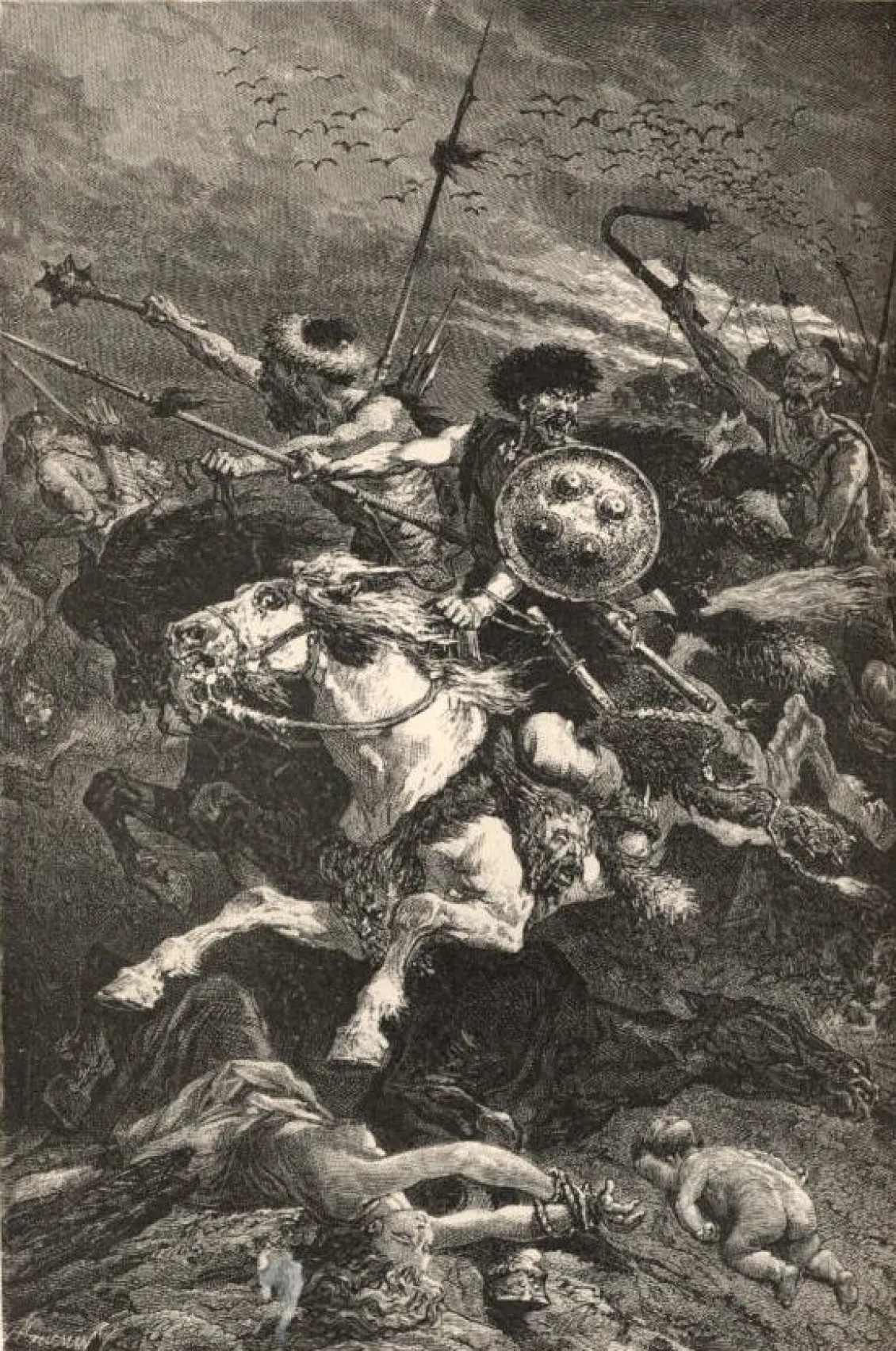
La forza di Attila non stava nella tattica di battaglia, ma nella mobilità. La cavalleria leggera unna, armata dell' arco composito di tipo scitico, poteva coprire centocinquanta chilometri al giorno per settimane intere. Le legioni romane, anche le migliori, non avevano modo di intercettare un esercito che si dissolveva e si ricomponeva a centinaia di chilometri di distanza. Attila colpiva le città indifese, incendiava le campagne ed evitava con metodo i grandi eserciti regolari, finché non era certo di poterli battere o aggirare. Una guerra di velocità condotta su scala continentale.
Attila' s strength lay not in battle tactics but in mobility. The light Hunnic cavalry, armed with the Scythian-type composite bow, could cover a hundred and fifty kilometres a day for weeks on end. The Roman legions, even the best, had no way to intercept an army that dissolved and reformed hundreds of kilometres away. Attila struck defenceless cities, burned the countryside, and methodically avoided the great regular armies until he was certain he could beat or outflank them. A war of speed waged on a continental scale.
La pace come merce
Peace as a commodity
La sua seconda arma fu l' estorsione, raffinata fino a diventare un vero sistema fiscale. Per quindici anni il tributo strappato all' Oriente fu il bilancio del regno unno: oro che finanziava le paghe dei vassalli germanici, dei disertori romani al suo servizio, degli ingegneri prigionieri impiegati nelle rare opere d' assedio. Costantinopoli pagava per non veder distrutte le proprie province balcaniche; la pace stessa era diventata una merce con un prezzo. Attila aveva trasformato la guerra da impresa in industria.
His second weapon was extortion, refined until it became a true fiscal system. For fifteen years the tribute wrung from the East was the budget of the Hunnic kingdom: gold that funded the pay of the Germanic vassals, of the Roman deserters in his service, of the captive engineers used in the rare siege works. Constantinople paid not to see its Balkan provinces destroyed; peace itself had become a commodity with a price. Attila had turned war from an enterprise into an industry.
I due limiti del flagello
The scourge's two limits
Il suo sistema aveva però due limiti, entrambi profondi. Il primo: l' incapacità di espugnare le città murate. Aquileia gli costò settimane; Costantinopoli, Roma e Ravenna gli restarono per sempre inaccessibili. Le grandi mura teodosiane salvarono l' Oriente almeno quanto l' oro dei tributi. Il secondo, fatale: l' impero unno dipendeva interamente da lui. Attila non costruì un' amministrazione, non fondò una capitale, non scrisse leggi. I suoi vassalli gli obbedivano per terrore e per denaro; alla sua morte, nulla più tenne insieme il regno. Morì lui, e con lui morì l' orda.
His system, however, had two limits, both profound. The first: the inability to storm walled cities. Aquileia cost him weeks; Constantinople, Rome and Ravenna remained forever beyond his reach. The great Theodosian walls saved the East at least as much as the tribute gold did. The second, fatal: the Hunnic empire depended entirely on him. Attila built no administration, founded no capital, wrote no laws. His vassals obeyed him out of terror and money; on his death, nothing held the kingdom together any longer. He died, and with him died the horde.
L'uomo dalla coppa di legno
The man with the wooden cup
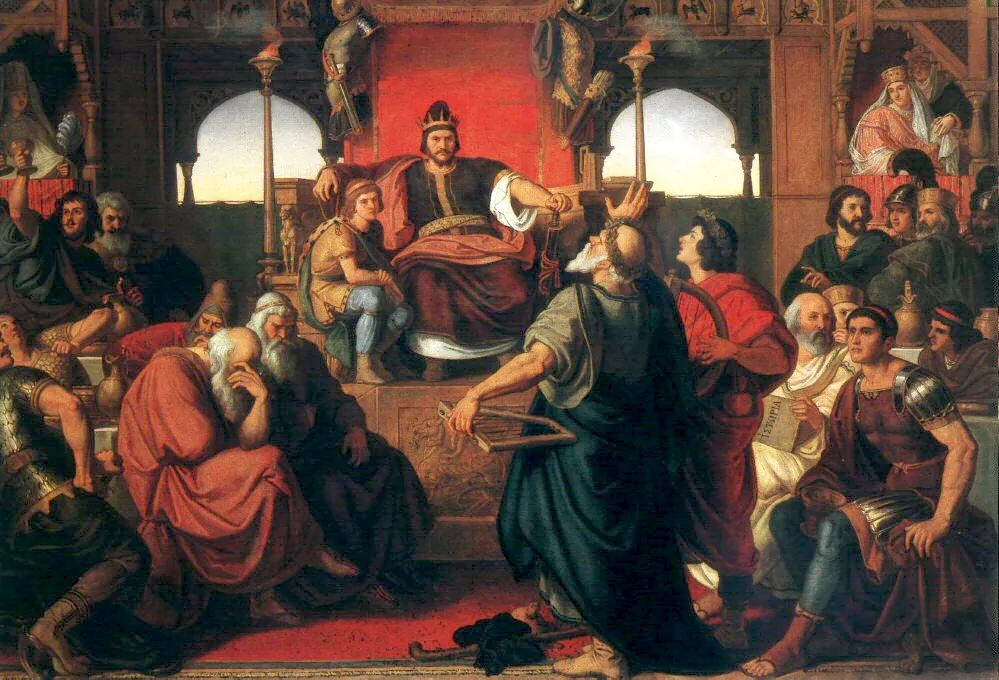
Sul piano umano, Prisco, che lo vide di persona, lo dipinge come una figura paradossale: terribile e sobria a un tempo. In mezzo ai banchetti sfarzosi dei suoi nobili, che mangiavano in vassoi d' oro e d' argento, Attila beveva da una coppa di legno e mangiava da un tagliere di legno, vestito di stoffe semplici e prive d' ornamento. La sua autorità non aveva bisogno di simboli: stava tutta nello sguardo, nella voce, nel calcolo glaciale. Voleva apparire un re-pastore frugale in mezzo a una corte che lo idolatrava. Una posa, certo, ma coltivata con disciplina di ferro.
On the human level, Priscus, who saw him in person, paints him as a paradoxical figure: terrible and sober at once. Amid the lavish banquets of his nobles, who ate from gold and silver platters, Attila drank from a wooden cup and ate from a wooden trencher, dressed in plain, unadorned cloth. His authority needed no symbols: it lay entirely in the gaze, the voice, the glacial calculation. He wished to appear a frugal shepherd-king in the midst of a court that idolised him. A pose, certainly, but one cultivated with iron discipline.
« Mentre agli altri si imbandivano vivande su vassoi d' argento, ad Attila non si serviva che carne su un tagliere di legno; e beveva da una coppa di legno, l' abito semplice, unico ornamento la sua sobrietà . » « While for the others fare was set out on silver platters, to Attila was served only meat on a wooden trencher; and he drank from a cup of wood, his dress plain, his only ornament his own sobriety. » Dalla relazione di Prisco di Panion, ambasciatore alla corte di Attila (448)From the account of Priscus of Panion, envoy to Attila' s court (448)
04Eredita e MitoLegacy and Myth
Il vuoto dopo l'orda
The void after the horde
La morte di Attila e il crollo del suo impero furono uno spartiacque per il Mediterraneo tardoantico, e, paradossalmente, una condanna per Roma. Venuto meno il cuneo unno che dall' esterno schiacciava i popoli germanici contro il limes, Ostrogoti, Gepidi, Eruli e Sciri si liberarono e cominciarono a muoversi per conto proprio. Vent' anni dopo, nel 476 d.C., fu proprio uno di quei capi sciri-eruli un tempo vassalli di Attila, Odoacre, a deporre Romolo Augustolo a Ravenna, ponendo formalmente fine all' Impero d' Occidente. Senza la pressione unna la mappa etnica d' Europa fu rimescolata; e proprio in quel rimescolio l' Occidente romano si sgretolò .
The death of Attila and the collapse of his empire were a watershed for the late antique Mediterranean, and, paradoxically, a sentence upon Rome. With the Hunnic wedge gone that from outside had crushed the Germanic peoples against the limes, Ostrogoths, Gepids, Heruls and Scirians broke free and began to move on their own. Twenty years later, in 476 AD, it was one of those Scirian-Herul chiefs, once Attila' s vassals, Odoacer, who deposed Romulus Augustus at Ravenna, formally ending the Western Empire. Without the Hunnic pressure the ethnic map of Europe was reshuffled; and in that very reshuffling the Roman West crumbled.
La mano destra e la mano sinistra
The right hand and the left
Aezio, il vincitore di Catalaunico, non sopravvisse a lungo al suo nemico. Nel 454 d.C. Valentiniano III, roso dalla gelosia per la sua gloria, lo pugnalò di propria mano in piena udienza imperiale. Sei mesi dopo, due ufficiali fedeli al generale vendicarono il loro comandante assassinando l' imperatore. Fece il giro delle corti il motto di un cortigiano: « l' imperatore si è tagliato la mano destra con la sinistra». La domanda della tarda antichità era ormai una sola: senza il blocco unno e senza Aezio, chi avrebbe difeso l' Italia? La risposta fu il vuoto. Il sacco vandalo del 455, l' invasione di Genserico, le scorrerie incessanti dei Goti: nei trent' anni seguenti l' Occidente romano si disgregò senza che più nessuno tentasse di resistere.
Aetius, the victor of the Catalaunian Plains, did not long survive his enemy. In 454 AD Valentinian III, gnawed by jealousy of his glory, stabbed him with his own hand in full imperial audience. Six months later, two officers loyal to the general avenged their commander by assassinating the emperor. A courtier' s quip went the rounds of the courts: « the emperor has cut off his right hand with his left». The question of late antiquity was now a single one: without the Hunnic block and without Aetius, who would defend Italy? The answer was the void. The Vandal sack of 455, Geiseric' s invasion, the ceaseless raids of the Goths: in the following thirty years the Roman West fell apart without anyone any longer trying to resist.
Le due vite del mito
The two lives of the myth
Sul piano del mito, Attila visse una doppia vita postuma. In Occidente la tradizione cristiana lo trasformò nel Flagellum Dei, il flagello di Dio: strumento involontario del castigo divino sui peccatori, fermato solo dall' intercessione miracolosa di papa Leone. L' immagine fissata da Raffaello nelle Stanze Vaticane restò canonica per mille anni. Nell' Oriente germanico, al contrario, divenne eroe positivo dell' epica: nel Nibelungenlied tedesco, Attila, chiamato Etzel, è un re generoso e ospitale, sposo di Crimilde, travolto dalla vendetta dei Burgundi; nel ciclo nordico è l'Atli dell'Edda poetica, fiero ma giusto. La memoria germanica conservò il ricordo di un re che li aveva uniti.
In myth, Attila lived a double afterlife. In the West Christian tradition turned him into the Flagellum Dei, the scourge of God: involuntary instrument of divine punishment on sinners, stopped only by the miraculous intercession of Pope Leo. The image fixed by Raphael in the Vatican Rooms remained canonical for a thousand years. In the Germanic East, by contrast, he became a positive hero of the epic: in the German Nibelungenlied, Attila, called Etzel, is a generous and hospitable king, husband of Kriemhild, swept up in the revenge of the Burgundians; in the Norse cycle he is the Atli of the Poetic Edda, fierce but just. Germanic memory preserved the recollection of a king who had united them.
« Uomo nato al mondo per sconvolgere le nazioni, terrore di tutte le terre. » « A man born into the world to shake the nations, the terror of all lands. » Giordane, Getica, su Attila (VI secolo)Jordanes, Getica, on Attila (6th century)
Il padre degli Ungheresi
The father of the Hungarians
In Ungheria, dove la pianura pannonica era stata il cuore del suo dominio, Attila divenne progenitore mitico della nazione. Nel Medioevo i sovrani magiari ne rivendicarono la discendenza; e ancora oggi Attila è un comune nome proprio maschile ungherese. Il suo accampamento di legno, descritto da Prisco, sorgeva forse nella pianura della Tisza: gli archeologi vi hanno cercato a lungo, senza esito. Come per Alarico, la terra non ha mai restituito la sua tomba. E come Alarico, Attila resta un' assenza fisica e un' ipertrofia simbolica: un flagellum Dei di cui non conosciamo né il volto vero né la sepoltura.
In Hungary, where the Pannonian plain had been the heart of his dominion, Attila became the mythical progenitor of the nation. In the Middle Ages the Magyar sovereigns claimed descent from him; and to this day Attila is a common male given name in Hungary. His wooden camp, described by Priscus, perhaps stood in the plain of the Tisza: archaeologists have long searched there, without result. As with Alaric, the earth has never yielded his tomb. And like Alaric, Attila remains a physical absence and a symbolic hypertrophy: a flagellum Dei whose true face and burial are alike unknown.
Il giudizio della storia
The verdict of history
Il giudizio storico moderno ha smesso di vedere in Attila la pura incarnazione della barbarie. Fu, prima di tutto, un politico di statura immensa: unificò una congerie di tribù sparse su tre milioni di chilometri quadrati, costrinse i due imperi romani a trattarlo da pari, edificò un sistema fiscale fondato sull' estorsione organizzata. Il suo vero limite fu non costruire nulla che gli sopravvivesse. Quando i suoi grandi avversari romani (Stilicone, Alarico, Aezio) morirono o furono uccisi, lasciarono dietro di sé eredi, popoli, regni. Quando morì Attila, lasciò soltanto il vuoto. La sua era stata una nazione lunga quanto la vita di un uomo. Nessun' altra figura dell' antichità aveva concentrato tanto su di sé ; nessun' altra, dopo la morte, fu così rapidamente nulla.
Modern historical judgement has ceased to see in Attila the pure incarnation of barbarism. He was, first of all, a politician of immense stature: he unified a congeries of tribes spread over three million square kilometres, forced the two Roman empires to treat him as a peer, built a fiscal system founded on organised extortion. His true limit was that he built nothing to outlast him. When his great Roman adversaries (Stilicho, Alaric, Aetius) died or were killed, they left behind heirs, peoples, kingdoms. When Attila died, he left only the void. His had been a nation as long as the life of one man. No other figure of antiquity had concentrated so much upon himself; none other, after death, was so swiftly nothing.