01BiografiaBiography
Il giuramento del Danubio
The oath of the Danube
Alarico nacque intorno al 370 d.C., secondo lo storico goto Giordane sull' isola di Peuce, là dove il Danubio si sfrangia in rami e paludi prima di morire nel Mar Nero. Apparteneva alla gens Balthi, « gli Audaci» , la stirpe più nobile dei Visigoti dopo gli Amali. Persino il suo nome era un presagio: Alareiks significa « sovrano di tutti» . La storia lo avrebbe preso alla lettera.
Alaric was born around 370 AD, according to the Gothic historian Jordanes on the island of Peuce, there where the Danube frays into branches and marshes before dying in the Black Sea. He belonged to the gens Balthi, « the Bold» , the noblest Visigothic line after the Amali. Even his name was an omen: Alareiks means « ruler of all» . History would take it literally.
La sua infanzia coincise col terremoto che avrebbe disfatto l' Occidente. Nel 376 d.C., sospinte dall' avanzata inarrestabile degli Unni, decine di migliaia di famiglie gotiche si accalcarono sulla riva del Danubio e implorarono Roma di accoglierle come foederati: terra e protezione in cambio di soldati. Roma acconsentì , e subito tradì il patto. Gli ufficiali imperiali speculavano sul grano, vendevano carne di cane agli affamati, riducevano in schiavitù i figli dei profughi. La disperazione divenne rivolta. Nel 378 d.C., ad Adrianopoli, l' intero esercito d' Oriente fu accerchiato e annientato, e lo stesso imperatore Valente svanì tra le fiamme di una capanna di contadini. Alarico aveva otto anni. Crebbe in un mondo in cui l' impensabile, la disfatta di Roma per mano di una nazione barbara, era appena diventato realtà .
His childhood coincided with the earthquake that would unmake the West. In 376 AD, driven by the unstoppable advance of the Huns, tens of thousands of Gothic families crowded onto the bank of the Danube and begged Rome to receive them as foederati: land and protection in exchange for soldiers. Rome consented, and at once betrayed the pact. Imperial officers profiteered on grain, sold dog-meat to the starving, enslaved the children of the refugees. Despair turned to revolt. In 378 AD, at Adrianople, the entire army of the East was encircled and annihilated, and the emperor Valens himself vanished in the flames of a peasant hut. Alaric was eight years old. He grew up in a world where the unthinkable, Rome' s defeat at the hands of a barbarian nation, had just become real.
Federato di Roma, e tradito
Federate of Rome, and betrayed
Divenuto uomo, Alarico imboccò l' unica via che il suo mondo offriva a un guerriero ambizioso: il servizio sotto le aquile. Comandò un contingente federato nell' esercito di Teodosio I e nel 394 d.C. combatté alla battaglia del fiume Frigido contro l' usurpatore Eugenio. I Visigoti furono scagliati in prima linea contro i veterani d' Occidente e ne pagarono il prezzo: diecimila caddero, metà del contingente. Alarico ne trasse una lezione che non avrebbe più dimenticato, per Roma il sangue barbaro andava versato fino all' ultima goccia, purché non fosse sangue romano.
Grown to manhood, Alaric took the only road his world offered an ambitious warrior: service beneath the eagles. He commanded a federate contingent in the army of Theodosius I, and in 394 AD fought at the battle of the river Frigidus against the usurper Eugenius. The Visigoths were flung into the front line against the western veterans and paid the price: ten thousand fell, half the contingent. Alaric drew a lesson he would never forget: to Rome, barbarian blood was to be spilled to the last drop, so long as it was not Roman blood.
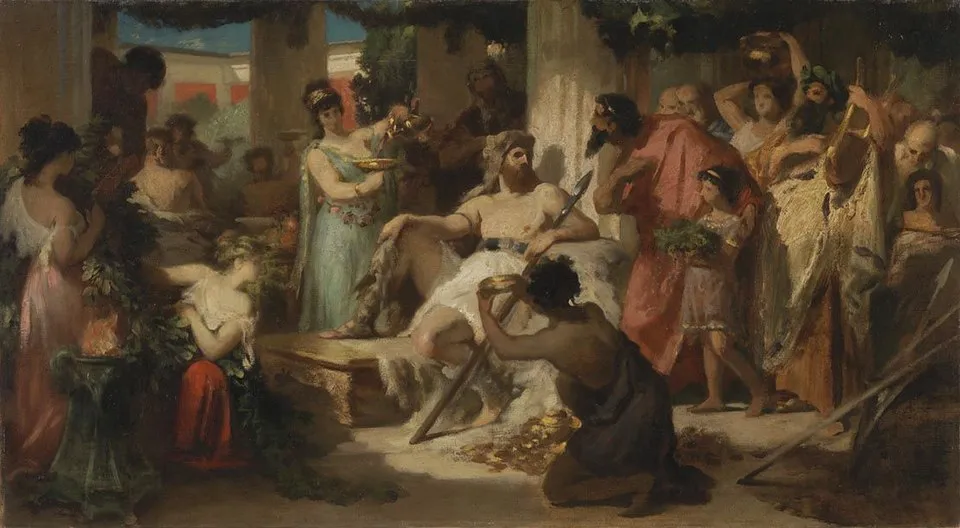
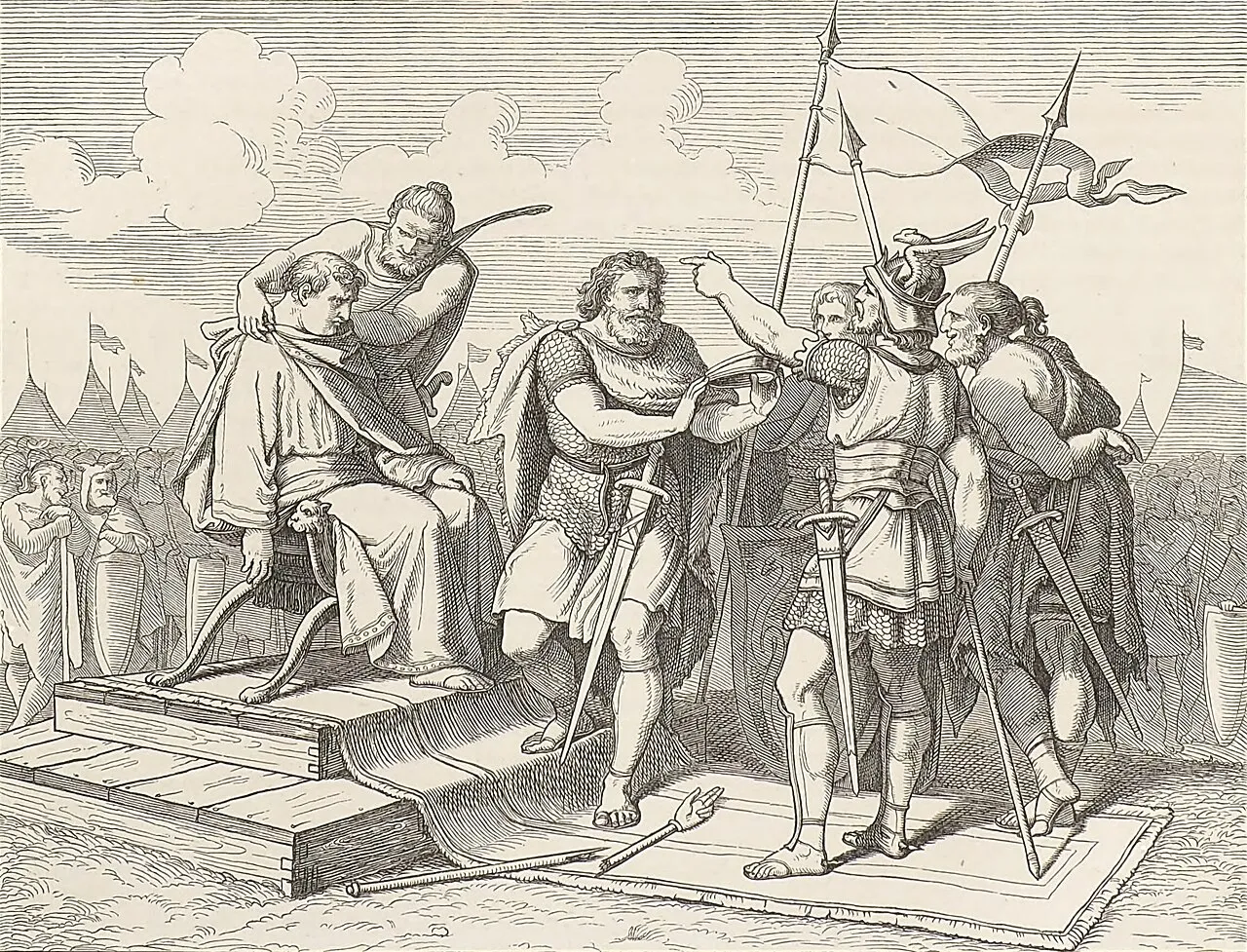
Quando Teodosio morì l' anno seguente, nel 395 d.C., l' Impero fu spartito fra i suoi due figli: il debole Arcadio in Oriente, il fanciullo Onorio in Occidente, nessuno dei due all' altezza del proprio nome. In quel vuoto di potere i Visigoti, riuniti in assemblea, innalzarono Alarico sullo scudo e lo acclamarono re. Aveva venticinque anni. Per la prima volta un popolo intero e un esercito agguerrito (già addestrato alla disciplina di Roma, ma fedele a lui soltanto) obbedivano a un' unica volontà .
When Theodosius died the following year, in 395 AD, the Empire was divided between his two sons: the weak Arcadius in the East, the boy Honorius in the West, neither equal to the name he bore. Into that vacuum of power the Visigoths, gathered in assembly, raised Alaric on the shield and acclaimed him king. He was twenty-five. For the first time an entire people and a hardened army (already schooled in the discipline of Rome, yet loyal to him alone) obeyed a single will.
Il flagello dell'Oriente
The scourge of the East
La prima mossa del nuovo re fu uno schiaffo calcolato all' Impero che lo aveva tradito. Fra il 395 e il 397 d.C. i Visigoti dilagarono nei Balcani e in Grecia: Macedonia, Tessaglia, Beozia, Attica. Atene si salvò pagando un tributo: Zosimo narra che Alarico, già pronto all' assalto, vide profilarsi armata sulle mura la dea Atena Parthenos accanto all' ombra di Achille, e per timore desisté . Eleusi, sede dei misteri più sacri del mondo antico, non ebbe la stessa sorte: fu data alle fiamme, e con essa si spense un culto vecchio di mille anni.
The new king' s first move was a calculated slap to the Empire that had betrayed him. Between 395 and 397 AD the Visigoths overran the Balkans and Greece: Macedonia, Thessaly, Boeotia, Attica. Athens was spared by paying tribute: Zosimus tells that Alaric, already poised to attack, saw the goddess Athena Parthenos standing armed upon the walls beside the shade of Achilles, and in fear held back. Eleusis, seat of the most sacred mysteries of the ancient world, met no such fate: it was given to the flames, and with it a cult a thousand years old was snuffed out.
Stilicone, il generale per metà vandalo che reggeva l' Occidente in nome di Onorio, gli mosse contro e lo intrappolò in Grecia, ma la corte di Costantinopoli, che temeva il proprio protettore più del nemico, gli ordinò di ritirarsi. Alarico non solo sopravvisse: ne uscì insignito del titolo di magister militum per Illyricum, governatore militare romano dell' Illirico. Era ormai due cose insieme, e nessuna fino in fondo: re dei Visigoti e funzionario dell' Impero. In quella doppia natura è già scritta tutta la sua tragedia.
Stilicho, the half-Vandal general who governed the West in Honorius' s name, marched against him and trapped him in Greece, but the court of Constantinople, fearing its own protector more than the enemy, ordered him to withdraw. Alaric not only survived: he emerged invested with the title of magister militum per Illyricum, Roman military governor of Illyricum. He was now two things at once, and neither wholly: king of the Visigoths and officer of the Empire. In that double nature his whole tragedy is already written.
Alle porte d'Italia
At the gates of Italy
Nel 401 d.C. Alarico varsò le Alpi Giulie e calò per la prima volta sull' Italia. Puntò su Mediolanum per sorprendervi Onorio, ma la corte fuggì a Ravenna, inespugnabile dietro le sue paludi. Stilicone richiamò in fretta le guarnigioni dal Reno e dal Danubio, una mossa che cinque anni dopo, sguarnito il confine, avrebbe spalancato la Gallia alle invasioni del 406, e affrontò Alarico a Pollenzo, il giorno di Pasqua del 402 d.C. Gli annali parlano di vittoria romana: l' accampamento goto espugnato, la stessa moglie del re fatta prigioniera. L' anno seguente, a Verona, Alarico fu battuto una seconda volta.
In 401 AD Alaric crossed the Julian Alps and came down upon Italy for the first time. He struck at Mediolanum to surprise Honorius there, but the court fled to Ravenna, impregnable behind its marshes. Stilicho hastily recalled the garrisons from the Rhine and the Danube, a move that five years later, the frontier stripped bare, would throw Gaul open to the invasions of 406, and faced Alaric at Pollentia on Easter Day 402 AD. The annals speak of a Roman victory: the Gothic camp stormed, the king' s own wife taken captive. The following year, at Verona, Alaric was beaten a second time.
Eppure Stilicone non lo distrusse quando avrebbe potuto. Anzi, cominciò a vedere nel re visigoto uno strumento prezioso: un esercito già pronto, da impiegare per strappare l' Illirico all' Oriente. Nacque così , fra i due uomini, una diplomazia inquieta e ambigua, intessuta di trattati e sospetti, che li avrebbe legati per sei anni, finché un colpo di scure a Ravenna non avrebbe spezzato quell' equilibrio, scatenando la catastrofe.
Yet Stilicho did not destroy him when he could have. On the contrary, he began to see in the Visigothic king a precious instrument: an army already at hand, to be used to wrest Illyricum from the East. So was born, between the two men, an uneasy and ambiguous diplomacy, woven of treaties and suspicion, that would bind them for six years, until an axe-stroke at Ravenna shattered that balance and unleashed the catastrophe.
La fame e l'oro: il primo assedio
Hunger and gold: the first siege
La svolta venne il 22 agosto 408 d.C. Su istigazione del ciambellano Olimpio, Onorio fece arrestare e decapitare Stilicone a Ravenna. In un solo giorno l' Occidente perse il suo ultimo generale capace. E ci fu di peggio: nelle città imperiali esplosero pogrom contro i barbari, e le famiglie dei soldati federati furono massacrate a migliaia. I superstiti, trentamila guerrieri inferociti, disertarono in massa e corsero da Alarico. Il suo esercito raddoppiò di colpo. Privato dell' unico interlocutore romano e del titolo di magister militum che da sempre inseguiva, il re marciò sull' Italia.
The turning point came on 22 August 408 AD. At the chamberlain Olympius' s instigation, Honorius had Stilicho arrested and beheaded at Ravenna. In a single day the West lost its last capable general. And worse followed: in the imperial cities pogroms erupted against the barbarians, and the families of the federate soldiers were slaughtered by the thousand. The survivors, thirty thousand enraged warriors, deserted en masse and ran to Alaric. His army doubled overnight. Stripped of his one Roman interlocutor and of the magister militum title he had always pursued, the king marched on Italy.
Nell' autunno del 408 i Visigoti serrarono Roma in un assedio di ferro. La città non era più capitale da oltre un secolo, lo era Ravenna, ma restava il cuore simbolico del mondo e la più grande concentrazione di ricchezza sulla terra. La fame fece il suo lavoro: si sussurrò perfino di cannibalismo fra le insulae affollate. Piegato, il Senato trattò . Il prezzo della salvezza fu vertiginoso: cinquemila libbre d' oro, trentamila d' argento, quattromila tuniche di seta, tremila pelli tinte di scarlatto, tremila libbre di pepe. Per racimolare tanto oro si fuse persino la statua aurea della Virtus, il Valore. Con la dea, osservarono i cronisti, si era fuso anche il valore di Roma.
In the autumn of 408 the Visigoths locked Rome in an iron siege. The city had not been the capital for over a century, Ravenna was, yet it remained the symbolic heart of the world and the greatest concentration of wealth on earth. Hunger did its work: there were even whispers of cannibalism in the crowded tenements. Broken, the Senate negotiated. The price of survival was staggering: five thousand pounds of gold, thirty thousand of silver, four thousand silk tunics, three thousand scarlet-dyed hides, three thousand pounds of pepper. To gather so much gold, even the golden statue of Virtus, Valour, was melted down. With the goddess, the chroniclers observed, the valour of Rome had been melted away as well.
« Quanto più fitta cresce l' erba, tanto più agevole è falciarla. » « The thicker the grass grows, the easier it is to scythe. » Alarico agli ambasciatori romani durante il primo assedio (Zosimo, Storia nuova, VAlaric to the Roman envoys during the first siege) Zosimus, New History, V
Un imperatore di paglia
An emperor of straw
In verità Alarico non voleva la rovina di Roma: voleva un posto dentro l' Impero. Chiedeva grano, terre per il suo popolo nelle province danubiane di Pannonia e Norico, e per sé il titolo di magister militum praesentalis, il comando supremo. Ma Onorio, al sicuro fra le paludi di Ravenna, rifiutò ogni trattativa con un' ostinazione quasi sonnambula. Allora, alla fine del 409 d.C., il re cambiò arma e passò alla guerra politica.
In truth Alaric did not want Rome' s ruin: he wanted a place within the Empire. He asked for grain, lands for his people in the Danubian provinces of Pannonia and Noricum, and for himself the title of magister militum praesentalis, the supreme command. But Honorius, safe among the marshes of Ravenna, refused all negotiation with an almost sleepwalking obstinacy. So, at the end of 409 AD, the king changed weapons and turned to political warfare.
Stringendo Roma in un secondo assedio, Alarico fece proclamare imperatore dal Senato il prefetto urbano Prisco Attalo, una marionetta senza eserciti, innalzata al solo scopo di costringere Onorio al riconoscimento. Ma il fantoccio prese sul serio la porpora: respinse i consigli del re e fallì nel riprendere l' Africa, da cui dipendeva il grano della capitale. Quando seimila soldati inviati dall' Oriente raggiunsero Ravenna, Onorio si sentì salvo. Disgustato, Alarico depose Attalo con le proprie mani, abbassandone la corona davanti alle mura. Aveva ormai compreso una verità amara: con quella corte, ogni trattativa era impossibile.
Tightening Rome in a second siege, Alaric had the Senate proclaim the urban prefect Priscus Attalus emperor, a puppet without armies, raised for the sole purpose of forcing Honorius into recognition. But the puppet took the purple seriously: he spurned the king' s counsel and failed to recover Africa, on which the capital' s grain depended. When six thousand soldiers sent from the East reached Ravenna, Honorius felt himself safe. In disgust, Alaric deposed Attalus with his own hands, lowering his crown before the walls. He had grasped at last a bitter truth: with that court, no negotiation was possible.
24 agosto 410: la Città eterna violata
24 August 410: the eternal city violated
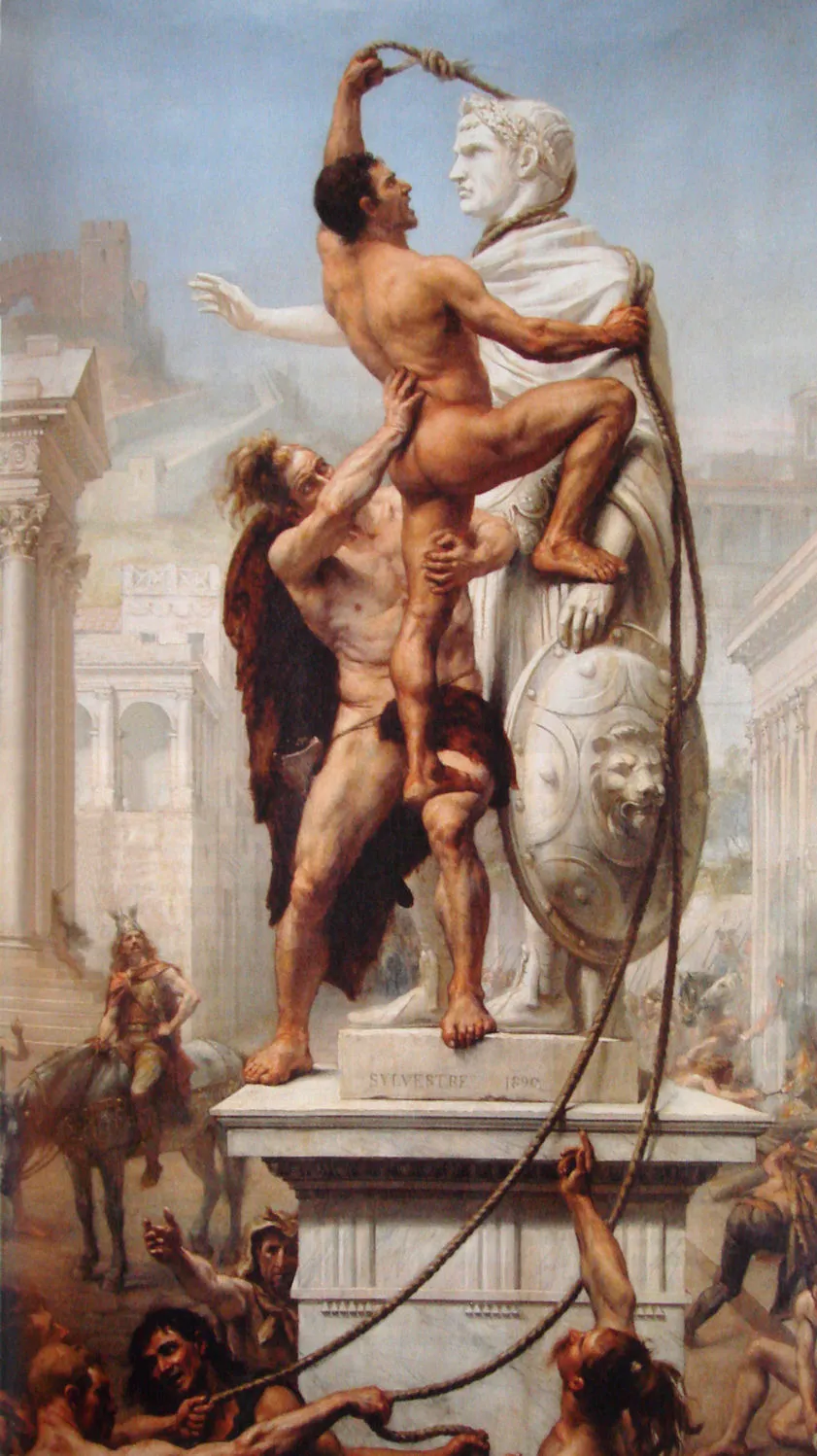
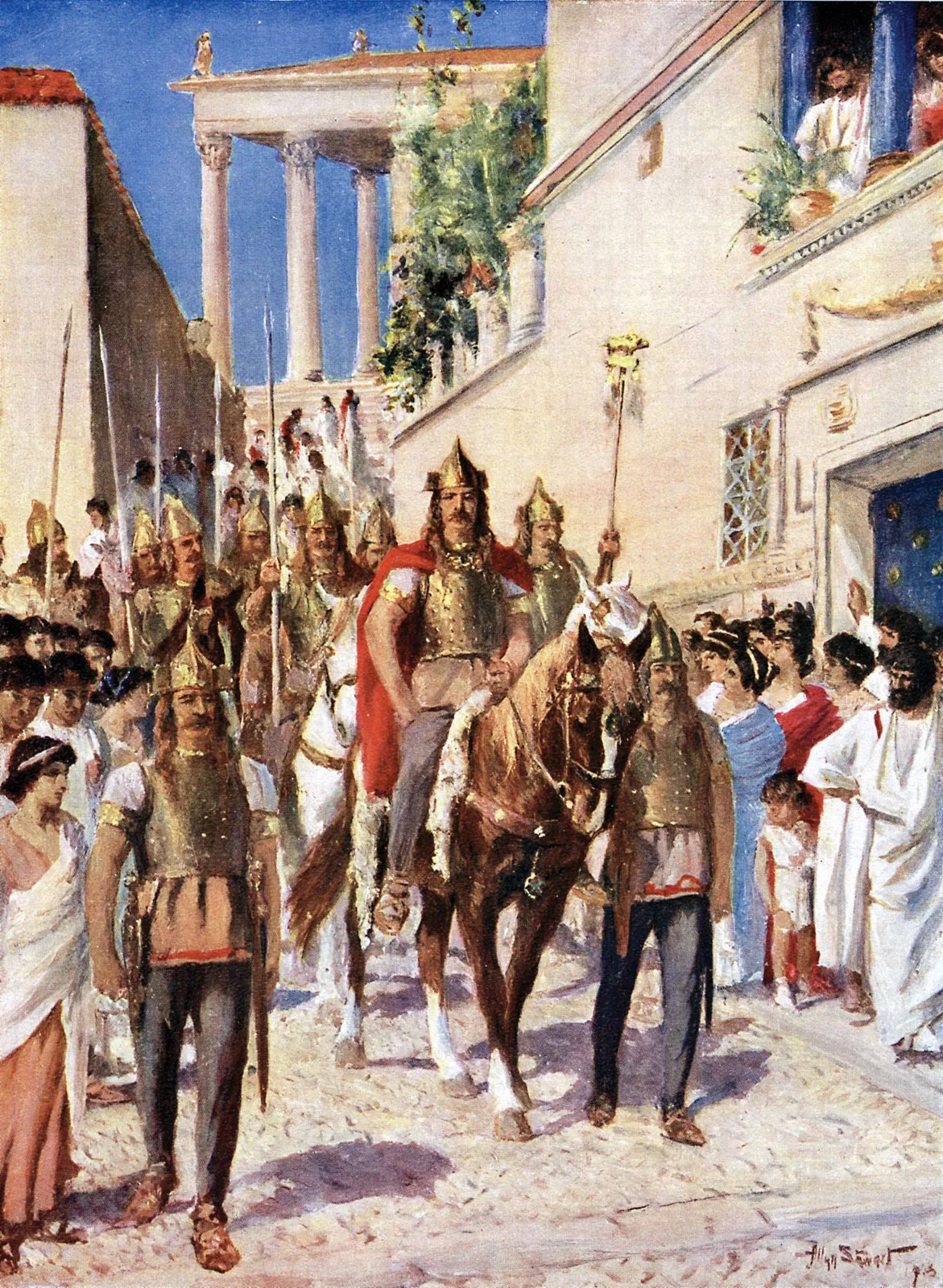
Venne dunque il terzo assedio, e con esso l' inconcepibile. Nella notte fra il 23 e il 24 agosto del 410 d.C. la Porta Salaria si spalancò dall' interno: per mano, secondo Procopio, della nobildonna cristiana Anicia Faltonia Proba, mossa a pietà per la fame del popolo; per il tradimento di schiavi goti infiltrati, secondo altre fonti. Al suono delle trombe gotiche i Visigoti irruppero nella città . Per tre giorni Roma fu saccheggiata.
Then came the third siege, and with it the inconceivable. On the night of 23–24 August 410 AD the Porta Salaria swung open from within: by the hand, according to Procopius, of the Christian noblewoman Anicia Faltonia Proba, moved by pity at the people' s hunger; by the treachery of infiltrated Gothic slaves, according to other sources. To the blast of Gothic trumpets the Visigoths burst into the city. For three days Rome was sacked.
Fu un saccheggio, non un massacro. Alarico, cristiano di fede ariana, ordinò di rispettare i luoghi sacri: le basiliche di San Pietro e San Paolo divennero asili inviolabili, e i suoi guerrieri vi scortarono in armi fuggiaschi e tesori sottratti al sacco. Ma tutto il resto fu spogliato: palazzi senatori, mausolei imperiali, templi degli antichi dè i, dimore private. Galla Placidia, sorella dell' imperatore, fu condotta via prigioniera: cinque anni dopo avrebbe sposato Ataulfo, successore di Alarico. Le vittime furono poche per gli standard di un sacco antico; ma il colpo inferto all' anima del mondo fu incommensurabile. Per la prima volta in ottocento anni, dai Galli di Brenno, nel 390 a.C.: un nemico straniero camminava da padrone nel Foro. San Girolamo, nella sua cella di Betlemme, depose la penna: « è stata troncata la testa dell' Impero romano», scrisse, soffocato dai singhiozzi. In Africa, un vescovo di nome Agostino cominciò a scrivere La Città di Dio.
It was a sack, not a massacre. Alaric, a Christian of Arian faith, ordered the holy places respected: the basilicas of St. Peter and St. Paul became inviolable sanctuaries, and his warriors escorted into them, under arms, both fugitives and the treasures saved from the plunder. But all the rest was stripped bare: senatorial palaces, imperial mausoleums, temples of the old gods, private homes. Galla Placidia, the emperor' s sister, was led away captive: five years later she would marry Athaulf, Alaric' s successor. The dead were few by the standards of an ancient sack; but the blow struck to the soul of the world was beyond measure. For the first time in eight hundred years (since the Gauls of Brennus, in 390 BC) a foreign enemy walked as master through the Forum. St. Jerome, in his cell at Bethlehem, laid down his pen: « the head of the Roman Empire has been severed», he wrote, choked with sobs. In Africa, a bishop named Augustine began to write The City of God.
Il re e il fiume
The king and the river
Roma non fu la meta, ma una tappa. Alarico bramava l'Africa: il granaio dell' Impero, ricco e mai sfiorato dalla guerra. Marciò verso sud lungo la Calabria e radunò a Reggio una flotta per traghettare il suo popolo in Sicilia e di lì in Africa. Ma una tempesta improvvisa (vendetta divina, mormorarono i contemporanei) sfasciò le navi nello Stretto di Messina. Costretto a risalire la penisola, il re fu colto da una febbre violenta a Cosentia, l' odierna Cosenza. Vi morì prima della fine del 410 d.C., a circa quarant' anni: nello stesso anno del suo trionfo.
Rome was not the goal, but a stage. Alaric craved Africa: the granary of the Empire, rich and never touched by war. He marched south through Calabria and gathered a fleet at Rhegium to ferry his people into Sicily and thence to Africa. But a sudden storm (divine vengeance, murmured his contemporaries) smashed the ships in the Strait of Messina. Forced back up the peninsula, the king was struck by a violent fever at Cosentia, modern Cosenza. There he died before the end of 410 AD, around forty years old: in the very year of his triumph.
La sua sepoltura divenne leggenda. Secondo Giordane, i Visigoti costrinsero una schiera di prigionieri a deviare il corso del fiume Busento; nel letto messo a nudo scavarono una tomba e vi calarono il re con le sue armi e i tesori predati a Roma; poi riversarono di nuovo le acque sopra di lui e trucidarono gli schiavi, perché nessuna lingua potesse mai rivelare il luogo. Da sedici secoli il fiume custodisce il suo segreto: la tomba di Alarico non è mai stata ritrovata.
His burial became legend. According to Jordanes, the Visigoths forced a band of prisoners to divert the course of the river Busento; in the bared riverbed they dug a tomb and lowered the king into it with his arms and the treasures plundered from Rome; then they loosed the waters back over him and slew the slaves, so that no tongue could ever reveal the place. For sixteen centuries the river has kept its secret: the tomb of Alaric has never been found.
02Campagne e AssediCampaigns and Sieges
Quindici anni alle porte dell'Impero
Fifteen years at the gates of the Empire
La carriera di Alarico fu una lunga, ostinata pressione sul corpo morente dell' Impero: non la cavalcata di un conquistatore, ma l' assedio di un' intera generazione. Dai campi insanguinati del Frigido alle tre morse intorno a Roma, ogni tappa fu un passo verso l' unico obiettivo che inseguiva, un posto, per sé e per il suo popolo, dentro il mondo romano. La cronologia che segue ne ripercorre il cammino, dalla prima battaglia al fiume che ne avrebbe inghiottito la tomba.
Alaric' s career was one long, stubborn pressure on the dying body of the Empire: not a conqueror' s charge, but the siege of an entire generation. From the bloodied fields of the Frigidus to the three vices around Rome, every stage was a step toward the single goal he pursued: a place, for himself and his people, within the Roman world. The chronology that follows retraces that road, from his first battle to the river that would swallow his tomb.
- 394 d.C. Battaglia del Frigido — Alarico comanda i federati visigoti per Teodosio contro l' usurpatore Eugenio. Mandati in prima linea, i Visigoti perdono diecimila uomini, metà del contingente. Lo scontro lo convince che Roma sacrifica i barbari come carne da cannone. Battle of the Frigidus — Alaric commands the Visigothic federates for Theodosius against the usurper Eugenius. Sent into the front line, the Visigoths lose ten thousand men, half the contingent. The clash convinces him that Rome sacrifices the barbarians as cannon fodder.
- 395 d.C. Elezione a re — Alla morte di Teodosio, l' assemblea dei Visigoti lo eleva re. La carica unisce per la prima volta autorità politica e comando militare federato: è re visigoto e generale romano insieme. Election as king — On Theodosius' s death, the assembly of the Visigoths raises him to the kingship. The office unites for the first time political authority and federate military command: he is Visigothic king and Roman general at once.
- 395–397 d.C. Devastazione della Grecia — Macedonia, Tessaglia, Beozia. Atene paga tributo e si salva; Eleusi è rasa al suolo, fine dei misteri. Stilicone interviene ma e richiamato dalla corte di Costantinopoli. Alarico ottiene il titolo di magister militum per Illyricum. Devastation of Greece — Macedonia, Thessaly, Boeotia. Athens pays tribute and is spared; Eleusis is razed, end of the mysteries. Stilicho intervenes but is recalled by the Constantinople court. Alaric obtains the title of magister militum per Illyricum.
- 401–402 d.C. Prima invasione d' Italia — Alarico attraversa le Alpi Giulie. Mira a Mediolanum, dove c' è Onorio. La corte fugge a Ravenna. Stilicone richiama legioni dal Reno per affrontarlo: errore strategico che cinque anni dopo costerà la Gallia. First invasion of Italy — Alaric crosses the Julian Alps. He aims at Mediolanum, where Honorius is. The court flees to Ravenna. Stilicho recalls legions from the Rhine to face him: a strategic error that five years later will cost Gaul.
- 6 apr. 402 d.C. Battaglia di Pollenzo — Domenica di Pasqua. Stilicone attacca Alarico mentre i Visigoti, cristiani, celebrano la festa. L' accampamento goto è travolto, la moglie di Alarico catturata. Il re visigoto si ritira ma il suo esercito non è annientato. Battle of Pollentia — Easter Sunday. Stilicho attacks Alaric while the Visigoths, Christians, celebrate the feast. The Gothic camp is overrun, Alaric' s wife captured. The Visigothic king withdraws but his army is not annihilated.
- 403 d.C. Battaglia di Verona — Stilicone lo intercetta una seconda volta e lo sconfigge. Alarico evacua l' Italia. Comincia un periodo di ambigua collaborazione: Stilicone vuole usarlo per riprendere l' Illirico all' Oriente. Battle of Verona — Stilicho intercepts him a second time and defeats him. Alaric evacuates Italy. A period of ambiguous collaboration begins: Stilicho wants to use him to retake Illyricum from the East.
- 22 ago. 408 d.C. Esecuzione di Stilicone — Onorio fa giustiziare Stilicone a Ravenna. Pogrom anti-barbari nei territori imperiali: migliaia di soldati federati con le famiglie disertano per Alarico. Il suo esercito raddoppia. Execution of Stilicho — Honorius has Stilicho executed at Ravenna. Anti-barbarian pogroms across imperial territory: thousands of federate soldiers with families desert to Alaric. His army doubles.
- aut. 408 d.C. Primo assedio di Roma — La fame piega il Senato. Riscatto: 5000 lb d' oro, 30000 d' argento, 4000 tuniche di seta, 3000 pelli scarlatte, 3000 lb di pepe. Per pagare, fusa la statua aurea della Virtus. Onorio, a Ravenna, rifiuta ogni accordo politico. First siege of Rome — Hunger bends the Senate. Ransom: 5000 lb gold, 30000 silver, 4000 silk tunics, 3000 scarlet hides, 3000 lb pepper. To pay, the golden statue of Virtus is melted. Honorius, at Ravenna, refuses any political agreement.
- 409 d.C. Secondo assedio e Prisco Attalo — Alarico proclama imperatore il prefetto urbano Prisco Attalo, fantoccio per costringere Onorio a trattare. La manovra fallisce: l' arrivo di 6000 uomini dall' Oriente salva Onorio. Attalo è deposto. Roma resta nel mezzo. Second siege and Priscus Attalus — Alaric proclaims the urban prefect Priscus Attalus emperor, a puppet to force Honorius to negotiate. The manoeuvre fails: the arrival of 6000 men from the East saves Honorius. Attalus is deposed. Rome is left in the middle.
- 24 ago. 410 d.C. Sacco di Roma — Notte fra 23 e 24 agosto, Porta Salaria aperta dall' interno. Tre giorni di saccheggio. Risparmiate San Pietro e San Paolo, basiliche-rifugio. Galla Placidia, sorella dell' imperatore, presa prigioniera. Per la prima volta in 800 anni, dal sacco gallico di Brenno, Roma cade in mani straniere. Sack of Rome — Night of 23–24 August, Porta Salaria opened from inside. Three days of plunder. St. Peter' s and St. Paul' s spared as refuge basilicas. Galla Placidia, the emperor' s sister, taken prisoner. For the first time in 800 years, since Brennus' s Gallic sack, Rome falls into foreign hands.
- fine 410 d.C. Marcia verso l' Africa e morte — Alarico marcia verso sud per traghettare in Africa, granaio dell' Impero. Una tempesta a Reggio distrugge la flotta. Tornando indietro, è colpito da febbre a Cosentia. Muore. Sepolto nel letto del fiume Busento, deviato dagli schiavi poi uccisi: la tomba è perduta. March towards Africa and death — Alaric marches south to ferry into Africa, the granary of the Empire. A storm at Rhegium destroys the fleet. Turning back, he is struck by fever at Cosentia. He dies. Buried in the bed of the Busento, diverted by slaves then killed: the tomb is lost.
03Strategia e PoliticaStrategy and Politics
Non un ribelle, ma un candidato
Not a rebel, but a candidate
Alarico non fu né un Vercingetorige né un Arminio: non sognò mai di sterminare i Romani, né di ricacciarli oltre un confine. Voleva l' esatto contrario: entrare nell' Impero. Per quindici anni la sua strategia ebbe un solo asse: trasformare i Visigoti da popolo in fuga in nazione stanziata, con terre proprie e un comando militare riconosciuto da Roma. Il titolo di magister militum fu l' ossessione della sua vita: significava rango, paga regolare, legittimità . Non era la rivolta di un nemico: era la candidatura di chi voleva, a ogni costo, essere ammesso.
Alaric was neither a Vercingetorix nor an Arminius: he never dreamed of exterminating the Romans, nor of driving them beyond some border. He wanted the exact opposite: to enter the Empire. For fifteen years his strategy had a single axis: to turn the Visigoths from a people in flight into a settled nation, with lands of their own and a military command recognised by Rome. The title of magister militum was the obsession of his life: it meant rank, regular pay, legitimacy. It was not the revolt of an enemy: it was the candidacy of a man who wanted, at any cost, to be admitted.
La guerra del logoramento
The war of attrition
Sul piano militare fu un comandante prudente più che geniale. Non vinse battaglie campali decisive: a Pollenzo e a Verona fu sconfitto, e nelle altre occasioni evitò con metodo lo scontro frontale con gli eserciti regolari. Sapeva che la fanteria visigota, per quanto temibile, non poteva spezzare le legioni in campo aperto se ben guidate. La sua vera arma era un' altra: la pressione implacabile sul tessuto civile dell' Impero. Marciare lento, devastare le campagne, affamare le città , stringere il cappio finché il nemico non fosse costretto a trattare. Tre assedi di Roma in due anni, senza mai concedere a Onorio la battaglia decisiva che avrebbe potuto rovesciare tutto: una guerra di logoramento applicata, con fredda lucidità , al cuore simbolico del mondo romano.
Militarily he was a cautious commander rather than a brilliant one. He won no decisive pitched battles: at Pollentia and Verona he was beaten, and on other occasions he methodically avoided frontal clashes with the regular armies. He knew that Visigothic infantry, however fearsome, could not break the legions in open field if well led. His true weapon was another: relentless pressure on the civil fabric of the Empire. March slowly, ravage the countryside, starve the cities, tighten the noose until the enemy was forced to negotiate. Three sieges of Rome in two years, never granting Honorius the decisive battle that might have overturned everything: a war of attrition applied, with cold clarity, to the symbolic heart of the Roman world.
Il sacco come sconfitta
The sack as defeat
Il sacco di Roma non fu il suo trionfo strategico, ma la prova del suo fallimento politico. Per due anni aveva teso la mano; per due anni Onorio, trincerato a Ravenna fra le paludi, gliel' aveva respinta. Nel 410, allo stremo, Alarico prese con la forza ciò che gli era stato negato con la ragione. Tre giorni dopo lasciò la città : non la occupò , non si proclamò imperatore, non sciolse il Senato. Riprese la marcia verso l' Africa, in cerca di grano. Fu un saccheggio di sopravvivenza, non di conquista. Eppure il suo peso simbolico fu incalcolabile: rivelò al Mediterraneo intero che la legittimità dell' Impero d' Occidente era ormai una finzione, e che dietro le sue mura non esisteva più alcuna difesa.
The sack of Rome was not his strategic triumph, but the proof of his political failure. For two years he had held out his hand; for two years Honorius, entrenched at Ravenna among the marshes, had struck it away. In 410, at the end of his strength, Alaric took by force what had been denied him by reason. Three days later he left the city: he did not occupy it, did not proclaim himself emperor, did not dissolve the Senate. He resumed his march toward Africa, in search of grain. It was a sack of survival, not of conquest. And yet its symbolic weight was incalculable: it revealed to the whole Mediterranean that the legitimacy of the Western Empire was now a fiction, and that behind its walls no defence remained.
« In una sola Città è perito il mondo intero. » « In one single City the whole world has perished. » San Girolamo, alla notizia del sacco di Roma, Lettera CXXVII a PrincipiaSt. Jerome, on hearing of the sack of Rome, Letter 127 to Principia
04EreditaLegacy
Il regno che Alarico non vide
The kingdom Alaric never saw
La morte di Alarico non fermò i Visigoti. Il successore Ataulfo sposò a Narbona la prigioniera Galla Placidia, in un matrimonio che fu insieme oltraggio e disegno politico: il barbaro che entra nella casa imperiale per legittimarsi. Nei due decenni seguenti il popolo di Alarico ottenne finalmente ciò che il suo re aveva chiesto invano: terre stabili. Stanziati come foederati nell' Aquitania, nel sud-ovest della Gallia, i Visigoti vi edificarono il primo regno romano-barbarico riconosciuto, che presto si estese alla penisola iberica. Il regno visigoto di Tolosa, e poi di Toledo, sarebbe durato fino al 711 d.C., quando gli eserciti musulmani lo travolsero a Guadalete. L' intuizione di Alarico, che il futuro apparteneva a chi sapeva farsi spazio dentro Roma, gli sopravvisse di tre secoli.
Alaric' s death did not stop the Visigoths. His successor Athaulf married the captive Galla Placidia at Narbonne, in a marriage that was both outrage and political design: the barbarian entering the imperial house to legitimise himself. In the two decades that followed, Alaric' s people at last obtained what their king had asked for in vain: stable lands. Settled as foederati in Aquitaine, in south-western Gaul, the Visigoths built there the first recognised Romano-barbarian kingdom, which soon spread into the Iberian peninsula. The Visigothic kingdom of Toulouse, and later of Toledo, would last until 711 AD, when the Muslim armies overran it at Guadalete. Alaric' s insight, that the future belonged to those who could make a place for themselves inside Rome, outlived him by three centuries.
La fine del mondo antico
The end of the ancient world
L' eco del 410 fu universale, e prima di tutto spirituale. Per i pagani superstiti la caduta era la prova che gli antichi dè i, abbandonati per il Cristo, si vendicavano; per i cristiani fu uno smarrimento improvviso. La risposta andò ben oltre la cronaca: Sant' Agostino, dalla sua Africa, scrisse fra il 413 e il 426 il De Civitate Dei, « La Città di Dio» . Vi distinse la città eterna di Dio dalla città mortale degli uomini, Roma compresa, e mise per sempre la fede cristiana al riparo dalla rovina di qualsiasi impero. Fu uno dei maggiori spostamenti del pensiero occidentale, nato dalle ceneri di un saccheggio di tre giorni. Non a caso molti storici fissano nel 410 la fine simbolica del mondo antico, benché l' Impero d' Occidente dovesse formalmente sopravvivere fino al 476.
The echo of 410 was universal, and above all spiritual. For the surviving pagans the fall was proof that the ancient gods, forsaken for Christ, were taking their revenge; for the Christians it was a sudden bewilderment. The answer went far beyond chronicle: St. Augustine, from his Africa, wrote between 413 and 426 the De Civitate Dei, « The City of God» . In it he distinguished the eternal city of God from the mortal city of men, Rome included, and sheltered the Christian faith forever from the ruin of any empire. It was one of the great shifts of Western thought, born from the ashes of a three-day sack. It is no accident that many historians fix in 410 the symbolic end of the ancient world, though the Western Empire would formally survive until 476.
L'enigma del Busento
The enigma of the Busento
La leggenda della tomba nel fiume ha attraversato i secoli senza spegnersi. Nel 1820 il poeta tedesco August von Platen le dedicò l' ode Das Grab im Busento, « La tomba nel Busento» , che generazioni di studenti hanno imparato a memoria: i guerrieri goti che deviano il fiume nella notte, calano il re fra i tesori, richiudono le acque, e cantano il suo nome perché il Busento lo ripeta in eterno. Il fiume scorre ancora oggi attraverso Cosenza. Spedizioni archeologiche (nell' Ottocento, nel Novecento, e di recente nel 2015 con i georadar) hanno cercato il sepolcro: invano. Forse non esiste, forse fu spostato, forse Giordane romanzò una sepoltura assai più prosaica. Resta uno degli enigmi archeologici più seducenti d' Europa.
The legend of the tomb in the river has crossed the centuries without fading. In 1820 the German poet August von Platen dedicated to it the ode Das Grab im Busento, « The Tomb in the Busento» , which generations of schoolchildren have learned by heart: the Gothic warriors diverting the river by night, lowering the king among the treasures, closing the waters again, and singing his name so that the Busento might repeat it forever. The river still flows today through Cosenza. Archaeological expeditions (in the nineteenth century, the twentieth, and recently in 2015 with ground radar) have sought the sepulchre: in vain. Perhaps it does not exist, perhaps it was moved, perhaps Jordanes romanticised a far more prosaic burial. It remains one of the most seductive archaeological enigmas in Europe.
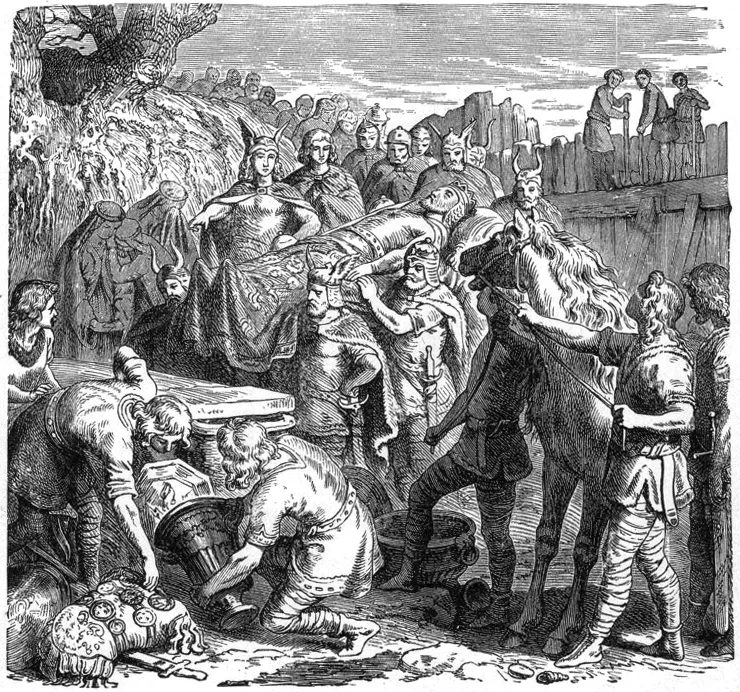
« Nella notte, presso Cosenza, sussurrano cupi canti sul Busento; e dalle acque, in un vortice, risuona la risposta. » « By night near Cosenza muffled songs whisper on the Busento; and from the waters, in an eddy, the answer sounds again. » August von Platen, Das Grab im Busento (1820)August von Platen, The Tomb in the Busento (1820)
Il giudizio della storia
The verdict of history
Il giudizio storico moderno restituisce ad Alarico una fisionomia complessa. Non fu il distruttore di Roma che la leggenda nera ne ha fatto: fu un' ambizione barbarica respinta, ostinatamente, dalla legalità imperiale. Tre volte chiese terre e un titolo; tre volte gli furono negati; e solo al terzo rifiuto stese la mano sulla città . Accanto ai grandi nemici dell' antichità romana (Annibale, Vercingetorige, Arminio) Alarico segna una soglia nuova: non più il barbaro che assale l' Impero da fuori, ma quello che vive già al suo interno, ne indossa le insegne, ne parla la lingua, e chiede soltanto di esserne parte. Quando Roma gliela negò , divenne, suo malgrado, il becchino del mondo che aveva sognato di abitare.
Modern historical judgement gives Alaric a complex face. He was not the destroyer of Rome that the dark legend made of him: he was a barbarian ambition refused, stubbornly, by imperial legality. Three times he asked for lands and a title; three times he was denied; and only at the third refusal did he lay his hand on the city. Beside the great enemies of Roman antiquity (Hannibal, Vercingetorix, Arminius) Alaric marks a new threshold: no longer the barbarian who assails the Empire from outside, but the one who already lives within it, wears its insignia, speaks its tongue, and asks only to belong. When Rome refused him, he became, despite himself, the gravedigger of the world he had dreamed of inhabiting.