
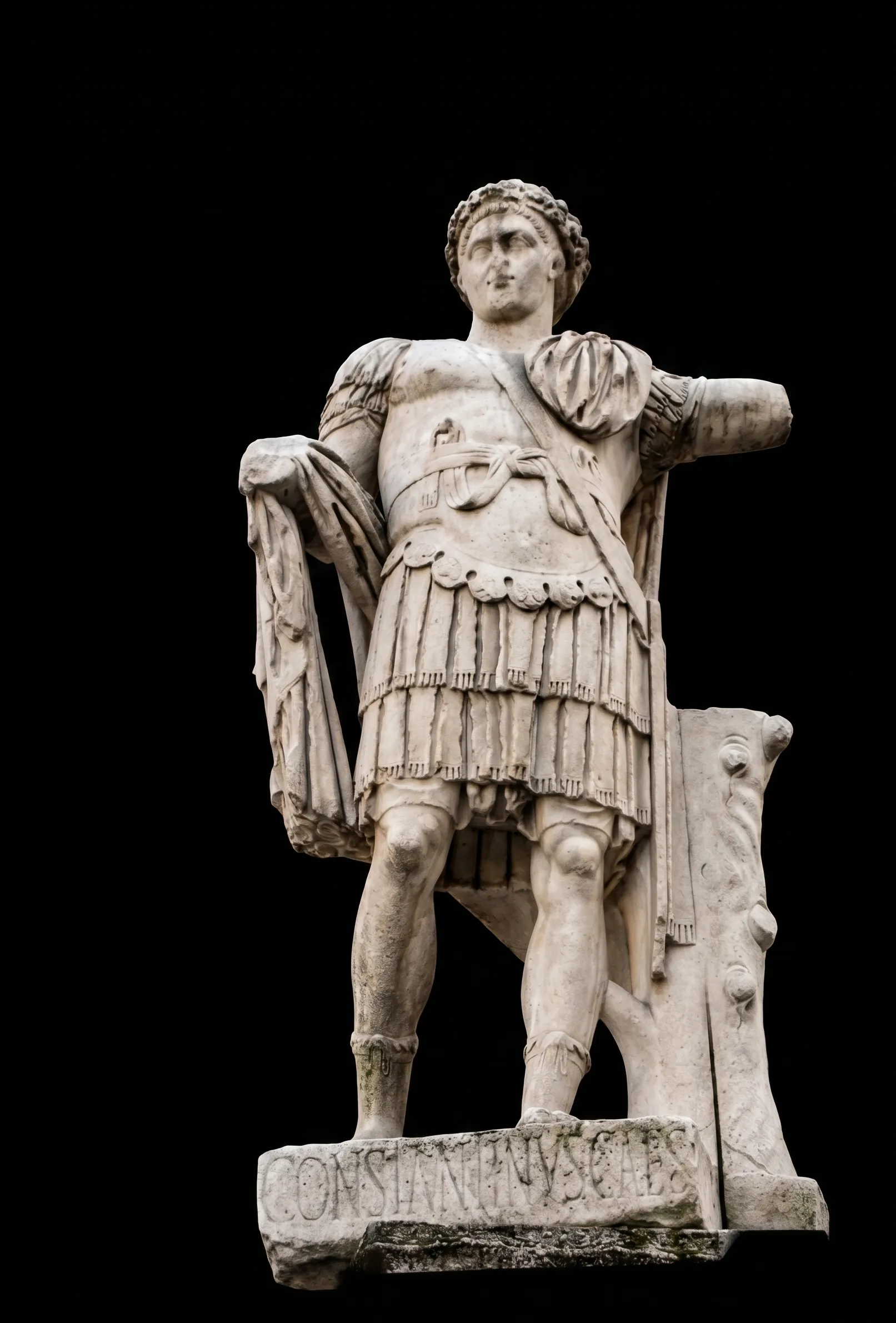
01BiografiaBiography
Nato in porpora ad Arelate (316–317)
Born in the purple at Arelate (316–317)
Flavio Claudio Costantino nacque nel 316 d.C. ad Arelate (l'odierna Arles, in Provenza), dove suo padre Costantino il Grande aveva da poco stabilito una corte imperiale. La data tradizionale è il 7 agosto, sebbene fonti tarde riportino anche il febbraio. La madre era Fausta, figlia di Massimiano Augusto e seconda moglie di Costantino: una donna ventiquattrenne educata nel più alto ambiente politico dell'Impero. Il neonato non era il primogenito assoluto del padre (quel ruolo apparteneva al fratellastro Crispo, figlio della prima moglie Minervina) ma era il primo dei figli legittimi di Fausta, e dunque destinato per nascita alla successione.
Flavius Claudius Constantinus was born in 316 AD at Arelate (today's Arles, in Provence), where his father Constantine the Great had recently established an imperial court. The traditional date is 7 August, though late sources also give February. His mother was Fausta, daughter of Augustus Maximian and Constantine's second wife: a twenty-four-year-old woman raised in the highest political milieu of the Empire. The newborn was not his father's absolute firstborn (that role belonged to his half-brother Crispus, son of the first wife Minervina) but he was the first of Fausta's legitimate children, and therefore by birth destined for succession.
A soli sette mesi, il 1 marzo 317, fu nominato Caesar nell'accordo di Serdica tra Costantino e Licinio, insieme al fratellastro Crispo (poco più che ventenne) e al cugino Liciniano (figlio di Licinio). Non era una designazione simbolica: gli Augusti del IV secolo stabilizzavano la successione nominando Cesari fin dall'infanzia, per evitare le crisi che avevano massacrato il III secolo. Costantino II era dunque ufficialmente nobilissimus Caesar prima ancora di camminare. Cresceva nella corte di Augusta Treverorum (Treviri), capitale militare della Gallia, sotto l'occhio di precettori scelti tra i letterati cristiani: l'oratore Aemilio Probo, secondo alcune fonti, e il retore Lattanzio (lo stesso testimone della visione paterna).
At only seven months old, on 1 March 317, he was named Caesar in the Serdica agreement between Constantine and Licinius, alongside half-brother Crispus (just over twenty) and cousin Licinianus (Licinius's son). It was not a symbolic appointment: the Augusti of the 4th century stabilised succession by appointing Caesars from infancy to avoid the crises that had ravaged the 3rd century. Constantine II was thus officially nobilissimus Caesar before he could walk. He grew up in the court of Augusta Treverorum (Trier), the military capital of Gaul, under tutors chosen from Christian men of letters: the orator Aemilius Probus, according to some sources, and the rhetor Lactantius (the very witness of his father's vision).
L'ombra di Crispo (317–326)
In Crispus's shadow (317–326)
Per i primi dieci anni della sua vita, Costantino II vide il proprio destino subordinato a quello del fratellastro maggiore. Crispo era il militare della famiglia: brillante, vincitore della battaglia navale dell'Ellesponto nel 324, designato dalla propaganda come il futuro Augusto. Costantino II, per quanto Cesare, era ancora un bambino. La situazione cambiò drammaticamente nel 326: in circostanze mai chiarite, Costantino I fece arrestare e giustiziare Crispo a Pola, e pochi mesi dopo fece uccidere Fausta soffocata nei vapori di un bagno. Le ipotesi storiche (intrigo, accusa di adulterio, lotta dinastica tra i figli di Minervina e quelli di Fausta) non sono state mai dirimente; la damnatio memoriae colpì entrambi i nomi.
For the first ten years of his life, Constantine II saw his own destiny subordinated to that of his elder half-brother. Crispus was the family's soldier: brilliant, victor of the naval battle of the Hellespont in 324, designated by propaganda as the future Augustus. Constantine II, Caesar though he was, was still a child. The situation changed dramatically in 326: in circumstances never fully clarified, Constantine I had Crispus arrested and executed at Pula, and a few months later had Fausta killed, suffocated in the steam of an overheated bath. The historical hypotheses (intrigue, accusation of adultery, dynastic struggle between Minervina's son and Fausta's) have never been resolved; the damnatio memoriae struck both names.
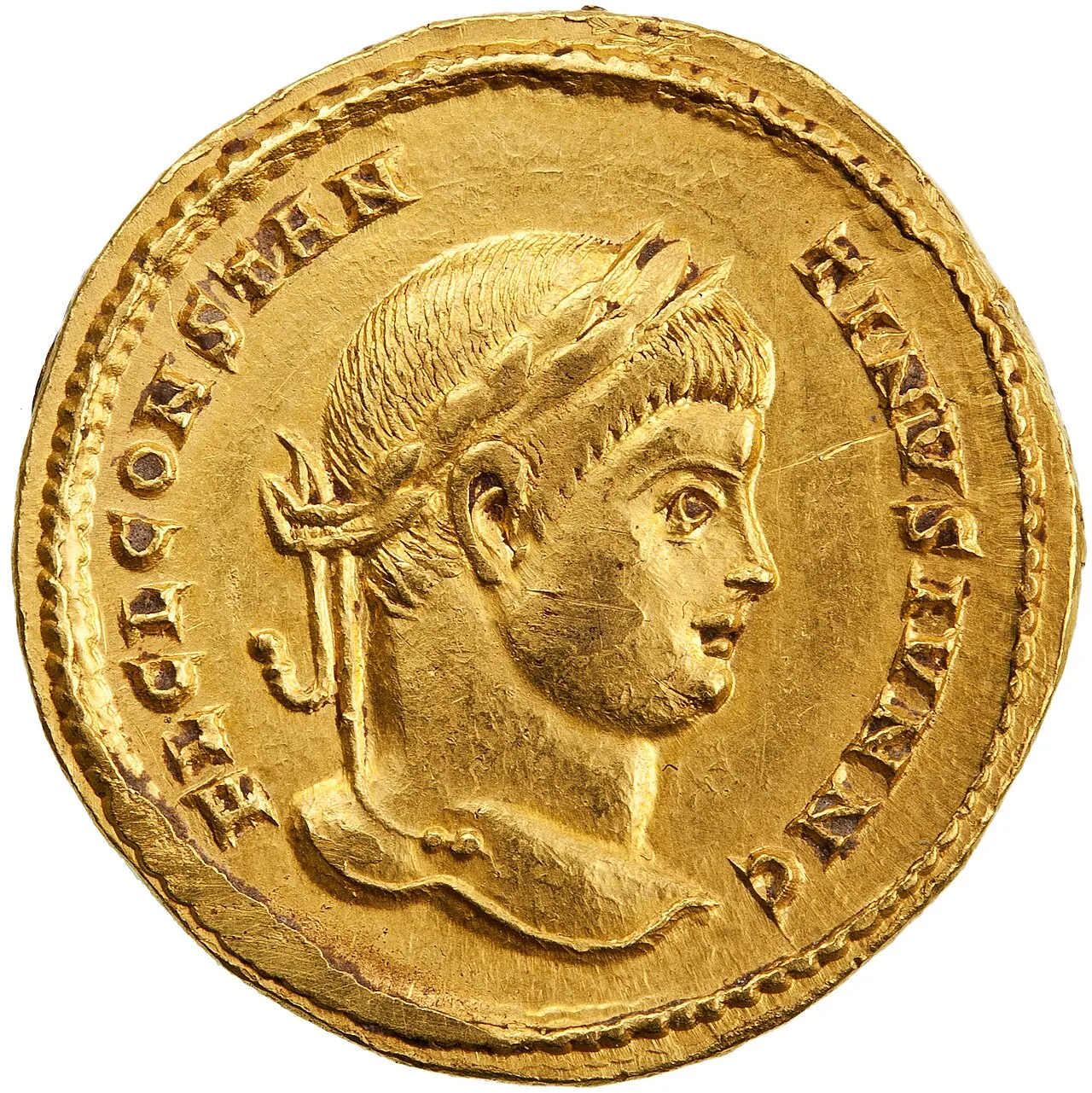
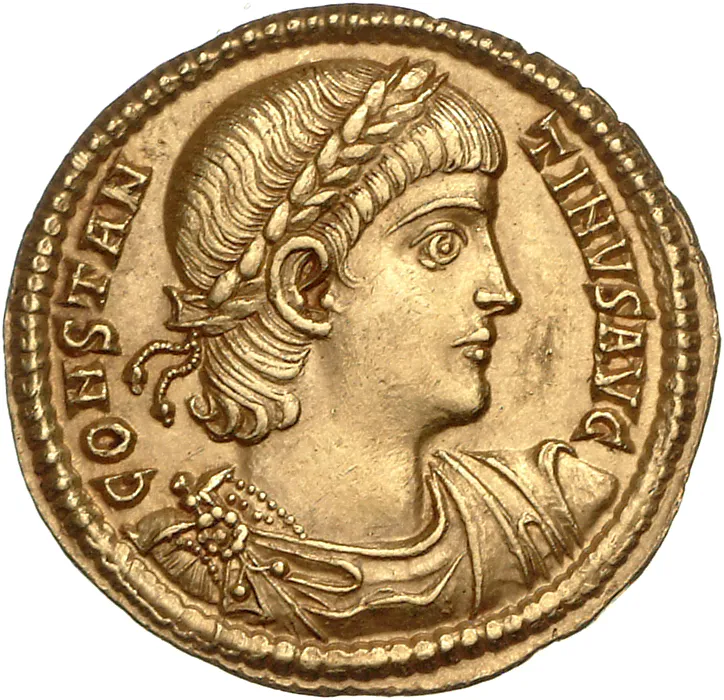
Per Costantino II, dieci anni e già Cesare, l'effetto fu inatteso: divenne in un attimo il primogenito superstite di Costantino. La sua immagine sostituì quella di Crispo nei rilievi ufficiali; le legende monetarie cominciarono a celebrarlo come DN CONSTANTINVS IVN NOB CAES, "Dominus Noster Costantino Iuniore, nobilissimo Cesare". Tuttavia la morte della madre, mai pronunciata in casa per il resto della vita, lo segnò in modi che le fonti non descrivono. Cresceva orfano di Fausta, lontano dal padre frequentemente impegnato altrove, allevato da governanti e precettori.
For ten-year-old Caesar Constantine II, the effect was unexpected: he became in an instant Constantine's surviving firstborn. His image replaced Crispus's on the official reliefs; coin legends began celebrating him as DN CONSTANTINVS IVN NOB CAES, "Our Lord Constantine the Younger, most noble Caesar." Yet his mother's death, never pronounced at home for the rest of his life, marked him in ways the sources do not describe. He grew up motherless, away from a father frequently engaged elsewhere, raised by stewards and tutors.
La giovinezza militare in Gallia (327–332)
The military youth in Gaul (327–332)
Dall'inizio dell'adolescenza Costantino II fu mandato sul fronte renano. Alla corte di Treviri esercitò formalmente la prefettura della Gallia, sotto la tutela di esperti generali, e accompagnò campagne minori contro Franchi e Alemanni. Le fonti registrano il suo titolo di Alamannicus Maximus dopo una vittoria del 328 d.C., e di Germanicus Maximus dopo un'altra del 331. Questi titoli onorifici, non sempre legati a guerre vere, erano lo strumento con cui la propaganda dinastica costruiva un'aura militare per un Cesare ancora ragazzino.
From early adolescence Constantine II was sent to the Rhine front. At the court of Trier he formally exercised the prefecture of Gaul, under the tutelage of experienced generals, and accompanied minor campaigns against Franks and Alamanni. Sources record his title of Alamannicus Maximus after a victory in 328 AD, and of Germanicus Maximus after another in 331. These honorific titles, not always tied to real wars, were the device through which dynastic propaganda built a military aura for a Caesar still a boy.
Nel 332, a sedici anni, sotto la supervisione paterna comandò ufficialmente la grande campagna contro i Goti Tervingi guidati da Ariarico. La vittoria fu schiacciante: centomila Goti caddero o si arresero, divenendo foederati al servizio di Roma. Il giovane Cesare fece il proprio ingresso vittorioso a Costantinopoli e ricevette il titolo di Gothicus Maximus. Era il primo vero successo militare a suo nome, anche se la strategia restava in mano agli ufficiali veterani del padre.
In 332, aged sixteen, under his father's supervision he officially commanded the great campaign against the Tervingi Goths led by Ariaric. The victory was crushing: one hundred thousand Goths fell or surrendered, becoming foederati in Rome's service. The young Caesar made his victorious entry into Constantinople and received the title Gothicus Maximus. It was his first real military success in his own name, though strategy still lay in the hands of his father's veteran officers.
Le Vicennalia e l'eredità del padre (335–337)
The Vicennalia and his father's legacy (335–337)
Nel 335, in occasione delle Vicennalia, i trent'anni di regno di Costantino I, il padre divise formalmente l'Impero tra i suoi eredi designati. A Costantino II, ventenne, andarono Britannia, Gallia, Hispania e Mauretania Tingitana (Marocco settentrionale): l'intero quarto nord-occidentale dell'Impero. Al fratello Costanzo II (diciottenne) l'Oriente con Costantinopoli; al più giovane Costante (quattordicenne) Italia, Africa proconsolare, Pannonia. Ai nipoti Dalmazio e Annibaliano sezioni minori dei Balcani e dell'Asia Minore. Era una tetrarchia familiare, tentativo di sintetizzare il modello dioclezianeo con l'ereditarietà dinastica. Non risultava chiaro chi fosse l'Augusto senior: forse volutamente, Costantino I aveva lasciato indeterminata la gerarchia.
In 335, on the occasion of the Vicennalia, Constantine I's thirty years of reign, his father formally divided the Empire among his designated heirs. Twenty-year-old Constantine II received Britain, Gaul, Spain and Mauretania Tingitana (northern Morocco): the entire north-western quarter of the Empire. His brother Constantius II (eighteen) got the East with Constantinople; the youngest Constans (fourteen) got Italy, proconsular Africa, Pannonia. Nephews Dalmatius and Hannibalianus got minor sections of the Balkans and Asia Minor. It was a family tetrarchy, an attempt to combine the Diocletianic model with dynastic inheritance. Who was senior Augustus was not clear: perhaps deliberately, Constantine I had left the hierarchy undefined.
Il 22 maggio 337, presso Nicomedia, Costantino I morì . La sua morte scatenò un'estate di sangue. Tra il maggio e l'estate del 337, l'esercito di Costantinopoli, ufficialmente di sua iniziativa, sostanzialmente con la regia di Costanzo II, allora il più vicino al cadavere imperiale, eliminò sistematicamente ogni discendente collaterale di Costanzo Cloro: i fratellastri di Costantino I (Dalmazio padre e Giulio Costanzo), tutti i nipoti maschi adulti (Dalmazio Cesare, Annibaliano re), e numerosi cugini. Sopravvissero solo due bambini ritenuti troppo giovani per essere pericolosi: Gallo (dodici anni) e Giuliano (cinque anni), l'ultimo sarebbe diventato decenni dopo Giuliano l'Apostata.
On 22 May 337, near Nicomedia, Constantine I died. His death unleashed a summer of blood. Between May and summer 337, the army at Constantinople, officially on its own initiative, in substance directed by Constantius II, then closest to the imperial corpse, systematically eliminated every collateral descendant of Constantius Chlorus: Constantine I's half-brothers (Dalmatius Senior and Julius Constantius), all adult male nephews (Dalmatius Caesar, Hannibalianus the King), and numerous cousins. Only two children deemed too young to be dangerous survived: Gallus (twelve) and Julian (five), the latter would become decades later Julian the Apostate.
Costantino II era in Gallia al momento della strage. Le fonti lo collocano fuori dalla scena del delitto, anche se il suo silenzio assenso pesa: nessuno dei tre fratelli sopravvissuti protestò . Il 9 settembre 337, dopo trattative tra i tre, si riunirono a Viminacium (nei pressi dell'odierna Belgrado) e furono proclamati Augusti uguali, abolendo ogni rango di Cesare. Costantino II, ventunenne, ricevette di nuovo Britannia, Gallia, Hispania; più il territorio che era stato di Dalmazio Cesare (Tracia e Macedonia) gli fu attribuito temporaneamente, ma fu poi spartito tra gli altri. Stabilì la propria corte a Treviri.
Constantine II was in Gaul at the time of the massacre. Sources place him off the scene, though his silent acquiescence weighs: none of the three surviving brothers protested. On 9 September 337, after negotiations among the three, they met at Viminacium (near today's Belgrade) and were proclaimed equal Augusti, abolishing every Caesar rank. Twenty-one-year-old Constantine II again received Britain, Gaul, Spain; plus the territory which had been Dalmatius Caesar's (Thrace and Macedonia), temporarily allotted to him, then divided among the others. He set up his court at Trier.
Augusto d'Occidente (337–339)
Augustus of the West (337–339)
Da Augusto, Costantino II inaugurò il regno con un gesto religioso significativo: richiamò dall'esilio Atanasio di Alessandria, il grande vescovo niceno che Costantino I aveva confinato a Treviri nel 335 per gli intrighi degli ariani. Atanasio era stato, di fatto, suo ospite per due anni; tra i due si era costruito un legame personale. Costantino II lo accompagnò solennemente verso Alessandria con una lettera ufficiale che ne giustificava il ritorno. Il gesto segnalava politicamente che il nuovo Augusto stava sul fronte niceno, in opposizione alla linea ariana di Costanzo II, e profilava una frattura teologica destinata a diventare politica.
As Augustus, Constantine II inaugurated his reign with a significant religious gesture: he recalled from exile Athanasius of Alexandria, the great Nicene bishop whom Constantine I had confined to Trier in 335 through the manoeuvres of the Arians. Athanasius had been, in fact, his guest for two years; a personal bond had built between them. Constantine II solemnly escorted him toward Alexandria with an official letter justifying his return. The gesture signalled politically that the new Augustus stood on the Nicene side, opposing the Arian line of Constantius II, and outlined a theological fracture set to become political.
Il primo problema concreto, tuttavia, fu il fratello più piccolo. Costante, sedicenne nel 337, aveva ricevuto Italia, Illirico, Africa: un impero gigantesco per un adolescente. Costantino II rivendicò un ruolo di tutela fraterna sul minore, presentandosi come senior Augustus in virtù dell'età e della primogenitura. Avanzò pretese su province specifiche: voleva l'Africa proconsolare (l'attuale Tunisia, il granaio di Roma) e forse parte dell'Italia settentrionale. Costante rifiutò . Per due anni i rapporti tra i due Augusti d'Occidente rimasero gelidi ma tecnicamente pacifici: monete e leggi continuavano a essere emanate in nome dei tre fratelli.
The first concrete problem, however, was the younger brother. Constans, sixteen in 337, had received Italy, Illyricum, Africa: a vast empire for a teenager. Constantine II claimed a role of fraternal guardianship over the youngest, presenting himself as senior Augustus by virtue of age and primogeniture. He pressed claims on specific provinces: he wanted proconsular Africa (today's Tunisia, Rome's granary) and possibly part of northern Italy. Constans refused. For two years relations between the two Western Augusti remained icy but technically peaceful: coins and laws continued to be issued in the names of the three brothers.
Negli stessi anni Costantino II difese il limes renano. Nel 338 condusse personalmente una piccola campagna contro gli Alemanni; in seguito visitò la Britannia, dove conferì la cittadinanza onoraria a uno dei suoi ufficiali. Erano operazioni di routine: la sua corte di Treviri funzionava efficientemente, il fisco gallico era stabile, la Chiesa locale gli era favorevole. La sua politica era essenzialmente di consolidamento, in attesa, gli storici ritengono, di un momento adatto per regolare i conti con il fratello.
In the same years Constantine II defended the Rhine limes. In 338 he personally led a small campaign against the Alamanni; he then visited Britain, where he granted honorary citizenship to one of his officers. These were routine operations: his Trier court worked efficiently, Gallic finance was stable, the local Church favourable to him. His policy was essentially one of consolidation, awaiting, historians believe, the right moment to settle accounts with his brother.
« Si comportò come il più anziano dei figli del divo Augusto suo padre, e cominciò a maltrattare il fratello minore Costante, e a esigere da lui parti delle sue terre.» « He acted as the eldest of the divine Augustus his father's sons, and began to mistreat his younger brother Constans, and to demand from him parts of his lands.» Zosimo, Storia nuova II, 41
L'invasione e l'imboscata di Aquileia (340)
The invasion and the Aquileia ambush (340)
Nella primavera del 340 Costantino II decise di forzare la mano. Approfittò dell'assenza di Costante, che si trovava in Dacia a combattere i Sarmati Liberi, per attraversare le Alpi con una colonna leggera di legioni galliche. Le fonti riportano numeri molto incerti: forse 20 000 uomini, forse meno. Marciò lungo la via Postumia verso il nord-est italiano, raggiungendo le pianure friulane. L'obiettivo dichiarato era forse "soccorrere" il fratello, in realtà impadronirsi delle province italiche con un fatto compiuto.
In the spring of 340 Constantine II decided to force the issue. He exploited Constans's absence, who was in Dacia fighting the Free Sarmatians, to cross the Alps with a light column of Gallic legions. Sources report very uncertain figures: perhaps 20,000 men, perhaps fewer. He marched along the Via Postumia toward north-eastern Italy, reaching the Friulan plains. The declared aim was perhaps to "relieve" his brother, in reality to seize the Italian provinces by fait accompli.
Costante, informato per via diplomatica, rispose con sangue freddo notevole per un diciannovenne. Non tornò di persona dal fronte danubiano: spedì invece un contingente di comitatenses veterani sotto il comando di ufficiali esperti, con ordine di intercettare l'invasore. I generali di Costante scelsero un luogo perfetto: una stretta valle fluviale presso Aquileia, lungo il fiume Alsa (l'odierno Ausa). Si presume zona di Cervignano del Friuli, oggi a qualche chilometro dalla costa adriatica. Lì tesero un'imboscata classica.
Constans, informed diplomatically, responded with remarkable cold blood for a nineteen-year-old. He did not return personally from the Danubian front: instead he dispatched a contingent of veteran comitatenses under experienced officers, with orders to intercept the invader. Constans's generals chose a perfect site: a narrow river valley near Aquileia, along the Alsa river (today's Ausa). Presumably the area of Cervignano del Friuli, today a few kilometres from the Adriatic coast. There they laid a classical ambush.
Costantino II marciava in testa con un piccolo gruppo di ufficiali, davanti al grosso della colonna, forse incalzando per una guerra-lampo. Cadde nella trappola, le truppe nemiche emerse dai boschi circondarono l'avanguardia. Lo scontro fu breve: il Cesare ventiquattrenne fu ucciso, forse colpito da una lancia, in mezzo ai suoi ufficiali. Il corpo, identificato dalle insegne imperiali, fu privato della porpora e gettato nel fiume Alsa. Si dice fu poi recuperato per rispetto formale, ma le esequie furono minime. Le legioni galliche, perso il comandante, si arresero alla prima richiesta dei generali di Costante. Il resto delle province occidentali passò a Costante senza ulteriori combattimenti.
Constantine II marched at the head with a small group of officers, ahead of the main column, perhaps pressing on for a lightning war. He fell into the trap; enemy troops emerging from the woods surrounded the vanguard. The clash was brief: the twenty-four-year-old Caesar was killed, perhaps struck by a spear, among his officers. His body, identified by imperial insignia, was stripped of the purple and thrown into the Alsa river. It is said it was later recovered for formal respect, but the funeral was minimal. The Gallic legions, having lost their commander, surrendered at the first demand of Constans's generals. The rest of the western provinces passed to Constans without further fighting.
Costantino II era morto. Damnatio memoriae immediata: le iscrizioni furono cancellate e le monete che portavano la sua effigie furono fuse o limate. Aveva regnato ventiquattro anni come Cesare, e meno di tre come Augusto. Sopravvivevano due fratelli, due Augusti soli: Costante in Occidente, Costanzo II in Oriente. La frattura dinastica era appena cominciata.
Constantine II was dead. Immediate damnatio memoriae: inscriptions were erased and coins bearing his effigy melted or filed down. He had reigned twenty-four years as Caesar, and less than three as Augustus. Two brothers survived, two Augusti alone: Constans in the West, Constantius II in the East. The dynastic fracture had only just begun.
02Battaglie e Campagne MilitariBattles and Military Campaigns
La carriera militare di Costantino II è in tre fasi: l'apprendista al fronte gallico negli anni del Cesarato, il comandante delle campagne gotiche e renane sotto la supervisione paterna, l'Augusto dei propri confini per due anni e mezzo, infine il perdente di una sola guerra civile. Combatté soprattutto contro tribù germaniche (Alemanni, Franchi, qualche scaramuccia contro i Pitti in Britannia) in operazioni di routine difficili da documentare nei dettagli. Morì nell'unico scontro armato significativo della sua vita: contro romani.
Constantine II's military career falls into three phases: the apprentice at the Gallic front in his Caesar years, the commander of Gothic and Rhine campaigns under his father's supervision, the Augustus of his own frontiers for two and a half years, finally the loser of a single civil war. He fought mostly against Germanic tribes (Alamanni, Franks, the odd skirmish with the Picts in Britain) in routine operations hard to document in detail. He died in the only significant armed clash of his life: against Romans.
- ~328 d.C. Prima vittoria sugli Alemanni — A circa dodici anni, sotto il comando effettivo di ufficiali veterani. Riceve l'epiteto onorifico Alamannicus Maximus. Operazione di propaganda dinastica più che vera campagna. First victory over the Alamanni — At about twelve, under the effective command of veteran officers. He receives the honorific epithet Alamannicus Maximus. More dynastic propaganda than real campaign.
- 331 d.C. Campagna germanica — Operazioni contro Franchi e tribù alemanniche minori sul medio Reno. Acquisisce il titolo di Germanicus Maximus. Germanic campaign — Operations against Franks and minor Alamannic tribes on the middle Rhine. He acquires the title Germanicus Maximus.
- 332 d.C. Vittoria sui Tervingi — Comando ufficiale, sebbene sotto la regia di Costantino I. La grande coalizione gotica di Ariarico viene annientata nei pressi del Danubio. Centomila Goti accettano lo statuto di foederati. Victory over the Tervingi — Official command, though under Constantine I's direction. Ariaric's great Gothic coalition is annihilated near the Danube. A hundred thousand Goths accept the status of foederati.
- 334 d.C. Trasferimento dei Sarmati — Partecipa all'accoglienza di 300 000 Sarmati Limigantes nelle province danubiane. Esperienza di logistica e amministrazione di confine, più che di combattimento. Sarmatian resettlement — He participates in receiving 300,000 Limigantes Sarmatians into the Danubian provinces. An experience in frontier logistics and administration, rather than combat.
- 337–338 d.C. Scaramucce sul Reno — Da Augusto difende il limes renano contro incursioni di gruppi minori. Visita la Britannia, dove conferma nomine militari. Skirmishes on the Rhine — As Augustus he defends the Rhine limes against incursions by smaller groups. He visits Britain, where he confirms military appointments.
- primav. 340 d.C. Invasione dell'Italia — Attraversa le Alpi con una colonna leggera di circa 20 000 uomini durante l'assenza di Costante. Marcia lungo la via Postumia verso il Veneto e il Friuli. Invasion of Italy — He crosses the Alps with a light column of about 20,000 men during Constans's absence. Marches along the Via Postumia toward Veneto and Friuli.
- aprile 340 d.C. Imboscata di Aquileia — I generali di Costante intercettano l'avanguardia lungo il fiume Alsa. Costantino II, in testa alla colonna, cade nell'imboscata e viene ucciso. Il corpo è gettato nel fiume. Le legioni galliche si arrendono. Senza ulteriori battaglie tutta la metà occidentale dell'Impero passa a Costante. Aquileia ambush — Constans's generals intercept the vanguard along the Alsa river. Constantine II, at the head of the column, falls into the trap and is killed. His body is thrown into the river. The Gallic legions surrender. Without further battles the entire western half of the Empire passes to Constans.
03Politica e Atti di GovernoPolitics and Acts of Government
In meno di tre anni di regno effettivo, Costantino II non ebbe il tempo per riforme strutturali. La sua azione politica fu di continuità con il padre e di posizionamento tattico: continuò le politiche fiscali e militari di Costantino I, mantenne il sistema delle prefetture, sostenne attivamente la Chiesa nicena. Gli atti documentati sono pochi ma significativi: ne emerge un giovane Augusto che cerca legittimità appoggiandosi alla parte dell'Impero più ortodossa e identificandosi col cristianesimo del padre.
In less than three years of effective reign, Constantine II had no time for structural reforms. His political action was one of continuity with his father and tactical positioning: he continued Constantine I's fiscal and military policies, maintained the prefecture system, and actively supported the Nicene Church. The documented acts are few but significant: a young Augustus emerges who seeks legitimacy by leaning on the most orthodox part of the Empire and identifying himself with his father's Christianity.
- 17 giu 337 d.C. Lettera per il ritorno di Atanasio — Pubblicata da Treviri, riferisce che il vescovo « ritorna ora alla sua sede secondo i desideri ben noti di nostro padre il divo Costantino» . Atto politico-religioso: schiera Costantino II col fronte niceno contro la fazione ariana di corte. Letter for Athanasius's return — Issued from Trier, it states that the bishop « now returns to his see in accordance with the well-known wishes of our father the divine Constantine» . A political-religious act: Constantine II aligns with the Nicene front against the Arian court faction.
- 9 set 337 d.C. Conferenza di Viminacium — I tre fratelli si incontrano nei pressi della futura Belgrado e si auto-proclamano Augusti uguali. Abolizione del rango di Cesare in seno alla dinastia; spartizione definitiva dei territori dopo la strage dell'estate. Viminacium conference — The three brothers meet near today's Belgrade and proclaim themselves equal Augusti. Abolition of the Caesar rank within the dynasty; final partition of territories after the summer massacre.
- 338 d.C. Mantenimento del Solidus — La moneta aurea di Costantino I continua a essere battuta da tutte e tre le zecche occidentali sotto il suo controllo (Treviri, Arles, Londinium). Nessuna svalutazione, nessun cambio di standard. Maintenance of the Solidus — Constantine I's gold coin continues to be struck by all three western mints under his control (Trier, Arles, Londinium). No debasement, no change of standard.
- 338 d.C. Conferma dei privilegi al clero — Vari rescritti emanati da Treviri ribadiscono l'esenzione fiscale del clero cristiano e l'episcopalis audientia. Continuità con la politica costantiniana. Confirmation of clergy privileges — Various rescripts issued from Trier reaffirm the Christian clergy's tax exemption and the episcopalis audientia. Continuity with Constantinian policy.
- 339 d.C. Disputa con Costante per l'Africa — Reclama formalmente le province dell'Africa proconsolare (Tunisia) e probabilmente parte dell'Italia padana. Costante rifiuta. La controversia non viene risolta diplomaticamente: è l'innesco della guerra civile. Dispute with Constans over Africa — He formally claims the provinces of proconsular Africa (Tunisia) and probably part of the Po valley Italy. Constans refuses. The controversy is not resolved diplomatically: it triggers the civil war.
- 339–340 d.C. Patronato edilizio a Treviri — Prosegue i lavori della grande aula palatina e della cattedrale paleocristiana iniziati dal padre. La Treviri costantiniana diventa una delle più ricche città dell'Occidente. Building patronage at Trier — He continues work on the great aula palatina and the early Christian cathedral begun by his father. Constantinian Trier becomes one of the wealthiest cities of the West.
04Opere e CostruzioniWorks and Constructions
Il patrimonio edilizio di Costantino II è modesto: la brevità del regno e la damnatio memoriae hanno cancellato molte tracce. Quel che resta è concentrato in due luoghi: la capitale Treviri, dove continuò e amplificò il programma paterno; e le zecche imperiali galliche, britanniche, ispaniche, che batterono moneta in suo nome per tre anni con notevole continuità stilistica rispetto al regno precedente. L'archeologia è tornata a riconoscere alcune sue iscrizioni e monumenti dopo la riabilitazione tardo-antica della sua memoria.
Constantine II's building heritage is modest: the brevity of his reign and the damnatio memoriae have erased many traces. What remains is concentrated in two places: the capital Trier, where he continued and enlarged his father's programme; and the Gallic, British and Hispanic imperial mints, which struck coins in his name for three years with notable stylistic continuity from the previous reign. Archaeology has come back to recognise some of his inscriptions and monuments after the late-antique rehabilitation of his memory.
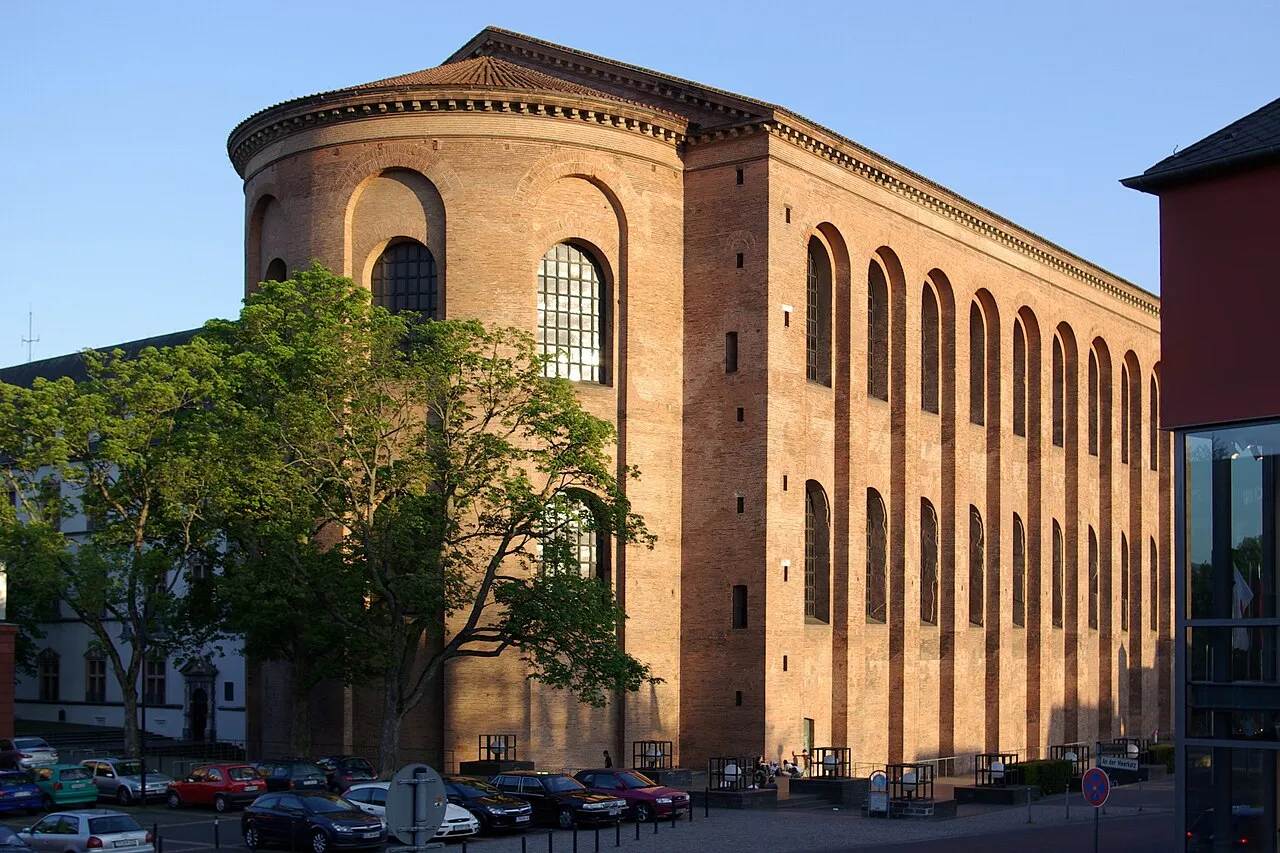
- ~328–340 d.C. Ampliamento del Palazzo di Treviri — Sotto di lui vengono completati il grande complesso termale "Kaiserthermen", la chiesa episcopale poi cattedrale (Trierer Dom), parte delle mura dette di Massimino, già iniziate dal padre. Treviri raggiunge ~80 000 abitanti, una delle cinque maggiori città occidentali. Enlargement of the Trier Palace — Under him are completed the great thermal complex "Kaiserthermen", the episcopal church later cathedral (Trierer Dom), part of the so-called Maximinus walls, already begun by his father. Trier reaches around 80,000 inhabitants, one of the five largest cities of the West.
- ~330 d.C. Statua equestre di Treviri — Una grande statua equestre bronzea di Costantino II, eretta nel foro di Augusta Treverorum, era ancora in piedi nel V secolo. La menziona il poeta Ausonio (Mosella, IV sec.). Distrutta probabilmente nelle incursioni franche. Trier equestrian statue — A large bronze equestrian statue of Constantine II, erected in the Augusta Treverorum forum, was still standing in the 5th century. It is mentioned by the poet Ausonius (Mosella, 4th c.). Probably destroyed in the Frankish raids.
- 337–340 d.C. Coniazione del solidus a Treviri — La zecca di Treveri (sigla TR) batte solidi con il busto laureato del giovane Augusto e legenda DN CONSTANTINVS MAX AVG. Continuano i rovesci propagandistici paterni: GLORIA EXERCITVS, VICTORIA AVGG, VOTA XV. Solidus coinage at Trier — The mint of Treveri (mintmark TR) strikes solidi with the laureate bust of the young Augustus and the legend DN CONSTANTINVS MAX AVG. The paternal propaganda reverses continue: GLORIA EXERCITVS, VICTORIA AVGG, VOTA XV.
- ~338 d.C. Restauri sul limes renano — Lavori documentati epigraficamente sulle fortificazioni di Castra Vetera (Xanten) e Argentoratum (Strasburgo). Continuità con il programma di Costantino I sul confine. Restorations on the Rhine limes — Epigraphically attested works on the fortifications of Castra Vetera (Xanten) and Argentoratum (Strasbourg). Continuity with Constantine I's frontier programme.
- ~339 d.C. Edicole cristiane in Britannia — Iscrizioni rinvenute a Caerleon e Londinium attribuiscono a Costantino II il finanziamento di piccole chiese e di restauri di basiliche civili. Quasi tutto perduto nelle invasioni del V secolo. Christian shrines in Britain — Inscriptions found at Caerleon and Londinium attribute to Constantine II the funding of small churches and the restoration of civic basilicas. Almost all lost in the 5th-century invasions.
05L'Eredità e il Giudizio della StoriaLegacy and Historical Judgment
La damnatio memoriae e la rimozione del nome
The damnatio memoriae and the removal of the name
Costante reagì alla morte del fratello con un'ondata di cancellazione amministrativa. Le iscrizioni pubbliche di Costantino II furono scalpellate o sostituite; le sue statue rimosse o rilavorate per somigliare ai sopravvissuti (alcuni ritratti dei Musei Capitolini, tradizionalmente identificati con Costantino II, sono in realtà immagini ritoccate di altri membri della dinastia). Le sue monete furono parzialmente ritirate dalla circolazione, soprattutto le emissioni in oro. Persino i papiri amministrativi egizi, originariamente datati « sotto i tre Augusti Costantino, Costanzo, Costante» , vennero retroattivamente corretti a « i due Augusti» . Il regno di tre anni venne in pratica letteralmente cancellato dalla memoria.
Constans reacted to his brother's death with a wave of administrative erasure. Constantine II's public inscriptions were chiselled away or replaced; his statues removed or reworked to resemble survivors (some portraits in the Capitoline Museums, traditionally identified as Constantine II, are actually retouched images of other dynastic members). His coins were partly withdrawn from circulation, especially the gold issues. Even Egyptian administrative papyri, originally dated « under the three Augusti Constantine, Constantius, Constans» , were retroactively corrected to « the two Augusti» . The three-year reign was literally erased from memory.
Il dramma fraterno che inghiottì la dinastia
The fraternal drama that swallowed the dynasty
La morte di Costantino II nel 340 fu solo il primo atto di una tragedia in più battute. Costante, vincitore di quel giorno, sarebbe stato a sua volta assassinato dieci anni dopo, nel 350, da un colpo di stato del comandante Magnenzio. Costanzo II, ultimo sopravvissuto dei tre fratelli, vinse Magnenzio nella sanguinosa battaglia di Mursa (351), uno degli scontri più cruenti del IV secolo, ma sopravvisse soltanto dieci anni dopo, morendo di malattia mentre andava ad affrontare il suo erede ribelle. Quell'erede era Giuliano, l'ultimo discendente vivente di Costantino I, lo stesso bambino di cinque anni risparmiato nella strage del 337: divenne Augusto, e quattro anni dopo, nel 363, morì in Persia colpito da una freccia di provenienza ignota. La dinastia costantiniana, fondata dal più potente imperatore dell'antichità tarda, si estinse in venticinque anni.
Constantine II's death in 340 was only the first act of a tragedy in several scenes. Constans, the day's winner, would in turn be assassinated ten years later, in 350, by the coup of his commander Magnentius. Constantius II, the last surviving of the three brothers, defeated Magnentius in the bloody battle of Mursa (351), one of the most brutal clashes of the 4th century, but he himself survived only another ten years, dying of illness as he marched to face his rebellious heir. That heir was Julian, Constantine I's last living descendant, the same five-year-old child spared in the massacre of 337: he became Augustus, and four years later, in 363, died in Persia struck by an arrow of unknown origin. The Constantinian dynasty, founded by the most powerful late-antique emperor, died out in twenty-five years.
Costantino II fu il primo a cadere. Se ne può ricostruire una colpa principale: aver sottovalutato Costante, e aver sopravvalutato la propria autorità di primogenito. Era cresciuto sentendosi destinato al ruolo guida della famiglia; ma Costantino I non aveva mai ufficialmente sancito quella gerarchia. La spartizione del 337 era stata fatta in nome del principio di uguaglianza tra Augusti. Costantino II non se ne accorse o non volle accorgersene. Quando invase l'Italia, era convinto che Costante si sarebbe inchinato. Costante non si inchinò .
Constantine II was the first to fall. One can reconstruct a chief fault for him: having underestimated Constans, and overestimated his own authority as firstborn. He had grown up feeling destined for the leadership of the family; but Constantine I had never officially sanctioned that hierarchy. The partition of 337 was made in the name of equality among Augusti. Constantine II did not notice, or did not wish to notice. When he invaded Italy, he was convinced Constans would bow. Constans did not bow.
Il problema strutturale: tre Augusti, una sola spada
The structural problem: three Augusti, one sword
Il fallimento del 340 fu, prima ancora che personale, strutturale. La tetrarchia familiare ideata da Costantino I (tre Augusti uguali più alcuni nipoti subordinati) replicava un errore già commesso da Diocleziano nel 305: presumere che i ranghi paritari potessero coesistere senza precipitare in guerra civile. Il principio monarchico, "un solo re sopra un solo territorio", era inscritto nella natura politica dell'Impero romano da tre secoli. Costantino I, più di chiunque altro, aveva incarnato questo principio: aveva eliminato uno dopo l'altro Massenzio, Massimiano, Licinio, il proprio figlio Crispo, la propria moglie Fausta, fino a restare unico Augusto. E poi, alla fine della vita, fece l'opposto: tre Augusti, divisione cooperativa, equilibrio paritario. Era un rovesciamento della propria stessa politica.
The failure of 340 was, even more than personal, structural. The family tetrarchy devised by Constantine I, three equal Augusti plus some subordinate nephews, replicated an error already made by Diocletian in 305: assuming that peer ranks could coexist without descending into civil war. The monarchic principle, "one ruler over one territory", had been inscribed in the political nature of the Roman Empire for three centuries. Constantine I, more than anyone, had embodied that principle: he had eliminated one by one Maxentius, Maximian, Licinius, his own son Crispus, his own wife Fausta, to remain sole Augustus. Then, at the end of his life, he did the opposite: three Augusti, cooperative division, peer equilibrium. It was a reversal of his own policy.
Aquileia 340, Mursa 351, Persia 363: tre date in una sequenza inevitabile, scolpita nei vizi strutturali della spartizione costantiniana. La storia romana del IV secolo è in larga misura la storia dei tentativi di tornare al monarchismo dopo un'utopia paritaria fallita.
Aquileia 340, Mursa 351, Persia 363: three dates in an inevitable sequence, carved into the structural flaws of the Constantinian partition. Roman history of the 4th century is, to a large degree, the history of attempts to return to monarchism after a failed peer utopia.
Il giudizio degli antichi
The verdict of the ancients
Le fonti antiche sono unanimi nel descrivere Costantino II come aggressore ingiustificato, vittima della propria ambizione. Zosimo (Storia Nuova, II) lo accusa di tracotanza; Eutropio (Breviarium X, 9) parla di « guerra mossa imprudentemente contro il fratello» ; Aurelio Vittore (De Caesaribus 41) riporta che « trasportato dalla gioventù e dall'avarizia, aggredisce Costante» . Anche le fonti cristiane, che pure gli erano debitrici per il richiamo di Atanasio, lo trattano con pietà tiepida: la sua morte fu accolta a Roma con un certo sollievo, perché aveva minacciato l'unità faticosamente rifondata dal padre.
The ancient sources are unanimous in describing Constantine II as an unjustified aggressor, a victim of his own ambition. Zosimus (New History, II) accuses him of arrogance; Eutropius (Breviarium X, 9) speaks of « a war rashly waged against the brother» ; Aurelius Victor (De Caesaribus 41) reports that « carried away by youth and greed, he attacks Constans» . Even the Christian sources, who owed him Athanasius's recall, treat him with lukewarm sympathy: his death was greeted at Rome with a certain relief, since he had threatened the unity painfully rebuilt by his father.
L'imperatore senza eredità
The emperor without legacy
Costantino II è storicamente il più dimenticato dei figli di Costantino. Costanzo II ebbe ventiquattro anni di regno e fondò di fatto la politica ecclesiastica del IV secolo. Costante governò l'intero Occidente per dieci anni e creò le condizioni che portarono al colpo di stato di Magnenzio. Anche il cugino Giuliano, sopravvissuto bambino, avrebbe lasciato una traccia indelebile come Apostata. Costantino II non ha lasciato né una legge ricordata, né un'opera monumentale a suo nome, né una battaglia che porti il suo nome di vincitore. La sua presenza nella storiografia si riduce alla cronaca del suo errore finale.
Constantine II is historically the most forgotten of Constantine's sons. Constantius II had twenty-four years of reign and effectively founded the ecclesiastical policy of the 4th century. Constans ruled the entire West for ten years and created the conditions that led to Magnentius's coup. Even cousin Julian, who survived as a child, would leave an indelible mark as the Apostate. Constantine II left no remembered law, no monumental work in his name, no battle bearing his name as victor. His presence in historiography reduces to the chronicle of his final error.
Eppure proprio per questo è un personaggio illuminante. La sua biografia mostra cosa accadeva alla dinastia costantiniana quando un suo membro si comportava da uomo comune, non da genio politico come il padre. Costantino I aveva creato un sistema in cui il successo dipendeva da qualità personali irripetibili: capacità di calcolo politico spietato, talento militare, intuizione religiosa, autoritarismo carismatico. I figli ereditarono il titolo, non le qualità . Costantino II, primogenito ambizioso ma poco geniale, fu il primo a constatare la differenza. Pagò ventiquattro anni di vita per quella constatazione.
And yet for precisely this reason he is an illuminating figure. His biography shows what happened to the Constantinian dynasty when one of its members behaved as an ordinary man, not as the political genius his father was. Constantine I had created a system in which success depended on unrepeatable personal qualities: ruthless political calculation, military talent, religious intuition, charismatic authoritarianism. The sons inherited the title, not the qualities. Constantine II, an ambitious but un-brilliant firstborn, was the first to find out the difference. He paid twenty-four years of life for that discovery.