01BiografiaBiography
Naissus, l'ostaggio di corte (272–305)
Naissus, the court hostage (272–305)
Flavio Valerio Costantino nacque il 27 febbraio, secondo la tradizione, intorno al 272 d.C. a Naissus, l'odierna Niš in Serbia: una città di frontiera nella Mesia Superiore, snodo militare lungo la via che collegava Singidunum (Belgrado) a Costantinopoli prima ancora che Costantinopoli esistesse. Il padre era Costanzo Cloro, ufficiale illirico di carriera militare; la madre era Elena, donna di origini umili, forse un'ostessa (stabularia) di Drepanum in Bitinia, secondo le fonti più spietate, forse semplice concubina di stato. Era una unione informale ma pubblica, abbastanza per trasmettere al figlio il rango imperiale.
Flavius Valerius Constantinus was born on 27 February, according to tradition, around 272 AD at Naissus, today Niš in Serbia: a frontier city in Moesia Superior, a military hub on the road linking Singidunum (Belgrade) to what would later become Constantinople. His father was Constantius Chlorus, an Illyrian career officer; his mother was Helena, a woman of humble origins, perhaps an innkeeper (stabularia) from Drepanum in Bithynia, according to the most cutting sources, perhaps simply a state concubine. It was an informal but public union, enough to transmit imperial rank to the son.
Nel 293 Diocleziano istituì la Tetrarchia: due Augusti (Diocleziano e Massimiano) e due Cesari (Costanzo e Galerio). Costanzo dovette ripudiare Elena per sposare Teodora, figliastra di Massimiano. Il giovane Costantino, di forse vent'anni, fu spedito alla corte orientale: prima a Nicomedia con Diocleziano, poi sotto Galerio. Ufficialmente era un onore. Sostanzialmente era un ostaggio: la sua incolumità garantiva la lealtà del padre lontano. Cresciuto a corte ricevette educazione greca e latina, vide bruciare le chiese cristiane durante la Grande Persecuzione del 303, accompagnò Galerio nelle campagne contro Sarmati e Persiani.
In 293 Diocletian instituted the Tetrarchy: two Augusti (Diocletian and Maximian) and two Caesars (Constantius and Galerius). Constantius had to repudiate Helena to marry Theodora, Maximian's stepdaughter. The young Constantine, perhaps twenty, was sent east: first to Nicomedia with Diocletian, then under Galerius. Officially an honour. Substantially a hostage: his safety guaranteed his absent father's loyalty. Court-raised, he received a Greek and Latin education, watched Christian churches burn during the Great Persecution of 303, and accompanied Galerius in campaigns against Sarmatians and Persians.
Nel 305 Diocleziano e Massimiano abdicarono: gesto senza precedenti nella storia romana. Costanzo divenne Augusto d'Occidente. A Galerio non interessava liberare l'ostaggio: Costantino fu trattenuto a corte con pretesti. La leggenda, trasmessa da Lattanzio, vuole che il giovane sia fuggito nottetempo, abbattendo i cavalli di posta lungo la via per non essere inseguito. Quel che è certo è che raggiunse il padre a Gesoriaco (Boulogne) appena in tempo per imbarcarsi insieme verso la Britannia. Erano le ultime settimane di Costanzo.
In 305 Diocletian and Maximian abdicated: an unprecedented act in Roman history. Constantius became Augustus of the West. Galerius had no interest in releasing the hostage: Constantine was kept at court under pretexts. The legend, passed down by Lactantius, says the young man fled by night, hamstringing the post-horses behind him to escape pursuit. What is certain is that he reached his father at Gesoriacum (Boulogne) just in time to sail with him to Britain. They were Constantius's last weeks.
L'acclamazione di York (306)
The York acclamation (306)
Costanzo morì a Eburacum (York) il 25 luglio 306, dopo una breve campagna contro i Pitti. Le legioni britanniche e l'anziano re alemanno Crocus, alleato di Roma, acclamarono immediatamente Costantino come Augustus. Era un colpo di stato che annullava le regole della Tetrarchia, dove il nuovo Cesare avrebbe dovuto essere scelto per cooptazione, non per discendenza dinastica. Costantino aveva circa trentaquattro anni e non aveva mai comandato una guerra propria. Si accordò comunque con Galerio: accettò il rango inferiore di Caesar in cambio del riconoscimento. Sarebbe stato il primo passo di una lunga sequenza di astuzie politiche.
Constantius died at Eburacum (York) on 25 July 306, after a brief campaign against the Picts. The British legions and the elderly Alamannic king Crocus, a Roman ally, immediately acclaimed Constantine as Augustus. It was a coup that overturned the rules of the Tetrarchy, where the new Caesar was supposed to be chosen by co-option, not dynastic descent. Constantine was about thirty-four and had never commanded a war of his own. He still struck a deal with Galerius: he accepted the lesser rank of Caesar in exchange for recognition. It was the first step in a long sequence of political cunning.
Per i sei anni seguenti Costantino consolidò il proprio dominio sulla Gallia e la Britannia. Creò una corte a Treviri (Augusta Treverorum), capitale strategica sul Reno; respinse incursioni di Franchi e Alemanni; fece massacrare due re franchi davanti al pubblico del circo, gesto deliberatamente brutale per affermare l'autorità militare. Nel frattempo la Tetrarchia agonizzava: Massenzio, figlio di Massimiano, si proclamò princeps a Roma; Massimiano uscì dal ritiro per riprendersi il trono; Galerio morì nel 311 di una malattia agghiacciante (probabilmente un cancro al colon), promulgando dal letto di morte l'Editto di Serdica che già tollerava in parte i cristiani. L'Impero era una giungla di sei pretendenti.
For the next six years Constantine consolidated his rule over Gaul and Britain. He set up a court at Trier (Augusta Treverorum), a strategic capital on the Rhine; repelled Frankish and Alamannic raids; had two Frankish kings massacred before the circus crowd, a deliberately brutal act to assert military authority. Meanwhile the Tetrarchy was dying: Maxentius, son of Maximian, proclaimed himself princeps at Rome; Maximian came out of retirement to retake the throne; Galerius died in 311 of a ghastly disease (probably colon cancer), promulgating from his deathbed the Edict of Serdica already partly tolerating Christians. The Empire was a jungle of six claimants.
Il segno e la battaglia (312)
The sign and the battle (312)
Nell'autunno del 312 Costantino prese una decisione strategica gigantesca: invadere l'Italia per eliminare Massenzio. Le sue forze erano inferiori: circa 40 000 uomini contro i 100 000 (forse esagerati dalle fonti) del rivale. Attraversò le Alpi all'inizio dell'estate, vinse a Susa, Torino, Milano, Brescia, Verona, quest'ultima una battaglia campale in cui sconfisse il prefetto del pretorio Ruricio Pompeiano. In meno di tre mesi era alle porte di Roma, dove l'attendeva l'esercito massenziano schierato sulla riva destra del Tevere.
In autumn 312 Constantine made a massive strategic decision: invade Italy to eliminate Maxentius. His forces were outnumbered: roughly 40,000 men against the 100,000 (perhaps exaggerated by sources) of his rival. He crossed the Alps at the start of summer, won at Susa, Turin, Milan, Brescia, Verona, the last a pitched battle in which he defeated the praetorian prefect Ruricius Pompeianus. In less than three months he was at the gates of Rome, where the Maxentian army was drawn up on the right bank of the Tiber.
Sulla marcia, secondo le fonti cristiane, avvenne il fatto destinato a riscrivere la storia religiosa dell'Occidente. Lattanzio (De mortibus persecutorum, 318 ca.) riferisce un sogno notturno: un'apparizione divina ordinò a Costantino di marcare sui suoi vessilli il monogramma di Cristo. Eusebio di Cesarea, decenni dopo nella Vita Constantini, amplifica: una visione diurna di una croce di luce nel cielo, con la scritta in greco « Τ ο υ τ ω ι Ν ι κ α », in latino « In hoc signo vinces» — "con questo segno vincerai". Quanto vi fosse di esperienza autentica, quanto di calcolo politico, quanto di leggenda costruita a posteriori, è uno dei dibattiti più antichi della storiografia. Ma l'effetto pratico fu chiaro: Costantino fece dipingere sugli scudi il Chi-Rho (Χ e Ρ intrecciati) e marciò in battaglia con un'insegna nuova.
On the march, according to Christian sources, the event that would rewrite Western religious history took place. Lactantius (De mortibus persecutorum, c. 318) reports a night dream: a divine apparition ordered Constantine to mark Christ's monogram on his standards. Eusebius of Caesarea, decades later in the Vita Constantini, amplifies it: a daytime vision of a cross of light in the sky, with the Greek inscription « Τ ο υ τ ω ι Ν ι κ α », in Latin « In hoc signo vinces» — "in this sign you shall conquer." How much was authentic experience, how much political calculation, how much legend built afterwards, is one of the oldest debates in historiography. But the practical effect was clear: Constantine had the Chi-Rho (Χ and Ρ intertwined) painted on the shields and marched into battle behind a new standard.
« In hoc signo vinces» — "Con questo segno vincerai." « In hoc signo vinces» — "In this sign you shall conquer." Eusebio, Vita Constantini I, 28
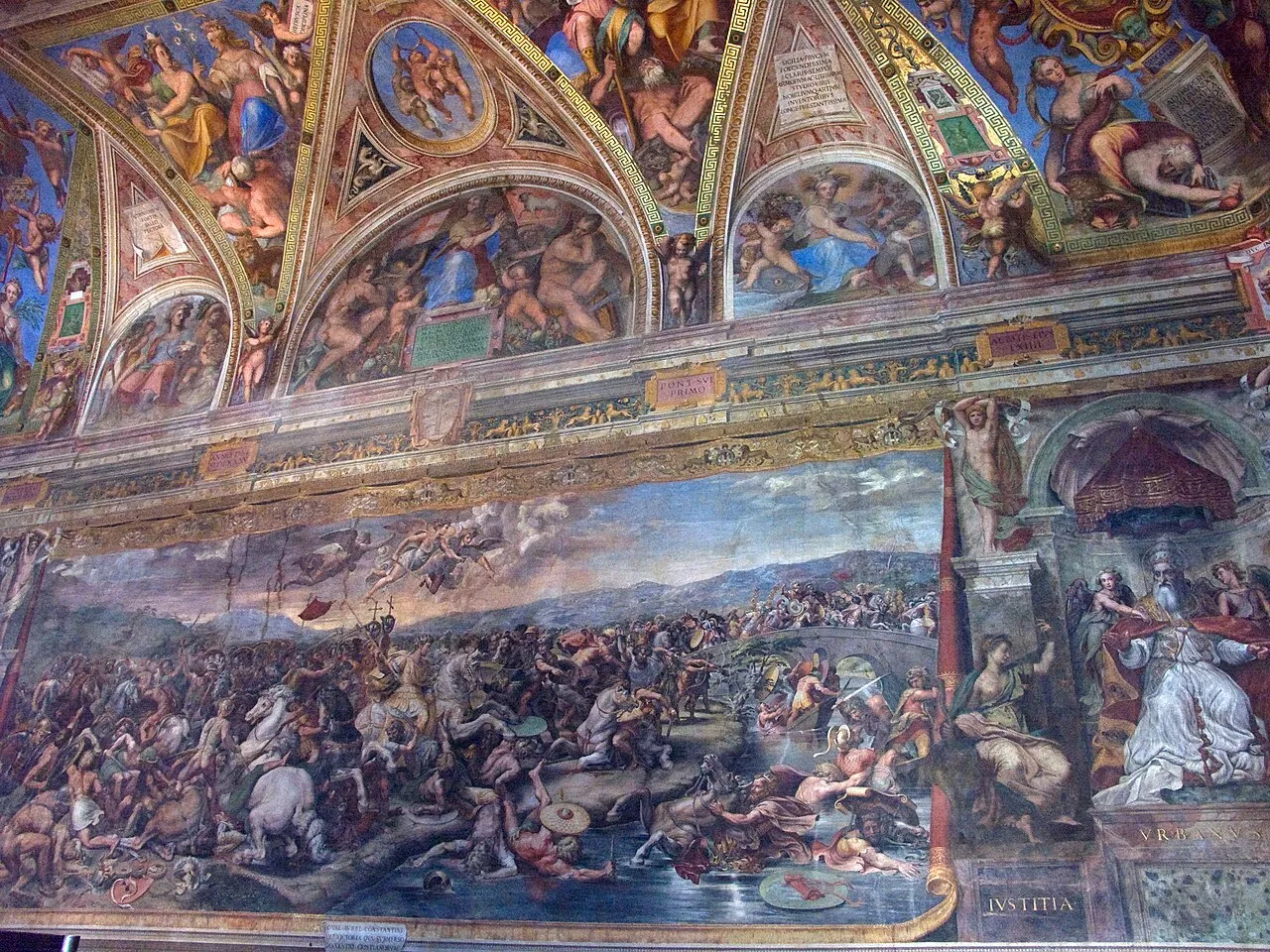
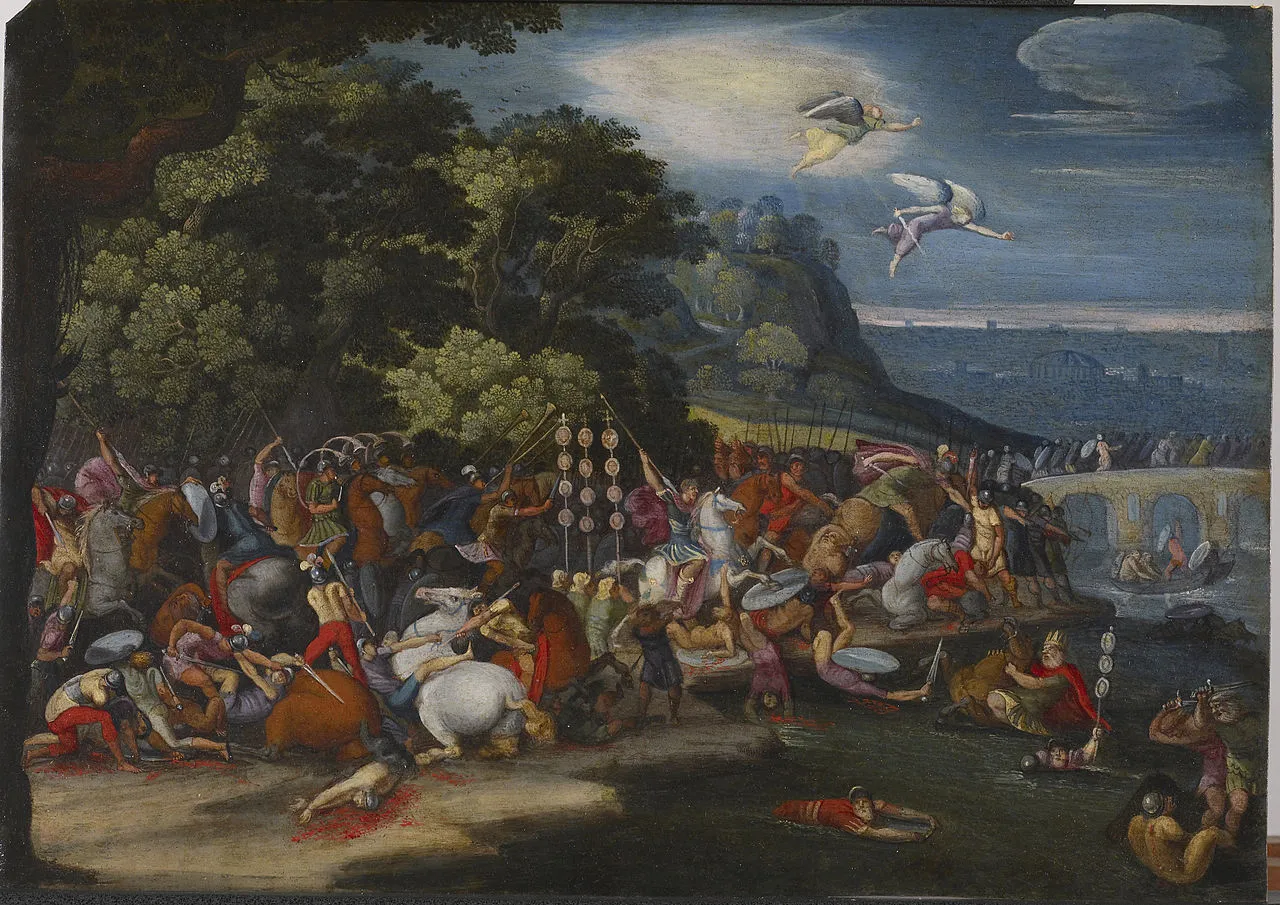
Il 28 ottobre 312, anniversario dell'ascesa al trono di Massenzio, le armate si scontrarono al Ponte Milvio, sul Tevere a nord di Roma. Massenzio aveva fatto demolire parzialmente il ponte di pietra e affiancato un ponte di barche per un'eventuale ritirata controllata. Le sue truppe, inizialmente in vantaggio, cedettero sotto la carica della cavalleria gallica e germanica di Costantino. La ritirata si trasformò in rotta; il ponte di barche cedette sotto il peso degli uomini in fuga. Massenzio annegò nel Tevere col corsaletto pesante. La testa, ripescata, fu portata trionfalmente a Roma su una picca. Costantino entrò in città il giorno dopo come liberator urbis.
On 28 October 312, the anniversary of Maxentius's accession, the armies clashed at the Milvian Bridge, on the Tiber north of Rome. Maxentius had partly dismantled the stone bridge and laid a pontoon bridge alongside it for a controlled retreat. His troops, initially gaining ground, gave way under the charge of Constantine's Gallic and Germanic cavalry. Retreat turned to rout; the pontoon bridge collapsed under the fleeing men. Maxentius drowned in the Tiber weighed down by his heavy cuirass. His head, fished out, was paraded into Rome on a pike. Constantine entered the city the next day as liberator urbis.
Da Augusto d'Occidente a unico signore (313–324)
From Augustus of the West to sole ruler (313–324)
Nel febbraio 313 Costantino incontrò a Mediolanum (Milano) il collega Augusto d'Oriente Licinio. Suggellarono l'alleanza politica col matrimonio tra Licinio e Costanza, sorellastra di Costantino, e con un accordo religioso epocale: la fine ufficiale delle persecuzioni cristiane in tutto l'Impero. Quel che la storiografia chiama "Editto di Milano" non fu un editto unico ma un programma concertato di lettere ai governatori. Sotto la facciata di concordia però la rivalità era totale: due Augusti, due capitali, due eserciti.
In February 313 Constantine met his Eastern co-Augustus Licinius at Mediolanum (Milan). They sealed the political alliance with the marriage between Licinius and Constantia, Constantine's half-sister, and with a religious agreement of epochal weight: the official end of the Christian persecutions across the Empire. What historiography calls the "Edict of Milan" was not a single edict but a co-ordinated programme of letters to governors. Behind the facade of concord, however, rivalry was total: two Augusti, two capitals, two armies.
Il primo scontro fu breve. Nel 316–317 Costantino sconfisse Licinio a Cibalae (Pannonia) e Mardia (Tracia), strappandogli i Balcani fino al delta del Danubio. Poi sette anni di tregua armata, durante i quali Costantino combatté vittoriose campagne contro Sarmati (322) e Goti (323), sconfinando occasionalmente nel territorio di Licinio per inseguire i barbari: pretesto perfetto per riaprire le ostilità . Lo scontro finale del 324 fu cosmico nelle proporzioni: oltre 200 000 uomini complessivi. Licinio fu sconfitto in campo aperto ad Adrianopoli, poi la sua flotta fu annientata nello stretto dell'Ellesponto da Crispo, figlio primogenito di Costantino. Lo scontro decisivo, a Crisopoli sull'altra riva del Bosforo, il 18 settembre 324, chiuse la partita. Licinio si arrese; gli fu promessa la vita; fu strangolato nove mesi dopo per ordine di Costantino: il primo dei suoi molti tradimenti familiari.
The first clash was short. In 316–317 Constantine defeated Licinius at Cibalae (Pannonia) and Mardia (Thrace), stripping him of the Balkans down to the Danube delta. Then came seven years of armed truce, during which Constantine fought victorious campaigns against Sarmatians (322) and Goths (323), occasionally crossing into Licinius's territory in pursuit of barbarians: the perfect pretext to reopen hostilities. The final clash of 324 was cosmic in scale: over 200,000 men in all. Licinius was defeated in open battle at Adrianople, then his fleet was annihilated in the Hellespont strait by Crispus, Constantine's eldest son. The decisive engagement at Chrysopolis on the other side of the Bosphorus, on 18 September 324, closed the game. Licinius surrendered; his life was promised; he was strangled nine months later by Constantine's order: the first of his many familial betrayals.
Costantino aveva cinquantadue anni ed era ora unico Augusto dell'Impero per la prima volta dopo le abdicazioni del 305. Aveva riunificato in trentadue mesi di guerra ciò che quarant'anni di Tetrarchia avevano spezzato.
Constantine was fifty-two and now sole Augustus of the Empire for the first time since the abdications of 305. He had reunified in thirty-two months of war what forty years of Tetrarchy had broken apart.
Nicea, Crispo, Fausta (325–326)
Nicaea, Crispus, Fausta (325–326)
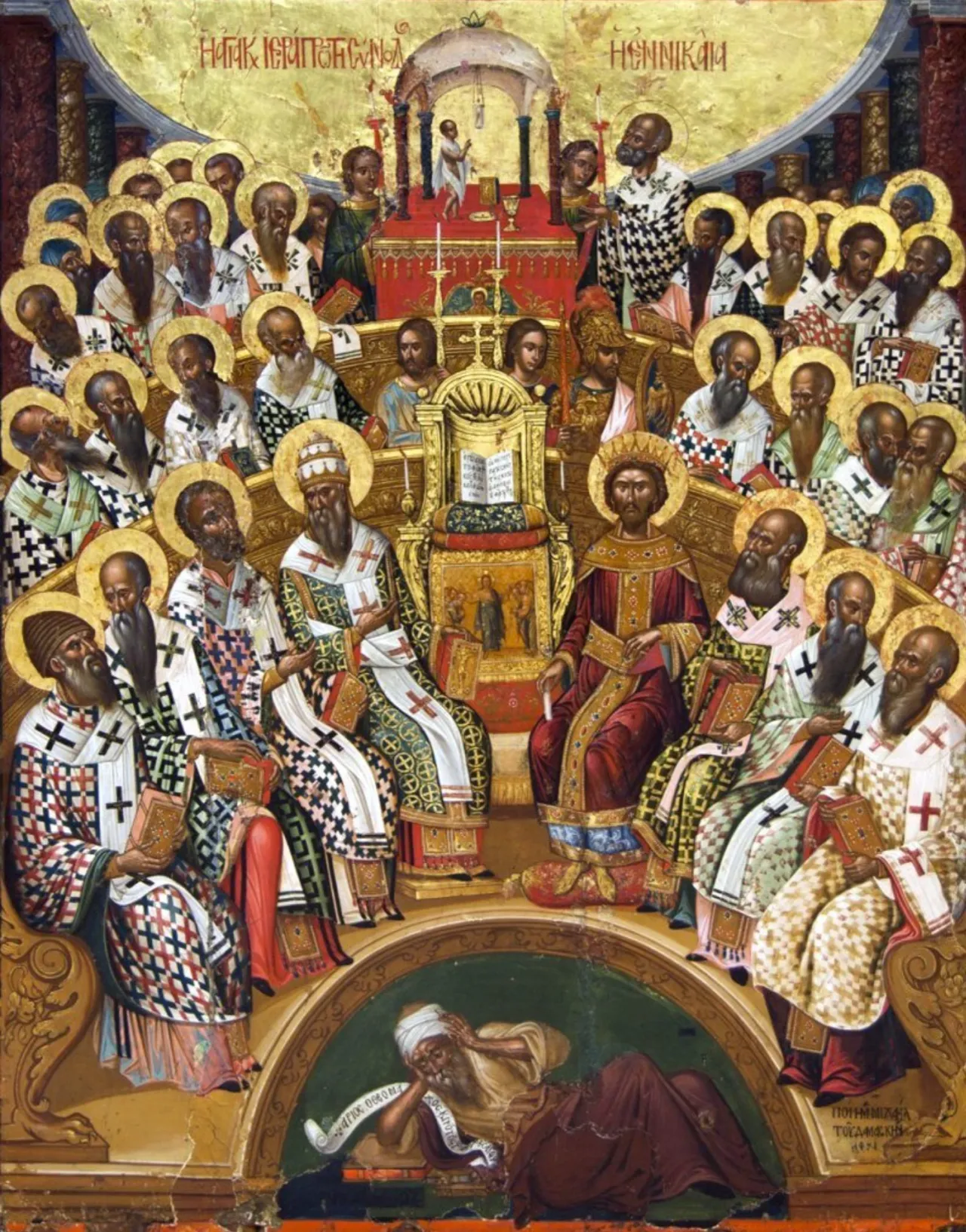
Nel maggio 325 convocò a Nicea (Iznik, Turchia) il primo Concilio Ecumenico della storia cristiana. Vi parteciparono 318 vescovi secondo la tradizione, forse 250 nella realtà , molti provenienti dall'Oriente, alcuni segnati dalle cicatrici della Grande Persecuzione. La questione urgente era la dottrina di Ario, prete di Alessandria che sosteneva la natura creata di Cristo. Costantino, in tunica imperiale di porpora, inaugurò i lavori in latino tradotto in greco; non era un teologo, sopravvive un suo giudizio sulla controversia come "questione frivola", ma capiva il valore politico di una Chiesa unificata. Sostenne il termine homoousios ("della stessa sostanza"), forse suggeritogli dal suo consigliere Ossio di Cordova. Ario fu condannato, esiliato; nacque il Credo Niceno, fondamento di ogni Cristianesimo successivo, ortodosso e cattolico.
In May 325 he convened at Nicaea (Iznik, Turkey) the first Ecumenical Council in Christian history. According to tradition 318 bishops attended, perhaps 250 in reality, many from the East, some still marked by the scars of the Great Persecution. The urgent matter was the doctrine of Arius, an Alexandrian priest who maintained Christ's created nature. Constantine, in imperial purple tunic, opened the proceedings in Latin translated into Greek; he was no theologian, a judgment of his on the controversy as a "frivolous matter" survives, but he understood the political value of a unified Church. He backed the term homoousios ("of the same substance"), perhaps suggested by his counsellor Ossius of Cordova. Arius was condemned, exiled; the Nicene Creed was born, the foundation of every subsequent Christianity, Orthodox and Catholic alike.
L'anno seguente, il 326, fu l'anno della tragedia familiare. Crispo, il figlio primogenito che aveva vinto a Crisopoli, brillante ventenne destinato alla successione, fu arrestato a Pola e giustiziato per ordine del padre. Pochi mesi dopo morì anche Fausta, seconda moglie e madre degli altri figli, soffocata dal vapore in un bagno surriscaldato. Le ragioni furono accuratamente cancellate dalle fonti ufficiali. La ricostruzione più diffusa (già antica, ma non provata) vuole Fausta innamorata o falsamente accusatrice di Crispo: Costantino avrebbe condannato a morte il figlio per adulterio, scoperto poi l'inganno della moglie e fatta uccidere anche lei. Variante moderna: lotta di successione tra Crispo (figlio di prima moglie) e i suoi tre fratelli figli di Fausta. Quel che è certo è che entrambi i nomi furono colpiti da damnatio memoriae: monete fuse, iscrizioni cancellate. Costantino non li pronunciò mai più .
The next year, 326, was the year of the family tragedy. Crispus, the eldest son who had won at Chrysopolis, a brilliant twenty-year-old destined for the succession, was arrested at Pula and executed on his father's order. A few months later Fausta, his second wife and mother of his other sons, also died: suffocated by steam in an overheated bath. The reasons were carefully scrubbed by official sources. The most widespread reconstruction, ancient but unproven, has Fausta either in love with Crispus or falsely accusing him: Constantine had his son executed for adultery, then discovered his wife's deception and had her killed too. Modern variant: a succession struggle between Crispus (son of his first wife) and his three brothers, Fausta's sons. What is certain is that both names suffered damnatio memoriae: coins melted, inscriptions erased. Constantine never spoke them again.
Quello stesso anno la madre Elena, oltre settantenne, partì pellegrina per la Terra Santa. La tradizione le attribuisce il ritrovamento della Vera Croce e la fondazione delle basiliche del Santo Sepolcro a Gerusalemme e della Natività a Betlemme. Forse era penitenza voluta dal figlio per i delitti familiari; forse calcolo politico per spostare il Cristianesimo verso le sue radici palestinesi; forse vera devozione. Probabilmente tutte e tre le cose insieme.
That same year his mother Helena, over seventy, set out as a pilgrim to the Holy Land. Tradition credits her with the discovery of the True Cross and the foundation of the basilicas of the Holy Sepulchre in Jerusalem and the Nativity in Bethlehem. Perhaps it was a penance imposed by her son for the family killings; perhaps political calculus to shift Christianity toward its Palestinian roots; perhaps real devotion. Probably all three at once.
Gli ultimi anni e la morte (327–337)
The last years and death (327–337)
Il decennio finale di Costantino fu un'amministrazione gigantesca da una nuova capitale. L'11 maggio 330 inaugurò ufficialmente Costantinopoli sul sito della modesta Bisanzio. Continuò le riforme amministrative, riorganizzò il sistema delle prefetture, confermò la moneta aurea del solidus. Nel 332 sconfisse i Goti dei Tervingi sotto il figlio Costantino II; nel 334 trasferì circa 300 000 Sarmati Limigantes nelle province danubiane. Nel 335, alle Vicennalia per i trent'anni di regno, divise formalmente l'Impero tra i tre figli (Costantino II, Costanzo II, Costante) e due nipoti (Dalmazio, Annibaliano), in un bizzarro tentativo di replicare la Tetrarchia.
Constantine's final decade was a vast administration run from a new capital. On 11 May 330 he officially inaugurated Constantinople on the site of modest Byzantium. He continued his administrative reforms, reorganised the prefecture system, confirmed the gold solidus. In 332 he defeated the Tervingi Goths under his son Constantine II; in 334 he resettled some 300,000 Limigantes Sarmatians in the Danube provinces. In 335, at the Vicennalia celebrations for thirty years of reign, he formally divided the Empire among his three sons (Constantine II, Constantius II, Constans) and two nephews (Dalmatius, Hannibalianus), in a bizarre attempt to replicate the Tetrarchy.
Nella primavera del 337 si preparava a una grande campagna contro la Persia sasanide di Sapore II, per difendere le comunità cristiane d'Oriente. Si ammalò subito dopo la Pasqua. Trasferito nella villa imperiale di Achyrona presso Nicomedia, ricevette finalmente il battesimo dal vescovo Eusebio di Nicomedia, che era, ironia delle ironie, di tendenze ariane, le stesse che Costantino aveva fatto condannare a Nicea. Depose la porpora imperiale per la tunica bianca dei battezzati. Morì il pomeriggio di Pentecoste, 22 maggio 337. Il corpo fu portato a Costantinopoli e deposto nella Chiesa dei Santi Apostoli, in mezzo a dodici cenotafi che lo rappresentavano come tredicesimo apostolo (isapostolos). La guerra civile tra i suoi successori scoppiò nei mesi seguenti: i due nipoti e tutti i discendenti maschi di Costanzo Cloro per altre vie furono massacrati in una notte da soldati di Costanzo II. Della stirpe ramificata di Costantino sopravvissero solo i tre figli e due bambini: Gallo e Giuliano. L'ultimo sarebbe diventato l'Apostata.
In the spring of 337 he was preparing a great campaign against Sassanid Persia under Shapur II, to defend Eastern Christian communities. He fell ill just after Easter. Moved to the imperial villa of Achyrona near Nicomedia, he finally received baptism from bishop Eusebius of Nicomedia, who was, irony of ironies, of Arian leanings, the very ones Constantine had had condemned at Nicaea. He laid aside the imperial purple for the white tunic of the baptised. He died on the afternoon of Pentecost, 22 May 337. The body was carried to Constantinople and laid in the Church of the Holy Apostles, amid twelve cenotaphs representing him as the thirteenth apostle (isapostolos). Civil war between his successors broke out in the following months: the two nephews and all other male descendants of Constantius Chlorus were massacred in one night by Constantius II's soldiers. Of Constantine's branching line only the three sons and two children survived: Gallus and Julian. The latter would become the Apostate.
02Battaglie e Campagne MilitariBattles and Military Campaigns
Costantino fu il più abile generale del IV secolo. A differenza di Augusto, che delegava il comando ad Agrippa, comandò di persona la quasi totalità delle sue campagne. Lo stile era quello dei cavalieri illirici che dominavano l'esercito tardo-romano: marce rapide, cariche di cavalleria pesante (cataphractarii) sul fianco, riserva mobile (comitatus) pronta a colpire dove il nemico cedeva. Vinse contro tutti: usurpatori romani, Franchi, Alemanni, Sarmati, Goti. Morì mentre preparava la sua unica campagna mai combattuta, contro la Persia.
Constantine was the most capable general of the 4th century. Unlike Augustus, who delegated command to Agrippa, he led nearly all his campaigns in person. His style was that of the Illyrian horsemen who dominated the late Roman army: rapid marches, heavy cavalry charges (cataphractarii) on the flank, a mobile reserve (comitatus) ready to strike where the enemy gave way. He won against all: Roman usurpers, Franks, Alamanni, Sarmatians, Goths. He died preparing his one unfought campaign, against Persia.
- 306 d.C. Acclamazione di Eburacum — Le legioni britanniche e il re alemanno Crocus proclamano Costantino Augusto dopo la morte di Costanzo Cloro. Inizio di vent'anni di guerra civile. Eburacum acclamation — The British legions and Alamannic king Crocus proclaim Constantine Augustus after the death of Constantius Chlorus. Start of twenty years of civil war.
- 306–310 d.C. Campagne renane — Respinge Franchi e Alemanni oltre il Reno. Cattura e fa massacrare nel circo di Treviri i re franchi Ascarico e Merogaiso: gesto di terrore deliberato per intimidire le tribù. Rhine campaigns — Pushes Franks and Alamanni back across the Rhine. Captures and butchers in the Trier circus the Frankish kings Ascaricus and Merogaisus: a deliberate act of terror to cow the tribes.
- 310 d.C. Soppressione di Massimiano — Il vecchio suocero, uscito dal ritiro per tentare di riprendersi il trono, è assediato a Marsiglia da Costantino e costretto al suicidio. Suppression of Maximian — His old father-in-law, out of retirement to try retaking the throne, is besieged at Marseille by Constantine and forced to suicide.
- 312 d.C. Campagna d'Italia — Susa, Torino, Milano, Brescia, Verona cadono in poche settimane. A Verona Costantino sconfigge personalmente in pieno assedio il prefetto del pretorio Ruricio Pompeiano. Marcia su Roma. Italian campaign — Susa, Turin, Milan, Brescia, Verona fall in weeks. At Verona Constantine personally defeats in mid-siege the praetorian prefect Ruricius Pompeianus. Marches on Rome.
- 28 ott 312 d.C. Battaglia di Ponte Milvio — Massenzio annega nel Tevere quando il ponte di barche cede sotto l'esercito in rotta. La sua testa è portata in trionfo a Roma su una lancia. Costantino entra in città come liberator. Battle of Milvian Bridge — Maxentius drowns in the Tiber when the pontoon bridge collapses under the routed army. His head is paraded into Rome on a pike. Constantine enters the city as liberator.
- 316–317 d.C. Prima guerra contro Licinio — Vittorie a Cibalae (Pannonia) e Mardia (Tracia). Pace breve: Costantino ottiene i Balcani fino al delta del Danubio. First war against Licinius — Victories at Cibalae (Pannonia) and Mardia (Thrace). Short peace: Constantine gains the Balkans down to the Danube delta.
- 322–323 d.C. Campagne sarmatiche e gotiche — Sconfigge i Sarmati Iazigi sulla Tisza e i Goti del re Rausimodo sul basso Danubio. Sconfinamenti in territorio di Licinio danno il casus belli finale. Sarmatian and Gothic campaigns — Defeats the Iazyges Sarmatians on the Tisza and king Rausimod's Goths on the lower Danube. Incursions into Licinius's territory provide the final casus belli.
- 3 lug 324 d.C. Battaglia di Adrianopoli — 130 000 uomini di Costantino contro 165 000 di Licinio. Vittoria campale grazie alla cavalleria pesante. Licinio si ritira nella città di Bisanzio. Battle of Adrianople — 130,000 men under Constantine against 165,000 under Licinius. Pitched victory thanks to the heavy cavalry. Licinius retreats to the city of Byzantium.
- lug 324 d.C. Battaglia navale dell'Ellesponto — Il figlio Crispo, con 200 navi leggere e veloci, annienta nello stretto la flotta di Abanto (350 navi più pesanti). Talento militare straordinario: lo pagherà con la vita due anni dopo. Naval battle of the Hellespont — Son Crispus, with 200 light and fast ships, annihilates in the strait the fleet of Abantus (350 heavier vessels). Extraordinary military talent: he would pay for it with his life two years later.
- 18 set 324 d.C. Battaglia di Crisopoli — Sull'altra riva del Bosforo, di fronte a Bisanzio, Costantino sbaraglia l'ultimo esercito di Licinio. Quest'ultimo si arrende, viene risparmiato, strangolato sei mesi dopo. Costantino unico Augusto. Battle of Chrysopolis — On the opposite bank of the Bosphorus, facing Byzantium, Constantine routs Licinius's last army. The latter surrenders, is spared, and is strangled six months later. Constantine sole Augustus.
- 332 d.C. Vittoria sui Tervingi — Costantino II, diciassettenne, sotto la supervisione del padre annienta l'esercito gotico di Ariarico. Centomila Goti sottomessi come foederati. Victory over the Tervingi — Seventeen-year-old Constantine II, under his father's supervision, annihilates Ariaricus's Gothic army. A hundred thousand Goths brought in as foederati.
- 334 d.C. Trasferimento dei Sarmati — Circa 300 000 Sarmati Limigantes, in fuga da una guerra civile interna, sono accolti nelle province danubiane: il più grande receptio dell'antichità . Sarmatian resettlement — Around 300,000 Limigantes Sarmatians, fleeing an internal civil war, are settled in the Danube provinces: the largest receptio of antiquity.
- 337 d.C. Campagna persiana mai combattuta — Mobilita l'esercito contro Sapore II per difendere i cristiani del regno sasanide. Si ammala e muore prima di partire. La guerra sarà ereditata e perduta da Costanzo II. Unfought Persian campaign — Mobilises the army against Shapur II to defend the Christians of the Sassanid kingdom. He falls ill and dies before setting out. The war would be inherited and lost by Constantius II.
03Riforme e Leggi FondamentaliKey Reforms and Laws
Le riforme di Costantino completarono l'opera iniziata da Diocleziano: trasformare il Principato augusteo in un Dominato autocratico, burocratico, sacralizzato. L'imperatore non era più un magistrato repubblicano camuffato; era dominus et deus, signore e dio, vicario terreno della divinità . Costantino prese questa struttura e le innestò una nuova religione di Stato, una nuova moneta, un nuovo esercito mobile, una nuova capitale. Era una rivoluzione conservatrice: cambiava tutto per mantenere in piedi un Impero che cinquant'anni prima era stato sull'orlo della disintegrazione.
Constantine's reforms completed the work begun by Diocletian: transforming the Augustan Principate into an autocratic, bureaucratic, sacralised Dominate. The emperor was no longer a disguised Republican magistrate; he was dominus et deus, lord and god, earthly vicar of the divinity. Constantine took this structure and grafted onto it a new state religion, a new coinage, a new mobile army, a new capital. It was a conservative revolution: changing everything to keep an Empire alive that fifty years earlier had stood on the brink of disintegration.
- 313 d.C. Editto di Milano — Concertato con Licinio, libertà di culto per tutte le religioni, restituzione dei beni confiscati ai cristiani durante la Grande Persecuzione di Diocleziano. Fine ufficiale di tre secoli di persecuzioni. Edict of Milan — Co-ordinated with Licinius, freedom of worship for all religions, restitution of goods confiscated from Christians during Diocletian's Great Persecution. Official end of three centuries of persecutions.
- 313 d.C. Privilegi al clero cristiano — Esenzione fiscale, esenzione dai munera civici, giurisdizione episcopale (episcopalis audientia) con valore legale equiparato a sentenza imperiale. Privileges to the Christian clergy — Tax exemption, exemption from civic munera, episcopal jurisdiction (episcopalis audientia) with legal force equivalent to an imperial sentence.
- 315 d.C. Abolizione della crocifissione — In rispetto del supplizio di Cristo, vietata come pena capitale; sostituita dalla forca o dalla decapitazione. Inizio della cristianizzazione del diritto penale. Abolition of crucifixion — Out of respect for Christ's passion, banned as capital punishment; replaced by the gallows or beheading. Beginning of the Christianisation of criminal law.
- 312–324 d.C. Riforma della cavalleria — Scioglie i Equites singulares Augusti (guardia a cavallo di Massenzio) e li sostituisce con le Scholae Palatinae, nuovi reggimenti d'élite cavallereschi alle dirette dipendenze imperiali. Cavalry reform — Disbands the Equites singulares Augusti (Maxentius's horse guard) and replaces them with the Scholae Palatinae, new elite cavalry regiments answering directly to the emperor.
- 312 d.C. Soppressione del Pretorio — Sciolta dopo Ponte Milvio la Guardia Pretoriana, in piedi dal tempo di Augusto e troppo politicamente pericolosa. I prefetti del pretorio mantengono il titolo ma diventano funzionari civili territoriali. Praetorian disbandment — After Milvian Bridge he dissolves the Praetorian Guard, in place since Augustus and too politically dangerous. The praetorian prefects keep the title but become territorial civil officials.
- 312–337 d.C. Esercito comitatense — Distinzione formale tra limitanei (truppe stanziali di frontiera) e comitatenses (esercito mobile interno al servizio dell'imperatore). Doctrina militare valida fino al VI secolo. Comitatensian army — Formal distinction between limitanei (stationary frontier troops) and comitatenses (mobile interior army at the emperor's service). A military doctrine valid down to the 6th century.
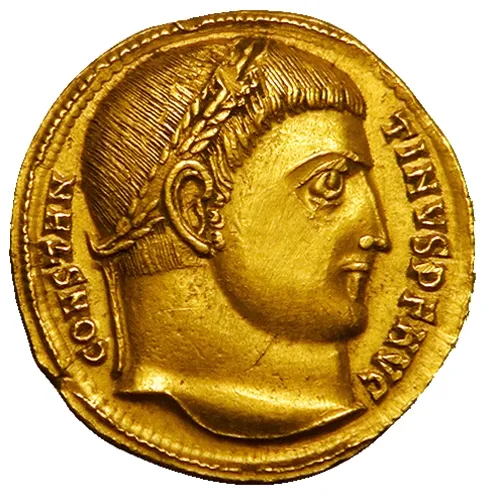
- 309 / 312 d.C. Solidus aureo — Nuova moneta d'oro di 4,55 g (1/72 di libbra), introdotta in Gallia e generalizzata dopo la vittoria. Stabilità monetaria miracolosa: il solidus sopravviverà senza svalutazioni per oltre mille anni, fino al 1453. Gold solidus — New gold coin of 4.55 g (1/72 of a pound), introduced in Gaul and generalised after the victory. Miraculous monetary stability: the solidus would survive without debasement for over a thousand years, until 1453.
- 318 d.C. Episcopalis audientia — I vescovi possono decidere come arbitri qualsiasi causa civile su richiesta delle parti, e le loro sentenze hanno valore esecutivo. Embrione del potere giudiziario ecclesiastico medievale. Episcopalis audientia — Bishops may arbitrate any civil case at the parties' request, and their sentences carry executive force. Embryo of medieval ecclesiastical judicial power.
- 321 d.C. Riposo domenicale — Die solis: la domenica diventa giorno festivo ufficiale dell'Impero, vietate le attività pubbliche e giudiziarie. L'editto non è esplicitamente cristiano (dies solis richiama anche il Sol Invictus), ma di fatto cristianizza il calendario. Sunday rest — Die solis: Sunday becomes the Empire's official rest day, with public and judicial activity forbidden. The edict is not explicitly Christian (dies solis also evokes Sol Invictus), but in fact Christianises the calendar.
- 321 d.C. Manumissio in ecclesia — Le manomissioni di schiavi compiute davanti a un vescovo, in chiesa, hanno piena validità legale: una via nuova, più semplice e pubblica, per affrancare gli schiavi cristiani. Manumissio in ecclesia — Slave manumissions performed before a bishop, in church, have full legal validity: a new, simpler, more public route for freeing Christian slaves.
- 325 d.C. Concilio di Nicea — Primo Concilio Ecumenico convocato e presieduto dall'imperatore. Condanna dell'arianesimo, formulazione del Credo Niceno, fissazione della data della Pasqua. Modello del rapporto Stato-Chiesa per mille anni. Council of Nicaea — First Ecumenical Council convened and presided over by the emperor. Condemnation of Arianism, formulation of the Nicene Creed, fixing of the date of Easter. Template of Church-State relations for a thousand years.
- 326 d.C. Leggi sulla famiglia — Inasprimento delle pene per adulterio e ratto, vincoli sui divorzi unilaterali. Si stringe la legislazione morale, sotto evidente influenza cristiana, paradossalmente lo stesso anno dell'uccisione di Crispo e Fausta. Family laws — Harsher penalties for adultery and abduction, restrictions on unilateral divorce. Moral legislation tightens under evident Christian influence, paradoxically the same year as the killings of Crispus and Fausta.
- 330–337 d.C. Riorganizzazione delle prefetture — Quattro grandi prefetture (Gallie, Italia-Africa, Illirico, Oriente) sotto altrettanti prefetti del pretorio civili. A capo di ogni grande circoscrizione delle dioecesi, un vicarius. Struttura amministrativa che sopravviverà nell'Impero d'Oriente fino al VII secolo. Reorganisation of the prefectures — Four great prefectures (Gauls, Italy-Africa, Illyricum, East) under as many civilian praetorian prefects. At the head of each great diocesis, a vicarius. An administrative structure that would survive in the Eastern Empire until the 7th century.
04Opere e CostruzioniWorks and Constructions
Costantino fu l'ultimo grande edificatore di Roma e il fondatore della più grande città medievale d'Occidente. La sua politica edilizia era bifronte: a Roma chiuse il ciclo monumentale pagano con l'Arco di trionfo e la basilica civile; allo stesso tempo aprì la stagione cristiana costruendo le prime grandi chiese pubbliche della storia. A Gerusalemme dette forma fisica ai luoghi santi. A Costantinopoli fece nascere dal nulla una capitale destinata a sopravvivere a Roma di mille anni.
Constantine was Rome's last great builder and the founder of the largest medieval city in the West. His architectural policy was two-faced: at Rome he closed the pagan monumental cycle with the triumphal arch and the civic basilica; at the same time he opened the Christian season by building the first great public churches in history. At Jerusalem he gave physical form to the holy sites. At Constantinople he conjured from nothing a capital destined to outlive Rome by a thousand years.
- 312–315 d.C. Basilica di Massenzio (Costantino) — Iniziata dal rivale sconfitto, completata da Costantino come basilica civile sul lato nord del Foro Romano: tre navate, volte a crociera, copertura in opus latericium di 35 m. Resta uno dei più grandi spazi voltati dell'antichità . Basilica of Maxentius (Constantine) — Begun by the defeated rival, completed by Constantine as a civic basilica on the north side of the Roman Forum: three naves, cross vaults, 35 m brick-and-mortar cover. It remains one of the largest vaulted spaces of antiquity.
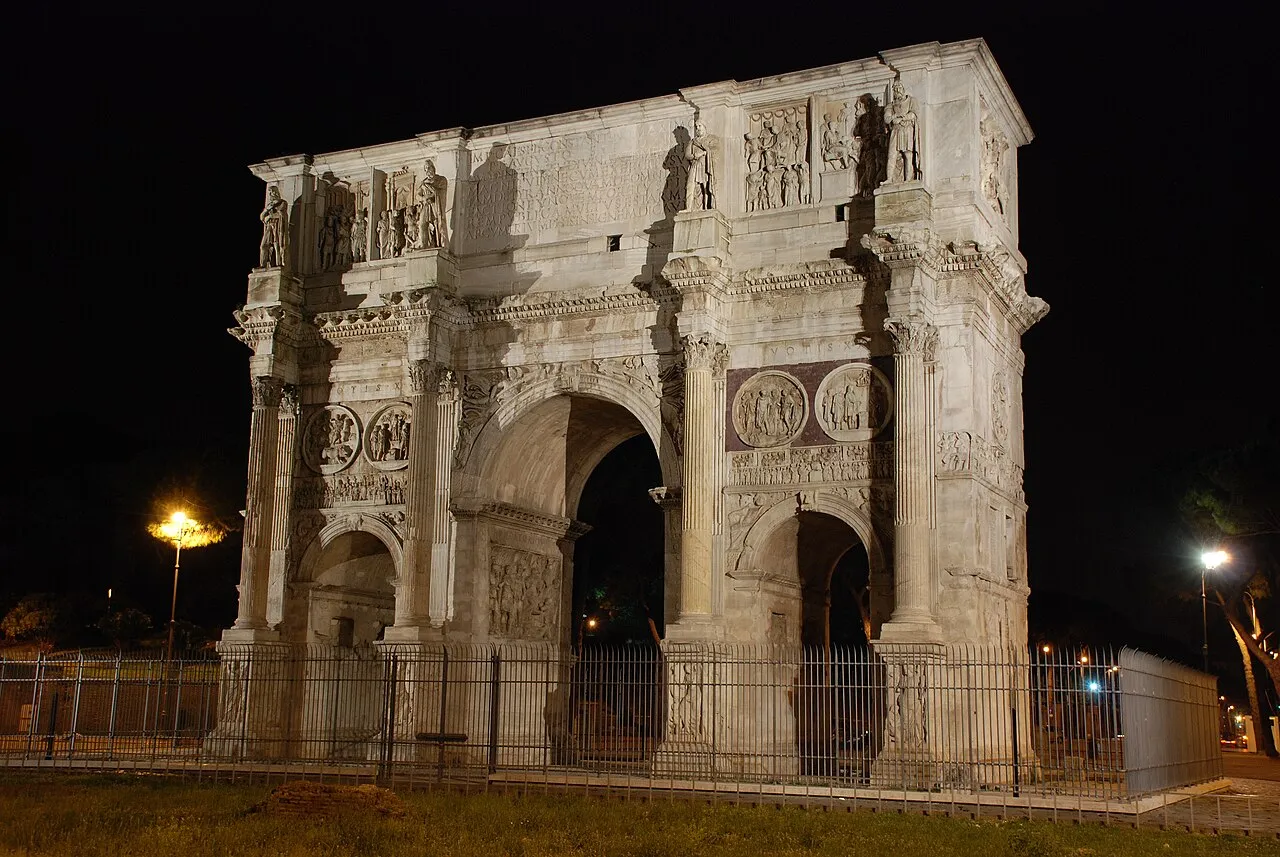
- 315 d.C. Arco di Costantino — Eretto dal Senato per celebrare il decennale della vittoria su Massenzio. Il più grande arco di trionfo romano sopravvissuto (h 21 m, largh. 25,9 m). Notevole per la composizione eclettica: molti rilievi sono spolia, prelevate da monumenti di Traiano, Adriano, Marco Aurelio. Arch of Constantine — Erected by the Senate for the tenth anniversary of the victory over Maxentius. The largest surviving Roman triumphal arch (h 21 m, w 25.9 m). Notable for its eclectic composition: many reliefs are spolia, lifted from monuments of Trajan, Hadrian, Marcus Aurelius.
- ~313–320 d.C. Basilica Lateranense — Prima grande chiesa pubblica della storia, costruita sui terreni della famiglia Plauzia Laterana confiscati a Massenzio. Sede del vescovo di Roma fin dal IV secolo, ancora oggi cattedrale ufficiale del Papa. Lateran Basilica — First great public church in history, built on the lands of the Plautii Laterani family seized from Maxentius. Seat of the bishop of Rome since the 4th century, still today the Pope's official cathedral.
- ~319–333 d.C. Antica San Pietro in Vaticano — Costruita sopra la memoria della tomba dell'apostolo Pietro, sul colle Vaticano. Pianta a cinque navate, transetto, abside occidentale. Demolita nel XVI secolo per far posto all'attuale Basilica di San Pietro. Old St Peter's in the Vatican — Built over the memoria of the apostle Peter's tomb on the Vatican hill. Five-nave plan, transept, western apse. Demolished in the 16th century to make way for the present St Peter's Basilica.
- ~320 d.C. Basiliche minori romane — Santa Croce in Gerusalemme (palazzo Sessoriano dell'imperatrice Elena), San Sebastiano fuori le mura, San Lorenzo fuori le mura, Santi Marcellino e Pietro, Santi Apostoli. Cristianizzazione del paesaggio urbano romano. Minor Roman basilicas — Santa Croce in Gerusalemme (the empress Helena's Sessorian palace), San Sebastiano fuori le mura, San Lorenzo fuori le mura, Santi Marcellino e Pietro, Santi Apostoli. Christianisation of the Roman urban landscape.
- 312–315 d.C. Terme di Costantino — Sul colle Quirinale, ultime grandi terme imperiali costruite a Roma. Conserveranno le statue dei Dioscuri, ora di fronte al Quirinale, e parti del Colosso bronzeo trasportato poi al Laterano. Baths of Constantine — On the Quirinal Hill, the last great imperial baths built in Rome. They preserved the statues of the Dioscuri, now in front of the Quirinale, and parts of the bronze Colossus later moved to the Lateran.
- ~325–335 d.C. Santo Sepolcro a Gerusalemme — Su mandato di Costantino, dopo che Elena identificò il luogo del Calvario e della Tomba di Cristo. Nella città di Aelia Capitolina rifondata da Adriano, abbatte il tempio di Venere e scopre la tomba sotto. La basilica originaria viene distrutta nel 1009; la chiesa attuale è crociata. Holy Sepulchre in Jerusalem — By Constantine's mandate, after Helena identified the site of Calvary and Christ's Tomb. In Aelia Capitolina, refounded by Hadrian, he tears down the temple of Venus and uncovers the tomb beneath. The original basilica was destroyed in 1009; the current church is Crusader.
- ~333 d.C. Basilica della Natività a Betlemme — Su iniziativa di Elena, sopra la grotta indicata dalla tradizione cristiana come luogo della nascita di Gesù . Distrutta da una rivolta samaritana nel 529, ricostruita da Giustiniano, sopravvissuta intatta da allora. Basilica of the Nativity at Bethlehem — At Helena's initiative, over the cave Christian tradition identifies as Jesus's birthplace. Destroyed by a Samaritan revolt in 529, rebuilt by Justinian, intact ever since.
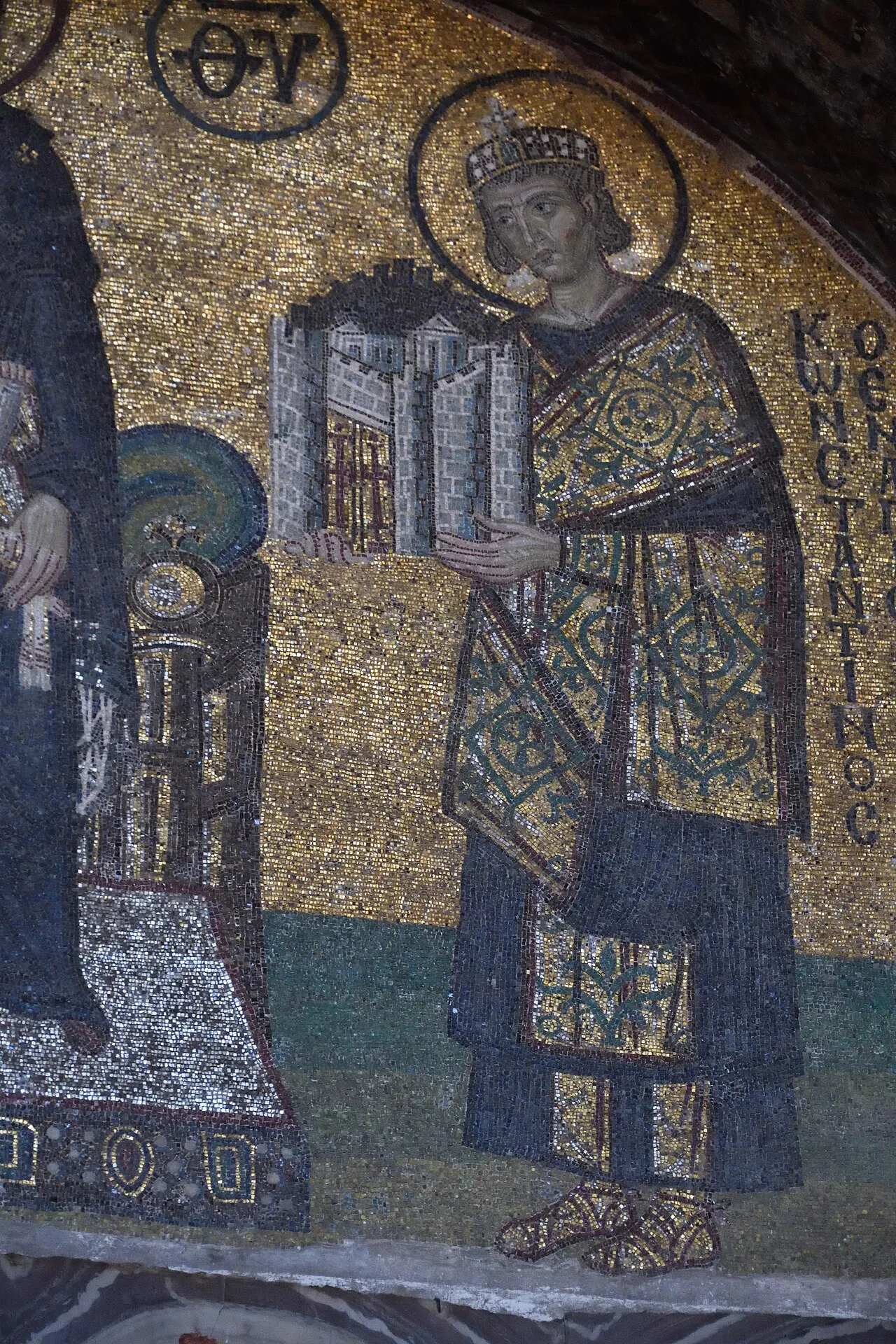
- 324–330 d.C. Fondazione di Costantinopoli — Sul sito di Bisanzio, città greca di 4 000 abitanti, fa tracciare lui stesso il perimetro con la lancia. In sei anni: mura quintuplicate, Foro di Costantino con colonna porfirea (l'attuale Ç emberlitaş), palazzo imperiale, ippodromo (450 m), Senato, chiese monumentali. Inaugurata l'11 maggio 330 come Nova Roma. Founding of Constantinople — On the site of Byzantium, a Greek city of 4,000, he traces the perimeter himself with a spear. In six years: walls fivefold extended, Forum of Constantine with porphyry column (today's Ç emberlitaş), imperial palace, hippodrome (450 m), Senate, monumental churches. Inaugurated 11 May 330 as Nova Roma.
- ~325–360 d.C. Santa Sofia originaria — Megale Ekklesia (Grande Chiesa), iniziata da Costantino e completata dal figlio Costanzo II. Sarà incendiata nel 404, ricostruita, di nuovo incendiata nel 532; la basilica attuale è di Giustiniano (537). Original Hagia Sophia — Megale Ekklesia (Great Church), begun by Constantine and completed by his son Constantius II. Burned in 404, rebuilt, burned again in 532; the current basilica is Justinian's (537).
- ~325 d.C. Chiesa dei Santi Apostoli — A Costantinopoli, pianta cruciforme, destinata fin dall'inizio a contenere la tomba di Costantino al centro di dodici cenotafi degli Apostoli. Distrutta dai turchi nel 1461 per costruire la moschea di Fatih. Church of the Holy Apostles — At Constantinople, cruciform plan, intended from the outset to house Constantine's tomb at the centre of twelve cenotaphs of the Apostles. Destroyed by the Turks in 1461 to build the Fatih mosque.
05L'Età Costantiniana e l'EreditàThe Constantinian Age and Legacy
Costantinopoli millenaria
Millennial Constantinople
La fondazione di Costantinopoli è forse il singolo gesto più di lunga durata di tutta la storia romana. Quando l'Impero d'Occidente cadde nel 476 d.C., Costantinopoli era la più ricca e popolosa città d'Europa, con quasi 400 000 abitanti contro i 50 000 di Roma in macerie. Sopravvisse alle invasioni unniche, gotiche, persiane, arabe, slave, bulgare, normanne, latine, ottomane. Ricostruì sotto Giustiniano nel VI secolo una codificazione del diritto romano (Corpus Iuris Civilis) che è alla base del diritto civile di tre quarti del mondo moderno. Conservò , copiò e trasmise i testi della letteratura greca classica che sarebbero altrimenti andati perduti: senza i monaci costantinopolitani, Omero, Sofocle, Tucidide, Platone forse non li leggeremmo. Cadde solo il 29 maggio 1453, sotto i cannoni di Maometto II: aveva resistito 1.123 anni dopo la morte del suo fondatore.
The founding of Constantinople is perhaps the single longest-lasting act in all Roman history. When the Western Empire fell in 476 AD, Constantinople was the richest and most populous city in Europe: nearly 400,000 inhabitants against 50,000 in ruined Rome. It survived Hun, Gothic, Persian, Arab, Slav, Bulgar, Norman, Latin, Ottoman invasions. Under Justinian in the 6th century it rebuilt the codification of Roman law (Corpus Iuris Civilis) underlying the civil law of three quarters of the modern world. It preserved, copied and transmitted the classical Greek literary texts otherwise lost: without the Constantinopolitan monks, Homer, Sophocles, Thucydides, Plato perhaps would not be read at all. It fell only on 29 May 1453, under Mehmet II's cannon: it had endured 1,123 years after the founder's death.
La cristianizzazione dell'Impero
The Christianisation of the Empire
Al momento di Ponte Milvio i cristiani erano forse il 10% della popolazione dell'Impero, concentrati nelle città orientali. Cento anni dopo, sotto Teodosio I, erano la maggioranza e il paganesimo era proibito. Questa accelerazione è impensabile senza Costantino: non fu lui a fare del Cristianesimo religione di Stato (lo farà Teodosio nel 380 con l'editto di Tessalonica), ma fu lui a creare le condizioni per cui ogni Romano ambizioso, ogni soldato in cerca di carriera, ogni funzionario, vide nella nuova fede la corsia preferenziale al successo. Nel giro di due generazioni il Cristianesimo passò da culto perseguitato a aristocrazia spirituale dello Stato. Il prezzo, per la Chiesa, fu un'altrettanto rapida imperializzazione: liturgie, gerarchie, palazzi vescovili, controversie politiche. La Chiesa povera dei primi tre secoli morì con Costantino quanto sopravvisse a lui.
At the time of Milvian Bridge Christians may have been around 10% of the Empire's population, concentrated in eastern cities. A hundred years later, under Theodosius I, they were the majority and paganism was banned. This acceleration is unthinkable without Constantine: he did not make Christianity the state religion (Theodosius would, with the Edict of Thessalonica in 380), but he created the conditions under which every ambitious Roman, every soldier seeking promotion, every official saw in the new faith the fast track to success. Within two generations Christianity went from persecuted cult to spiritual aristocracy of the State. The price, for the Church, was an equally rapid imperialisation: liturgies, hierarchies, episcopal palaces, political controversies. The poor Church of the first three centuries died with Constantine as much as it survived him.
Cesaropapismo: lo Stato sulla Chiesa
Caesaropapism: State over Church
Costantino fece un altro gesto, meno visibile ma profondo: stabilì il principio per cui l'imperatore convoca i Concili, presiede le dispute teologiche, decide chi è ortodosso e chi è eretico. Nicea fu la sua opera, non quella della Chiesa: lui propose i compromessi, lui esiliò gli sconfitti, lui poi richiamò gli ariani quando gli parve politico farlo. Questo modello, il cesaropapismo, sarebbe rimasto la regola dell'Impero d'Oriente per mille anni, fino alla caduta di Costantinopoli. In Occidente invece, dopo la dissoluzione del potere imperiale nel V secolo, la Chiesa romana si emancipò sotto figure come Leone Magno e Gregorio Magno, fino a rivendicare nel Medioevo il primato sul potere temporale (la teoria delle due spade). Il dualismo Stato-Chiesa dell'Occidente, e la sua particolare propensione alla separazione dei poteri, nasce qui per reazione a un cesaropapismo che a Bisanzio non fu mai contestato.
Constantine made another, less visible but profound gesture: he established the principle that the emperor convenes the Councils, presides over theological disputes, decides who is orthodox and who is heretical. Nicaea was his work, not the Church's: he proposed the compromises, he exiled the losers, he later recalled the Arians when it seemed politic. This model, caesaropapism, would remain the rule of the Eastern Empire for a thousand years, until the fall of Constantinople. In the West, by contrast, after the dissolution of imperial power in the 5th century, the Roman Church emancipated itself under figures like Leo the Great and Gregory the Great, eventually claiming in the Middle Ages primacy over the temporal power (the theory of the two swords). The West's State-Church dualism, and its particular tendency toward separation of powers, is born here by reaction against a caesaropapism that at Byzantium was never contested.
La Donazione apocrifa
The apocryphal Donation
Sui rapporti tra Costantino e il papato gravò per oltre sette secoli una bugia formidabile: la Constitutum Constantini o Donazione di Costantino, documento fabbricato probabilmente nell'VIII secolo alla corte pontificia di Stefano II. Il documento, presentato come editto autentico del 315, avrebbe trasferito al papa Silvestro I la sovranità temporale su Roma, sull'Italia e su tutto l'Occidente, in cambio della guarigione di Costantino dalla lebbra. Per 700 anni il papato usò questo falso per giustificare lo Stato Pontificio e per rivendicare superiorità politica sui sovrani europei. Lorenzo Valla, umanista del XV secolo, nel suo De falso credita et ementita Constantini donatione (1440) dimostrò con analisi filologica spietata la falsificazione, segnando uno dei primi grandi successi della critica storica moderna. La Donazione è falsa; l'influenza del documento sul Medioevo europeo è stata reale e gigantesca.
A formidable lie weighed for over seven centuries on relations between Constantine and the papacy: the Constitutum Constantini or Donation of Constantine, a document probably fabricated in the 8th century at the papal court of Stephen II. The document, presented as an authentic edict of 315, allegedly transferred to Pope Silvester I temporal sovereignty over Rome, Italy and the whole West, in exchange for Constantine's healing from leprosy. For 700 years the papacy used this forgery to justify the Papal States and to claim political superiority over European sovereigns. Lorenzo Valla, the 15th-century humanist, in his De falso credita et ementita Constantini donatione (1440) demonstrated with merciless philological analysis the fabrication, marking one of the first great successes of modern historical criticism. The Donation is false; the document's influence on the European Middle Ages was real and immense.
Il giudizio diviso della storia
History's divided verdict
La storia ha sempre giudicato Costantino in due modi inconciliabili. Per la Chiesa ortodossa, che lo venera come santo (festa il 21 maggio) e lo definisce isapostolos, "pari agli Apostoli", egli è lo strumento divino che ha trasformato la persecuzione in libertà . Per la Chiesa cattolica è venerato benevolmente ma non canonizzato. Per gli illuministi del XVIII secolo, in primis Edward Gibbon nel Declino e caduta dell'Impero Romano, fu il distruttore della grande tradizione classica, l'iniziatore della superstizione che avrebbe portato Roma al Medioevo. Per Burckhardt nell'Ottocento, geniale calcolatore politico che vide nel Cristianesimo il collante ideologico dello Stato in crisi. Per gli storici moderni (Brown, Lenski, Barnes) figura più complessa: non puro cinico, non puro mistico, ma uomo del suo tempo che intuì un passaggio epocale e lo cavalcò .
History has always judged Constantine in two irreconcilable ways. For the Orthodox Church, which venerates him as a saint (feast 21 May) and calls him isapostolos, "equal to the Apostles", he is the divine instrument who turned persecution into freedom. For the Catholic Church he is benevolently venerated but not canonised. For the 18th-century Enlightenment, first of all Edward Gibbon in the Decline and Fall of the Roman Empire: he was the destroyer of the great classical tradition, the initiator of superstition that would lead Rome into the Middle Ages. For Burckhardt in the 19th century, a brilliant political calculator who saw in Christianity the ideological glue of a State in crisis. For modern historians (Brown, Lenski, Barnes), a more complex figure: not pure cynic, not pure mystic, but a man of his time who sensed an epochal shift and rode it.
Probabilmente avevano ragione tutti, perché Costantino conteneva tutte queste cose insieme: era lo spietato che fece strangolare Licinio, uccidere il figlio prediletto, soffocare la moglie nel bagno; ed era il devoto che pianse alla morte di Elena, finanziò le più grandi chiese della storia, morì vestito di bianco implorando il battesimo. La grandezza storica raramente ha le mani pulite.
They were probably all right, because Constantine contained all these things at once: he was the ruthless man who had Licinius strangled, his favourite son killed, his wife smothered in the bath; and he was the devout one who wept at Helena's death, financed the greatest churches in history, died dressed in white begging for baptism. Historical greatness rarely has clean hands.
L'imperatore che ha cambiato la storia
The emperor who changed history
Senza Costantino, l'Europa medievale sarebbe stata radicalmente diversa: la Chiesa cattolica non avrebbe ereditato la struttura dell'amministrazione tardo-romana, non ci sarebbero state cattedrali al posto dei templi pagani, non ci sarebbe stato un Papa a Roma a sopravvivere all'Impero. Senza Costantinopoli, l'Islam nascente nel VII secolo avrebbe forse dilagato indisturbato fino all'Atlantico molto prima del 711; le scienze, la filosofia, la giurisprudenza greco-romane che gli arabi tradussero a Baghdad e che attraverso la Spagna tornarono in Occidente nel XII secolo, forse sarebbero andate perdute. Senza il Concilio di Nicea, il Cristianesimo non avrebbe avuto un nucleo dottrinale unitario su cui costruire dieci secoli di teologia.
Without Constantine, medieval Europe would have been radically different: the Catholic Church would not have inherited the structure of late-Roman administration, there would have been no cathedrals on the sites of pagan temples, no Pope at Rome surviving the Empire. Without Constantinople, nascent Islam in the 7th century might have spread unchecked to the Atlantic long before 711; the sciences, philosophy and Graeco-Roman jurisprudence that the Arabs translated at Baghdad and which returned to the West via Spain in the 12th century, perhaps would have been lost. Without the Council of Nicaea, Christianity would have lacked a unified doctrinal core on which to build ten centuries of theology.
Pochi singoli individui hanno avuto un impatto comparabile sulla storia del mondo. Forse solo Alessandro Magno prima di lui, forse solo Maometto dopo. Costantino è il punto in cui l'antichità classica greco-romana finisce e comincia il Medioevo cristiano. La sua morte nel 337 segna più nettamente la fine del mondo antico di quanto non lo segni la deposizione di Romolo Augustolo nel 476: a quella data Roma era già cristiana, già bizantina nello spirito, già medievale nell'orientamento. La vera caduta di Roma, e la vera nascita di quel che chiamiamo Europa, avvenne il 28 ottobre 312 a Ponte Milvio.
Few individuals have had a comparable impact on the world's history. Perhaps only Alexander the Great before him, perhaps only Muhammad after. Constantine is the point at which Graeco-Roman classical antiquity ends and Christian medieval times begin. His death in 337 marks the end of the ancient world more sharply than Romulus Augustulus's deposition in 476: by then Rome was already Christian, already Byzantine in spirit, already medieval in orientation. The true fall of Rome, and the true birth of what we call Europe, took place on 28 October 312 at the Milvian Bridge.