01Il Contesto — Dopo le Idi di MarzoContext — After the Ides of March
Il 15 marzo del 44 a.C. una congiura di sessanta senatori, guidata da Marco Giunio Bruto e Gaio Cassio Longino, uccise Giulio Cesare ai piedi della statua di Pompeo nella Curia di Pompeo, in Campo Marzio. I cospiratori, illusi di restaurare la Repubblica, avevano sbagliato i conti: nessun piano per il «dopo». Roma rimase ore sospesa, poi tornò il vuoto di potere. I funerali di Cesare, orchestrati da Marco Antonio con la lettura pubblica del testamento e del cadavere insanguinato esposto sul Foro, scatenarono una rivolta popolare. Bruto e Cassio dovettero fuggire dall'Italia e cominciarono a raccogliere legioni in Oriente.
On 15 March 44 BC a conspiracy of sixty senators, led by Marcus Junius Brutus and Gaius Cassius Longinus, killed Julius Caesar at the foot of Pompey's statue in the Curia of Pompey, on the Campus Martius. The conspirators, deluded that they would restore the Republic, had miscalculated: no plan for the «after». Rome hung suspended for hours, then the power vacuum returned. Caesar's funeral, orchestrated by Mark Antony with the public reading of the will and the bloodied corpse displayed in the Forum, unleashed a popular revolt. Brutus and Cassius had to flee Italy and began raising legions in the East.
Quando il testamento di Cesare fu aperto, ne emerse una sorpresa di portata storica: il dittatore non aveva nominato erede Antonio (il suo luogotenente di vent'anni, console in carica al momento della morte) bensì un ragazzo di diciotto anni, suo pronipote: Gaio Ottavio, figlio della nipote Azia, adottato post mortem come figlio. Da quel momento il giovane si firmò Gaius Iulius Caesar Octavianus: portava il nome del padre adottivo, ne ereditava la fortuna privata, le clientele, soprattutto il prestigio. Aveva diciannove anni; era in Apollonia (Illirico) a studiare; non aveva mai comandato un soldato.
When Caesar's will was opened, a historic surprise emerged: the dictator had not named Antony heir (his twenty-year lieutenant, consul at the moment of death) but a boy of eighteen, his great-nephew: Gaius Octavius, son of his niece Atia, adopted posthumously as son. From that moment the young man signed himself Gaius Iulius Caesar Octavianus: he bore the adoptive father's name, inherited his private fortune, the clienteles, above all the prestige. He was nineteen; he was in Apollonia (Illyricum) studying; he had never commanded a soldier.
Ottaviano sbarcò in Italia nell'aprile del 44 a.C. Antonio lo accolse con disprezzo, gli rifiutò l'eredità monetaria, lo derise come «ragazzino». Ottaviano rispose con un colpo di astuzia che lo rivelò: contrasse prestiti, raccolse il proprio patrimonio, pagò di tasca propria le elargizioni di Cesare al popolo e ai veterani, comprandosi così la loro fedeltà personale. Cicerone, fiutando un'opportunità contro Antonio (che già detestava da anni), pronunciò in Senato le sue celebri Filippiche, quattordici discorsi che dipingevano Antonio come tiranno e nuovo Catilina. Spinse il Senato ad allearsi con Ottaviano: «laudandum, ornandum, tollendum» «da lodare, onorare, eliminare» — fu la frase con cui descrisse confidenzialmente il piano di usare il ragazzo come strumento contro Antonio. Cicerone non sapeva ancora che il ragazzo lo stava ascoltando.
Octavian landed in Italy in April 44 BC. Antony received him with contempt, refused him the monetary inheritance, mocked him as a «little boy». Octavian replied with a stroke of cunning that revealed him: he took out loans, gathered his own wealth, paid from his own pocket Caesar's bequests to the people and the veterans, buying their personal loyalty. Cicero, sensing an opportunity against Antony (whom he had hated for years), delivered in the Senate his celebrated Philippics, fourteen speeches painting Antony as tyrant and new Catiline. He pushed the Senate to ally with Octavian: «laudandum, ornandum, tollendum» «to be praised, honoured, eliminated» — the phrase with which he privately described the plan to use the boy as a tool against Antony. Cicero did not yet know the boy was listening.
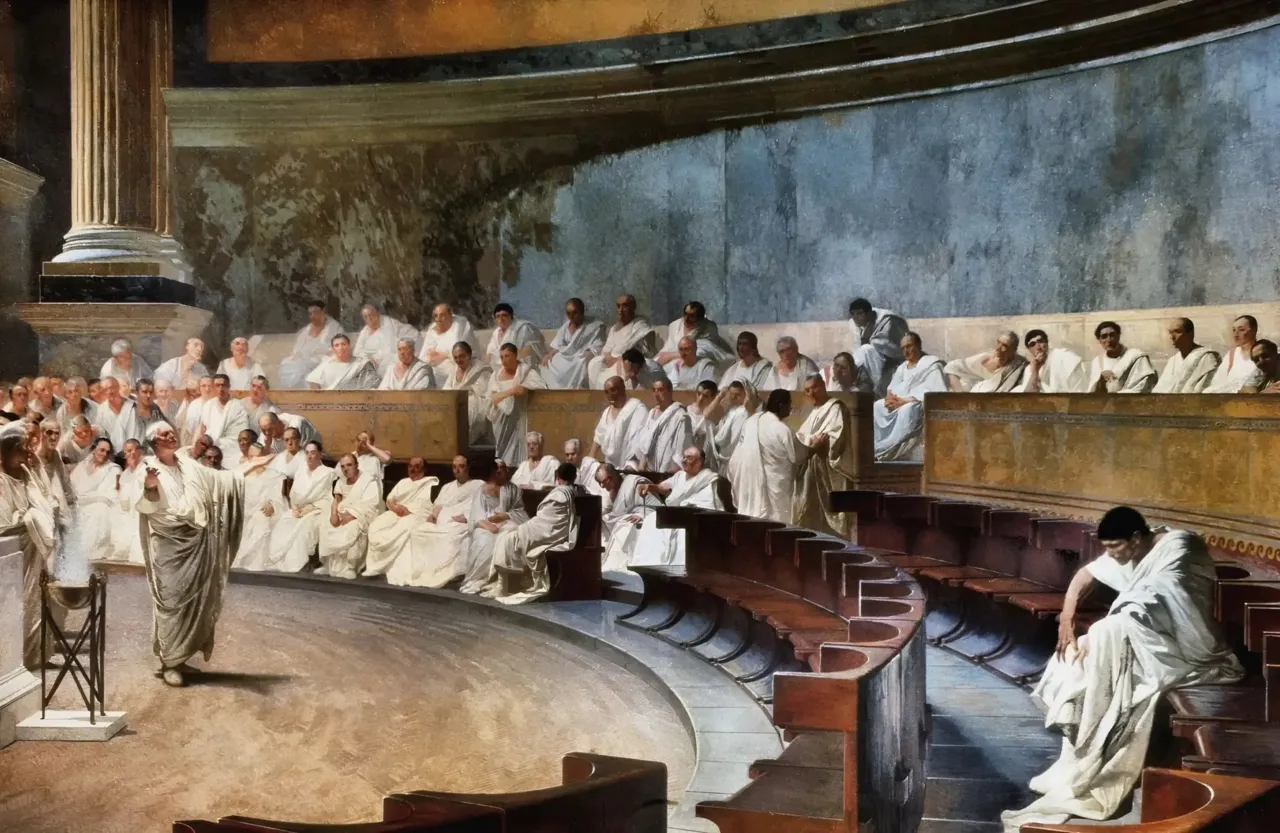
Nella primavera del 43 a.C. la situazione precipitò. Antonio, assediante Decimo Bruto (uno dei cesaricidi, cugino del più celebre Marco) a Modena, fu sconfitto dalle truppe consolari romane sostenute da Ottaviano nella battaglia di Modena (21 aprile 43 a.C.). Entrambi i consoli, Irzio e Pansa, morirono in combattimento: circostanza così conveniente per Ottaviano che gli storici antichi mormoravano di veleno. Restato unico comandante senza superiori, il diciannovenne marciò su Roma con otto legioni e impose al Senato il proprio consolato. Il 19 agosto 43 a.C. Ottaviano fu console, a poco meno di vent'anni, contro tutte le leggi sul cursus honorum. Cicerone lo aveva sottovalutato.
In spring 43 BC the situation precipitated. Antony, besieging Decimus Brutus (one of Caesar's assassins, cousin of the more famous Marcus) at Mutina, was defeated by the Roman consular troops backed by Octavian at the battle of Mutina (21 April 43 BC). Both consuls, Hirtius and Pansa, died in combat, a circumstance so convenient for Octavian that ancient historians whispered of poison. Now the sole commander without superiors, the nineteen-year-old marched on Rome with eight legions and imposed his own consulship on the Senate. On 19 August 43 BC Octavian became consul, at barely twenty, against every law of the cursus honorum. Cicero had underestimated him.
Ottaviano in Italia, Antonio in Gallia Cisalpina con sette legioni, Lepido in Gallia Narbonense e Spagna Citeriore con quattro legioni: controllavano insieme oltre quaranta legioni cesariane. Tutti e tre rivendicavano l'eredità di Cesare. Tutti e tre dovevano vendicarlo per legittimarsi. Ma se si fossero combattuti, i cesaricidi (Bruto e Cassio) in Oriente li avrebbero finiti uno alla volta. La logica era spietatamente chiara: o alleanza, o estinzione comune. Antonio e Lepido si incontrarono prima, sulle rive del Lavinius in Gallia; poi convocarono Ottaviano.
Octavian in Italy, Antony in Cisalpine Gaul with seven legions, Lepidus in Narbonensis Gaul and Hispania Citerior with four legions, together they controlled over forty Caesarian legions. All three claimed Caesar's inheritance. All three needed to avenge him to legitimise themselves. But if they fought, the assassins (Brutus and Cassius) in the East would finish them off one at a time. The logic was pitilessly clear: alliance, or shared extinction. Antony and Lepidus met first, on the banks of the Lavinius in Gaul; then they summoned Octavian.
02I Tre ProtagonistiThe Three Protagonists
A differenza del Primo Triumvirato, in cui le tre figure (Cesare, Pompeo, Crasso) portavano capitali politici diversi e complementari, il Secondo Triumvirato unì tre cesariani: tutti e tre eredi politici del dittatore, tutti e tre con clientele e legioni proprie. Era un'alleanza di calcolo fra rivali destinati a scontrarsi.
Unlike the First Triumvirate, in which the three figures (Caesar, Pompey, Crassus) brought different and complementary political capitals, the Second united three Caesarians, all three political heirs of the dictator, all three with their own clienteles and legions. It was a calculated alliance among rivals destined to clash.
 Ottaviano
L'Erede · 63 a.C. – 14 d.C.
The Heir · 63 BC – AD 14
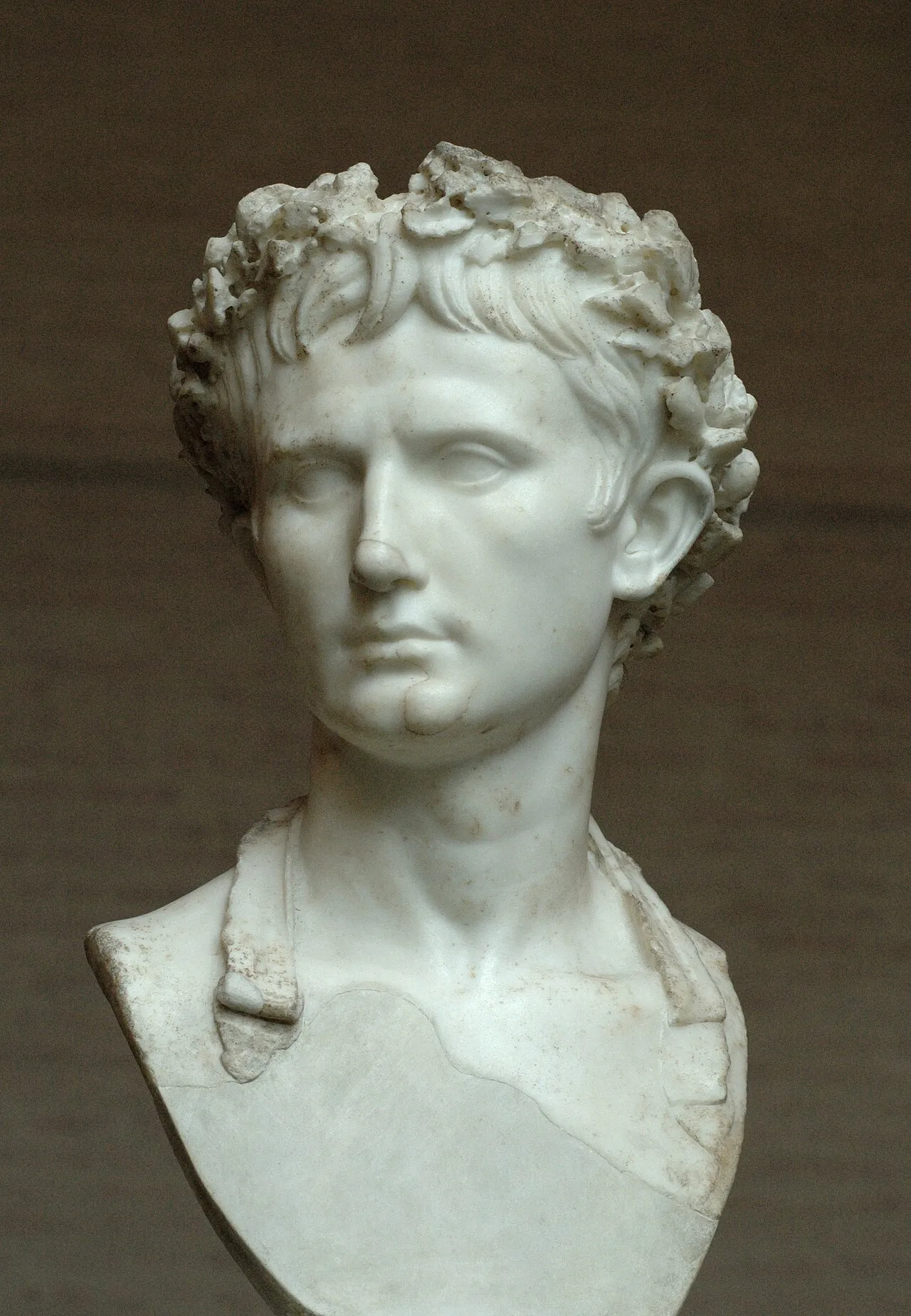
Ottaviano
L'Erede · 63 a.C. – 14 d.C.
The Heir · 63 BC – AD 14
Diciannove anni nel 43 a.C., gracile di salute ma freddo come pochi nella storia romana, Ottaviano portò al patto il nome di Cesare e la fedeltà delle legioni veterane che si sentivano in dovere col defunto dittatore. Sapeva aspettare; sapeva spettare l'occasione anche per decenni. Sarebbe diventato Augusto.
Nineteen in 43 BC, fragile in health but as cold as anyone in Roman history, Octavian brought to the pact Caesar's name and the loyalty of veteran legions who felt indebted to the dead dictator. He knew how to wait; he could bide his time for decades. He would become Augustus.
 Marco Antonio
Il Soldato · 83–30 a.C.
The Soldier · 83–30 BC
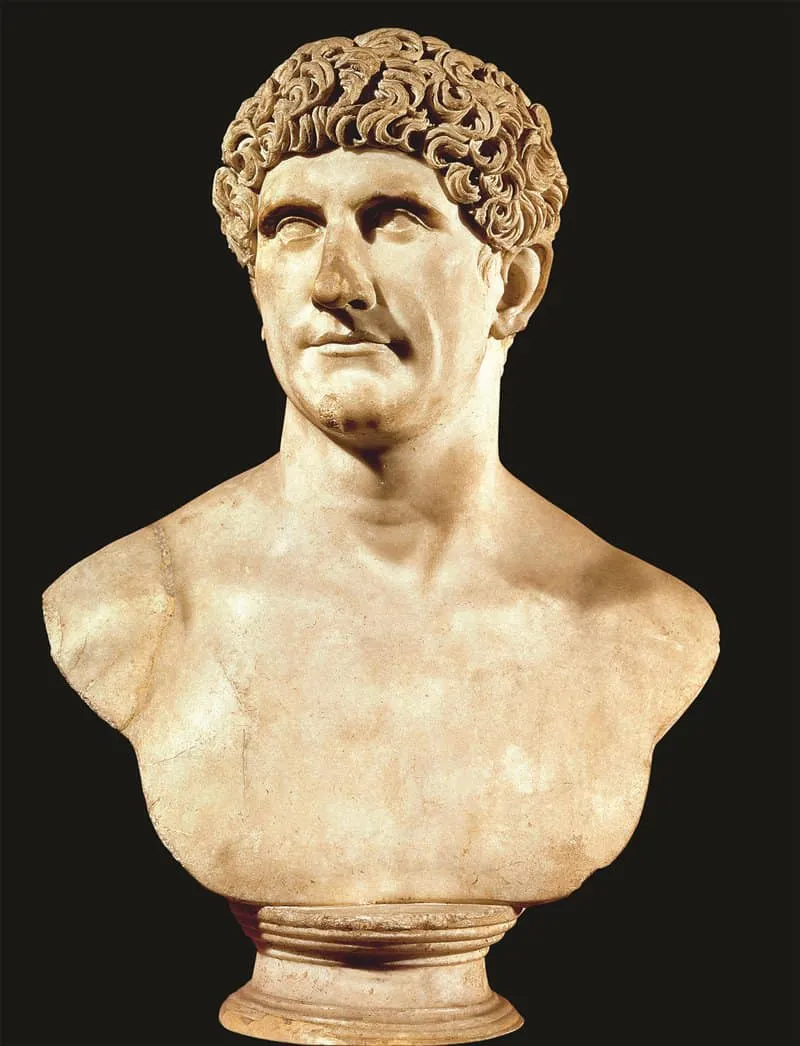
Marco Antonio
Il Soldato · 83–30 a.C.
The Soldier · 83–30 BC
Quarantenne, alto e robusto, già luogotenente di Cesare nelle Gallie e a Farsalo, console nel 44 a.C., Antonio era il vero generale del trio: portava nelle vene il prestigio militare cesariano e il controllo diretto delle legioni veterane di Cesare. Carismatico, generoso, dissoluto. Avrebbe preso l'Oriente e, con esso, Cleopatra.
In his forties, tall and robust, already Caesar's lieutenant in Gaul and at Pharsalus, consul in 44 BC, Antony was the true general of the trio: he carried in his veins the Caesarian military prestige and the direct command of Caesar's veteran legions. Charismatic, generous, dissolute. He would take the East and, with it, Cleopatra.
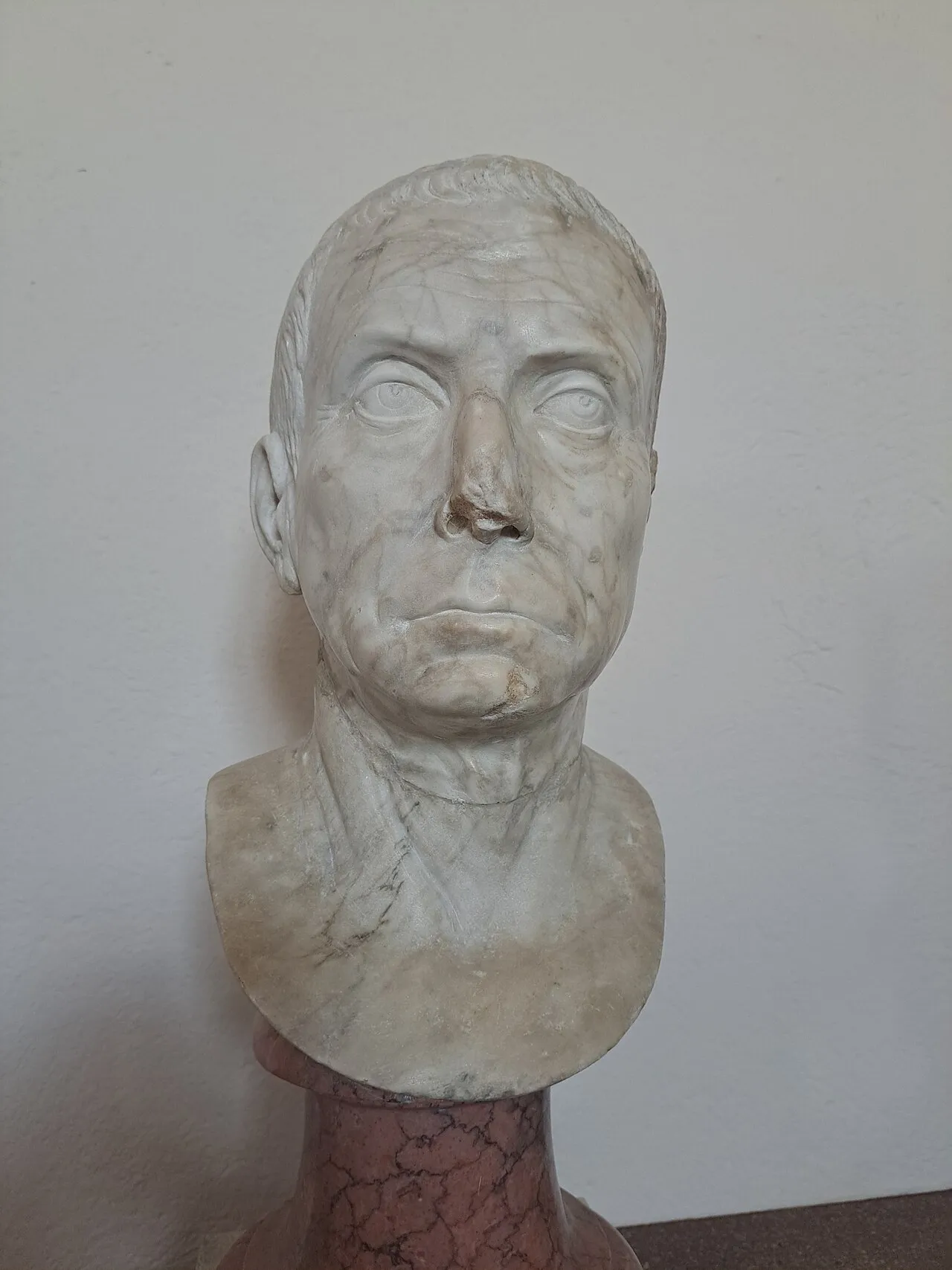 Marco Emilio Lepido
Il Pontefice · ~88–13/12 a.C.
The Pontiff · ~88–13/12 BC
Marco Emilio Lepido
Il Pontefice · ~88–13/12 a.C.
The Pontiff · ~88–13/12 BC
Il meno carismatico dei tre ma fondamentale all'origine: pontifex maximus dopo la morte di Cesare, comandante di sette legioni in Gallia Narbonense e Spagna, possedeva l'unico esercito vicino all'Italia capace di rovesciare l'equilibrio. Avrebbe ricevuto l'Africa, sarebbe stato emarginato nel 36 a.C., e sopravvissuto fino al 12 a.C., vecchio testimone della fine della Repubblica.
The least charismatic of the three but fundamental at the start: pontifex maximus after Caesar's death, commander of seven legions in Narbonensis Gaul and Spain, he held the only army near Italy capable of overturning the balance. He would receive Africa, would be sidelined in 36 BC, and survive until 12 BC, old witness to the end of the Republic.
03Bologna e la Lex Titia — 43 a.C.Bologna and the Lex Titia — 43 BC
L'incontro di Bologna durò tre giorni. Le clausole concordate furono di una gravità senza precedenti:
The Bologna meeting lasted three days. The agreed clauses were of unprecedented gravity:
- Clausola 1Clause 1 Magistratura collegiale per cinque anni.Collegial magistracy for five years. I tre divennero Tresviri Rei Publicae Constituendae, «triumviri per la costituzione dello Stato», con potere di emanare editti con forza di legge, nominare magistrati e governatori, condannare a morte senza processo. De facto una dittatura tripartita.The three became Tresviri Rei Publicae Constituendae, «triumvirs for the constitution of the State», with power to issue edicts with the force of law, appoint magistrates and governors, condemn to death without trial. De facto a tripartite dictatorship.
- Clausola 2Clause 2 Spartizione provinciale immediata.Immediate provincial division. Antonio: Gallie (eccetto la Narbonense). Lepido: Gallia Narbonense e Spagne. Ottaviano: Africa, Sicilia, Sardegna (le province più povere e quelle infestate da Sesto Pompeo). L'Oriente restava da conquistare contro Bruto e Cassio.Antony: the Gauls (except Narbonensis). Lepidus: Narbonensis and Spains. Octavian: Africa, Sicily, Sardinia (the poorest provinces, those infested by Sextus Pompey). The East still had to be conquered against Brutus and Cassius.
- Clausola 3Clause 3 Proscrizioni.Proscriptions. Eliminazione fisica di chi avrebbe potuto opporsi: senatori, cavalieri, ricchi possidenti. Liste pubbliche, taglie sui capi, beni confiscati al fisco. Ciascun triumviro dovette concedere agli altri il diritto di iscrivere alcuni dei propri parenti o amici: il «patto del sangue». Antonio sacrificò lo zio materno Lucio Cesare; Lepido il fratello Paolo Emilio; Ottaviano (a malincuore, ma sacrificò) Cicerone.Physical elimination of anyone who might oppose them: senators, knights, wealthy landowners. Public lists, bounties, assets confiscated. Each triumvir had to grant the others the right to put some of their own relatives or friends on the list: the «blood pact». Antony sacrificed his maternal uncle Lucius Caesar; Lepidus his brother Paulus Aemilius; Octavian (reluctantly, but he sacrificed) Cicero.
Il 27 novembre 43 a.C. il tribuno della plebe Publio Tizio fece votare al popolo la Lex Titia, che trasformò l'accordo privato in magistratura legalmente costituita. È questa la differenza decisiva col Primo Triumvirato: mentre il patto di Cesare-Pompeo-Crasso era stato un'intesa privata, mai sancita da legge, il Secondo fu, per la prima volta nella storia romana, una dittatura collegiale legalmente votata. La Repubblica si era ufficialmente sospesa da sola.
On 27 November 43 BC the tribune of the plebs Publius Titius had the people vote the Lex Titia, which transformed the private agreement into a legally constituted magistracy. This is the decisive difference from the First Triumvirate: while the Caesar-Pompey-Crassus pact had been a private understanding, never sanctioned by law, the Second was, for the first time in Roman history, a legally voted collegial dictatorship. The Republic had officially suspended itself.
A suggellare l'alleanza fra Antonio e Ottaviano fu un matrimonio politico (come per il primo triumvirato, in cui Pompeo aveva sposato Giulia, figlia di Cesare): nel 40 a.C. Marco Antonio avrebbe sposato Ottavia Minore, sorella di Ottaviano. Donna di grande dignità, generò ad Antonio due figlie. Sarebbe stata abbandonata e ripudiata otto anni dopo per Cleopatra, l'atto che innescò la guerra finale.
To seal the alliance between Antony and Octavian came a political marriage (as in the first triumvirate, when Pompey married Julia, Caesar's daughter): in 40 BC Mark Antony would marry Octavia Minor, Octavian's sister. A woman of great dignity, she bore Antony two daughters. She would be abandoned and repudiated eight years later for Cleopatra: the act that triggered the final war.
04Le Proscrizioni — la Morte di CiceroneThe Proscriptions — Cicero's Death
A novembre del 43 a.C. furono affisse al Foro le prime liste. I numeri restano discussi (le fonti antiche oscillano fra cifre molto diverse), ma il quadro è chiaro: circa 300 senatori e circa 2.000 cavalieri furono iscritti come nemici pubblici, da uccidere a vista. Le teste portate a Roma valevano premi in oro per il sicario, immunità per lo schiavo che denunciava il padrone, sterminio per chi nascondeva un proscritto. I beni confiscati servirono a pagare le legioni: operazione finanziaria oltre che politica.
In November 43 BC the first lists were posted in the Forum. The numbers remain debated (ancient sources oscillate widely), but the picture is clear: around 300 senators and around 2,000 knights were entered as public enemies, to be killed on sight. The heads brought to Rome paid bounties in gold to the assassin, immunity to the slave who denounced his master, extermination for whoever hid a proscribed man. The confiscated assets paid the legions: a financial operation as well as a political one.
La vittima simbolica fu Marco Tullio Cicerone. Le sue Filippiche avevano spinto il Senato contro Antonio; Antonio non perdonò. Cicerone, sessantatreenne, tentò la fuga via mare verso la Grecia ma il maltempo lo ricacciò sulla costa di Formia. Il 7 dicembre 43 a.C. i sicari di Antonio lo raggiunsero in lettiga vicino al mare. Plutarco racconta che Cicerone, riconoscendoli, sporse il collo dalla lettiga, fermo e immobile, offrendosi al colpo. Aveva il viso scarno, sporco di polvere, gli occhi pieni di stanchezza. Il centurione Erennio gli tagliò la testa e le mani: le mani che avevano scritto le Filippiche. Antonio le fece inchiodare sui Rostri del Foro, là dove Cicerone aveva pronunciato le sue più grandi orazioni. Si dice che Fulvia, moglie di Antonio, trafisse la lingua di Cicerone con una spilla d'oro.
The symbolic victim was Marcus Tullius Cicero. His Philippics had pushed the Senate against Antony; Antony did not forgive. Cicero, sixty-three, tried to flee by sea toward Greece but bad weather drove him back to the coast of Formia. On 7 December 43 BC Antony's assassins reached him on his litter near the sea. Plutarch reports that Cicero, recognising them, stretched out his neck from the litter, still and motionless, offering himself to the blow. His face was emaciated, smeared with dust, his eyes full of weariness. The centurion Herennius cut off his head and his hands: the hands that had written the Philippics. Antony had them nailed to the Rostra in the Forum, where Cicero had delivered his greatest orations. It is said that Fulvia, Antony's wife, pierced Cicero's tongue with a golden hairpin.
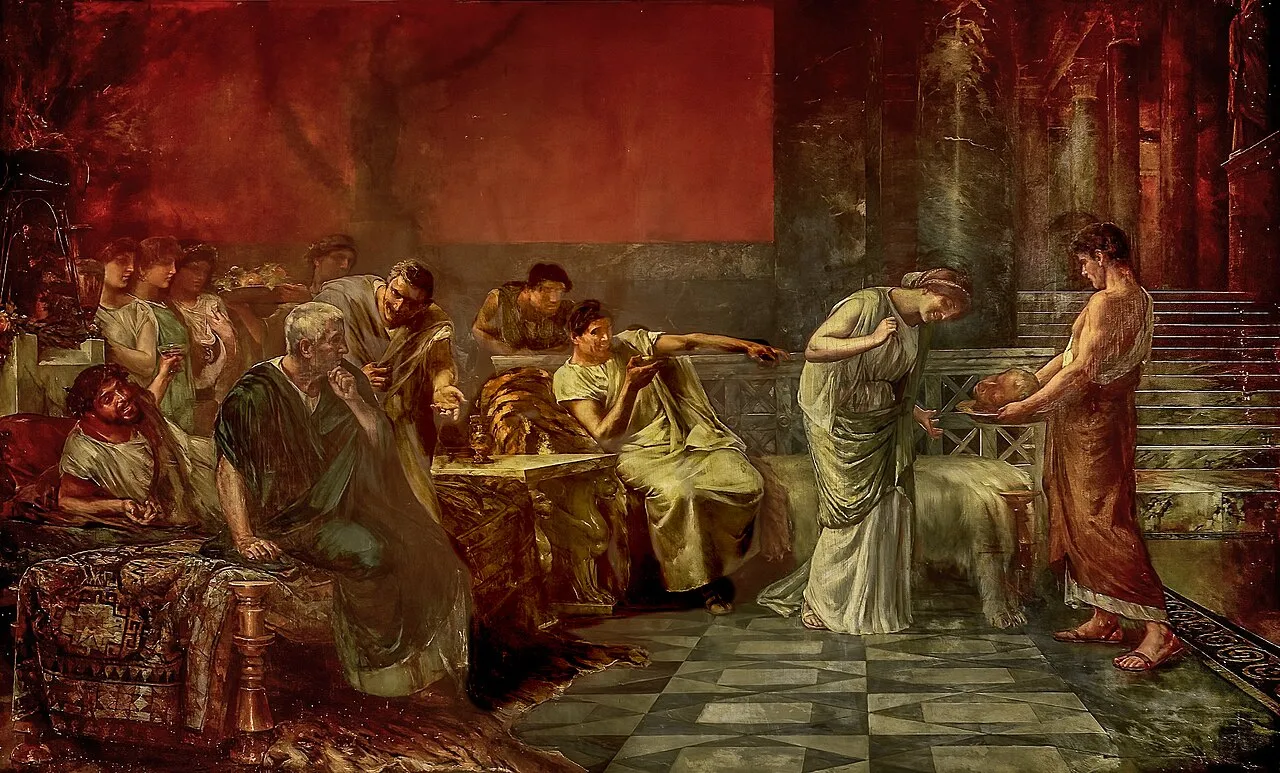
Le proscrizioni produssero anche eroismi opposti: schiavi che morirono per proteggere padroni, mogli (come la celebre Turia nota dal suo epitaffio) che nascosero il marito per mesi. Ma il bilancio fu un'epurazione che paralizzò ogni residua opposizione e drenò ogni patrimonio possibile. Quando le liste si chiusero, nessuno a Roma poteva ancora sognare di restaurare la Repubblica.
The proscriptions also produced opposite heroisms: slaves who died protecting masters, wives (like the celebrated Turia known from her epitaph) who hid their husbands for months. But the result was a purge that paralysed every residual opposition and drained every possible fortune. When the lists closed, no one in Rome could still dream of restoring the Republic.
05Filippi — Ottobre 42 a.C.Philippi — October 42 BC
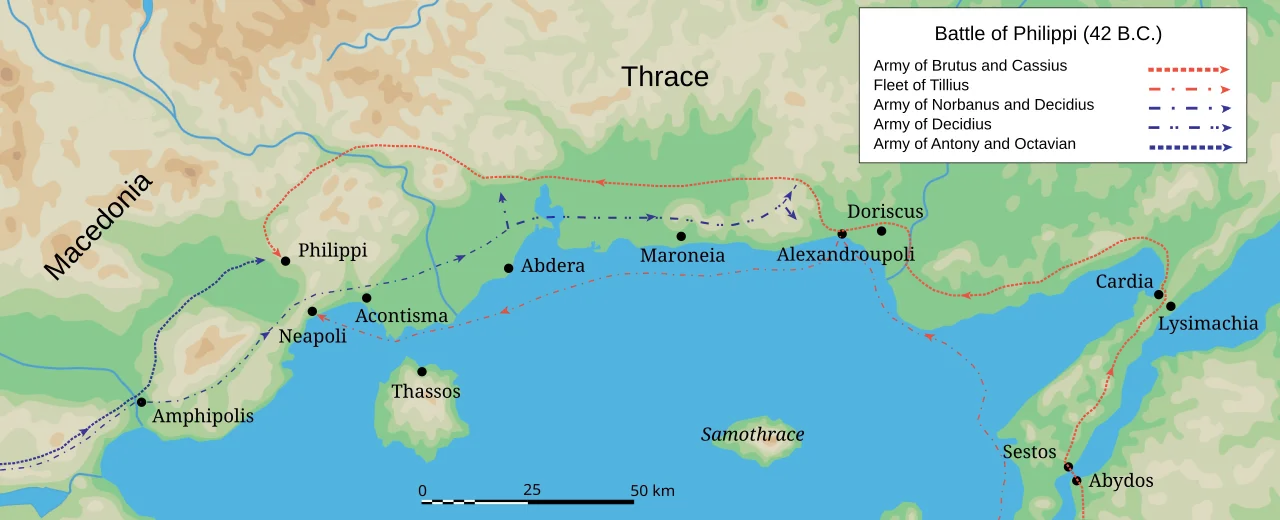
Liberata Roma dalle minacce interne, i triumviri rivolsero le armi contro i liberatores. Bruto e Cassio avevano accumulato in Oriente una forza notevole: diciannove legioni, circa 80.000 fanti, 17.000 cavalieri, l'intero tesoro delle province orientali. Antonio e Ottaviano sbarcarono in Grecia con un esercito leggermente inferiore di numero ma più aggressivo. Si fronteggiarono nella piana di Filippi, in Macedonia, presso il monte Pangeo.
Having freed Rome from internal threats, the triumvirs turned their arms against the liberatores. Brutus and Cassius had amassed in the East a considerable force: nineteen legions, around 80,000 infantry, 17,000 cavalry, the entire treasury of the eastern provinces. Antony and Octavian landed in Greece with an army slightly smaller in number but more aggressive. They faced each other on the plain of Philippi, in Macedonia, near Mount Pangaion.
-
Prima battaglia
3 ottobre 42First battle
3 Oct 42 Esito incerto.Mixed outcome. Antonio attacca il campo di Cassio sulla destra e lo travolge. Bruto sulla sinistra travolge il campo di Ottaviano, che riesce a salvarsi nascondendosi (ufficialmente «malato»). Cassio, isolato, in una nube di polvere fraintende la situazione e si crede sconfitto; ordina al liberto Pindaro di ucciderlo. Era forse il più capace dei due cesaricidi.Antony attacks Cassius's camp on the right and overwhelms it. Brutus on the left overwhelms Octavian's camp, who manages to save himself by hiding (officially «ill»). Cassius, isolated, in a cloud of dust misreads the situation and believes himself defeated; orders his freedman Pindarus to kill him. He was perhaps the more capable of the two assassins. -
Seconda battaglia
23 ottobre 42Second battle
23 Oct 42 Vittoria triumvirale.Triumvir victory. Bruto, indebolito, è costretto allo scontro da pressioni dei suoi ufficiali. La linea repubblicana cede. Bruto fugge con pochi compagni; il giorno dopo si suicida con la spada offerta da un amico. Le ultime parole, secondo Plutarco: «Virtù, non eri che un nome.» La generazione politica del Senato repubblicano scompare in due settimane.Brutus, weakened, is forced into battle by pressure from his officers. The Republican line breaks. Brutus flees with few companions; the next day he commits suicide with a sword offered by a friend. His last words, per Plutarch: «Virtue, you were but a name.» The political generation of the Republican Senate vanishes in two weeks.
Filippi consacrò Marco Antonio come il vero vincitore: era stato lui a vincere entrambe le battaglie. Ottaviano, scampato a malapena, era ancora il «ragazzino». La spartizione successiva, ratificata col patto di Brindisi nel 40 a.C., ne tenne conto: Antonio prese l'Oriente, Grecia, Asia Minore, Siria, Egitto, la parte più ricca e prestigiosa. Ottaviano ebbe l'Occidente (Italia, Gallia, Spagna), meno ricca ma con Roma e l'Italia. Lepido restò con l'Africa, sempre più marginalizzato.
Philippi consecrated Mark Antony as the real victor: he had won both battles. Octavian, narrowly escaped, was still the «little boy». The subsequent partition, ratified by the pact of Brundisium in 40 BC, took this into account: Antony took the East: Greece, Asia Minor, Syria, Egypt, the richest and most prestigious portion. Octavian got the West: Italy, Gaul, Spain, less wealthy but with Rome and Italy. Lepidus was left with Africa, ever more sidelined.
06Spartizione e Tensioni — 40–36 a.C.Partition and Tensions — 40–36 BC
Per cinque anni il triumvirato funzionò a singhiozzo. Antonio si stabilì in Oriente a riorganizzare le province, riscuotere tributi enormi, preparare la guerra contro i Parti, quella che doveva vendicare Carre del 53 a.C. e, allo stesso tempo, dargli la gloria di conquistator che mancava. Ad Alessandria, nell'inverno 41/40 a.C., conobbe Cleopatra VII Filopatore, regina d'Egitto, già amante di Cesare e madre di un figlio (Cesarione) che la regina sosteneva fosse di Cesare. L'incontro fu sia politico (Antonio aveva bisogno dell'oro e del grano d'Egitto) sia personale: ne nacque una relazione che produsse gemelli (Alessandro Helios, Cleopatra Selene) nel 40 a.C. e un terzo figlio (Tolomeo Filadelfo) nel 36 a.C.
For five years the triumvirate functioned fitfully. Antony settled in the East to reorganise the provinces, collect enormous tribute, prepare the war against the Parthians, the one meant to avenge Carrhae of 53 BC and at the same time give him the conqueror's glory he lacked. In Alexandria, in the winter of 41/40 BC, he met Cleopatra VII Philopator, queen of Egypt, already Caesar's lover and mother of a son (Caesarion) whom the queen claimed was Caesar's. The encounter was both political (Antony needed Egypt's gold and grain) and personal: a relationship arose that produced twins (Alexander Helios, Cleopatra Selene) in 40 BC and a third child (Ptolemy Philadelphus) in 36 BC.
In Italia Ottaviano si trovò a fronteggiare due crisi parallele. La guerra di Perugia (41–40 a.C.), sollevata dal fratello di Antonio, Lucio, e dalla cognata Fulvia per minare la sua posizione, si chiuse con la resa di Perugia dopo un terribile assedio. Ottaviano risparmiò Lucio ma, secondo Svetonio, fece giustiziare trecento notabili davanti all'ara di Cesare nelle Idi di marzo del 40 a.C. Più grave fu il problema di Sesto Pompeo, figlio di Pompeo Magno, che aveva preso il controllo della Sicilia, Sardegna e Corsica, e con la sua flotta bloccava il grano africano ed egiziano destinato a Roma. La fame nell'urbe esplose in rivolte.
In Italy Octavian had to face two parallel crises. The Perusine War (41–40 BC), raised by Antony's brother Lucius and sister-in-law Fulvia to undermine his position, ended with the surrender of Perugia after a terrible siege. Octavian spared Lucius but, according to Suetonius, had three hundred notables executed before Caesar's altar on the Ides of March 40 BC. More serious was the problem of Sextus Pompey, son of Pompey the Great, who had taken control of Sicily, Sardinia and Corsica, and with his fleet was blockading the African and Egyptian grain destined for Rome. Famine in the city exploded into riots.
- 40 a.C. Patto di BrindisiPact of Brundisium — Antonio e Ottaviano riconfermano l'alleanza dopo la crisi perusina. Antonio sposa Ottavia. Lepido relegato all'Africa.Antony and Octavian reconfirm the alliance after the Perusine crisis. Antony marries Octavia. Lepidus relegated to Africa.
- 39 a.C. Patto di Miseno con Sesto PompeoPact of Misenum with Sextus Pompey — Sesto ottiene Sicilia, Sardegna, Corsica e l'Acaia in cambio della fine del blocco navale. Un compromesso che durerà pochi mesi.Sextus gains Sicily, Sardinia, Corsica and Achaea in exchange for ending the naval blockade. A compromise that will last only months.
- 37 a.C. Patto di TarantoPact of Tarentum — Rinnovo del triumvirato per altri cinque anni (la Lex Titia era ormai scaduta da mesi: l'atto era retroattivamente illegale). Antonio cede 120 navi a Ottaviano per la guerra contro Sesto; Ottaviano promette 20.000 legionari per la campagna partica: promessa che non manterrà.Renewal of the triumvirate for five more years (the Lex Titia had expired months earlier: the act was retroactively illegal). Antony hands 120 ships to Octavian for the war against Sextus; Octavian promises 20,000 legionaries for the Parthian campaign: a promise he will not keep.
- 36 a.C. Nauloco e l'eliminazione di LepidoNaulochus and the elimination of Lepidus — Marco Vipsanio Agrippa, ammiraglio di Ottaviano, distrugge la flotta di Sesto Pompeo presso Nauloco (Sicilia, 3 settembre). Lepido, sbarcato in Sicilia con dodici legioni, tenta di rivendicare l'isola; Ottaviano marcia disarmato nel suo campo e si fa acclamare dai suoi soldati. Lepido è destituito, lasciato col solo pontificato massimo, esiliato a Circeo per i restanti ventiquattro anni di vita.Marcus Vipsanius Agrippa, Octavian's admiral, destroys Sextus Pompey's fleet near Naulochus (Sicily, 3 September). Lepidus, landing in Sicily with twelve legions, tries to claim the island; Octavian walks unarmed into his camp and has himself acclaimed by his soldiers. Lepidus is deposed, left with only the pontificate, exiled to Circeii for the remaining twenty-four years of his life.
Dopo il 36 a.C. il triumvirato è di fatto un duumvirato: il mondo romano è diviso fra Ottaviano (Occidente) e Antonio (Oriente), con Lepido neutralizzato. Le tensioni montano. Antonio, fallita disastrosamente la campagna partica del 36 a.C. (ritirata catastrofica con perdita di 32.000 uomini), ripiega ad Alessandria e sempre più si identifica con la corte tolemaica.
After 36 BC the triumvirate is effectively a duumvirate: the Roman world is divided between Octavian (West) and Antony (East), with Lepidus neutralised. Tensions rise. Antony, after the disastrous failure of the Parthian campaign of 36 BC (catastrophic retreat losing 32,000 men), withdraws to Alexandria and increasingly identifies with the Ptolemaic court.
Nel 34 a.C. Antonio celebrò in Alessandria un trionfo militare per la conquista dell'Armenia, atto già sospetto perché un trionfo si tributava solo a Roma. Poi, in una cerimonia ufficiale, distribuì regni a Cleopatra e ai loro figli: Cesarione fu proclamato co-sovrano dell'Egitto col titolo di Rex Regum; Alessandro Helios ricevette Armenia, Media, Partia (da conquistare); Cleopatra Selene la Cirenaica; Tolomeo Filadelfo la Siria e l'Asia Minore. Erano titoli regali su territori romani. Era, di fatto, una secessione orientale. A Roma, Ottaviano sfruttò ogni dettaglio per dipingere Antonio come traditore caduto in mano a una regina straniera.
In 34 BC Antony celebrated in Alexandria a military triumph for the conquest of Armenia, itself suspect because triumphs were granted only at Rome. Then, in an official ceremony, he distributed kingdoms to Cleopatra and their children: Caesarion was proclaimed co-sovereign of Egypt with the title Rex Regum; Alexander Helios received Armenia, Media, Parthia (to be conquered); Cleopatra Selene received Cyrenaica; Ptolemy Philadelphus received Syria and Asia Minor. These were royal titles over Roman territory. It was, in effect, an Eastern secession. At Rome, Octavian exploited every detail to paint Antony as a traitor fallen into the hands of a foreign queen.
07Azio — 2 Settembre 31 a.C.Actium — 2 September 31 BC
Nel 32 a.C. la Lex Titia, anche col rinnovo di Taranto, era scaduta. I due rivali erano formalmente privati cittadini. Ottaviano, con un atto di una spregiudicatezza estrema, fece irruzione nel tempio di Vesta a Roma, prese con la forza il testamento privato di Antonio (depositato dalle Vestali) e ne lesse in Senato i passaggi più scandalosi: Antonio voleva essere sepolto ad Alessandria accanto a Cleopatra, riconosceva Cesarione come figlio legittimo di Cesare, distribuiva i territori romani come regali alla regina egiziana. Lo scandalo paralizzò ogni residua simpatia per Antonio. Ottaviano fece dichiarare guerra non a Antonio (cittadino romano) ma a Cleopatra: un trucco di propaganda che evitava una formale guerra civile.
In 32 BC the Lex Titia, even with the renewal of Tarentum, had expired. The two rivals were formally private citizens. Octavian, with an act of extreme audacity, broke into the temple of Vesta at Rome, seized by force Antony's private will (deposited with the Vestals) and read in the Senate its most scandalous passages: Antony wanted to be buried in Alexandria beside Cleopatra, recognised Caesarion as Caesar's legitimate son, distributed Roman territories as gifts to the Egyptian queen. The scandal paralysed any remaining sympathy for Antony. Octavian had war declared not on Antony (a Roman citizen) but on Cleopatra: a propaganda trick avoiding a formal civil war.
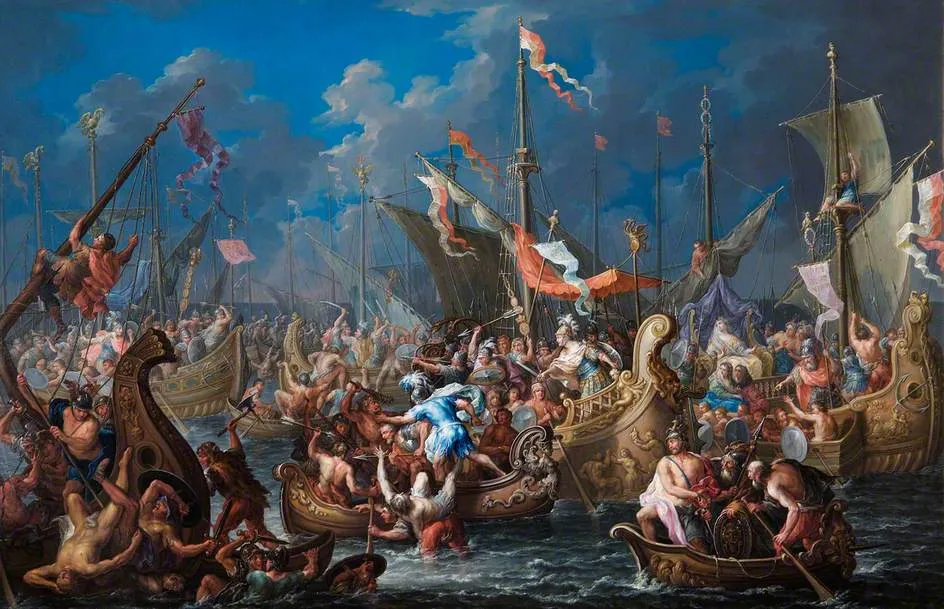
Le due flotte si fronteggiarono per mesi al largo delle coste della Grecia occidentale, nel golfo di Ambracia. Antonio disponeva di circa 500 navi (incluse 200 egiziane di Cleopatra), 100.000 fanti, 12.000 cavalieri. Ottaviano aveva circa 400 navi, più piccole e agili (le liburnae sviluppate da Agrippa), 80.000 fanti. Le navi di Antonio erano colossali quadriremi e quinqueremi rinforzate, lente ma micidiali in caso di abbordaggio. Le navi di Agrippa puntavano sulla mobilità e sulle frecce incendiarie.
The two fleets faced each other for months off the western coast of Greece, in the Ambracian Gulf. Antony had around 500 ships (including 200 Egyptian under Cleopatra), 100,000 infantry, 12,000 cavalry. Octavian had around 400 ships, smaller and more agile (the liburnae developed by Agrippa), 80,000 infantry. Antony's ships were colossal reinforced quadriremes and quinqueremes, slow but deadly in boarding. Agrippa's ships relied on mobility and incendiary arrows.
Il blocco navale di Agrippa, lento ma metodico, tagliò i rifornimenti di Antonio sul promontorio di Azio. Diserzioni a migliaia, malattie, mancanza di vela. Il 2 settembre 31 a.C. Antonio fu costretto a forzare l'uscita dal golfo. Lo scontro durò ore. A metà battaglia, in circostanze contestate dalle fonti antiche, Cleopatra col suo squadrone di 60 navi sfondò la linea di battaglia e fuggì verso sud, verso Alessandria. Antonio, abbandonata la propria nave ammiraglia, la seguì su una nave veloce. La sua flotta, vista la fuga del comandante, si sgretolò: in poche ore Agrippa catturò o affondò 300 navi. Sulla terraferma le 19 legioni di Antonio, dopo una settimana, si arresero in massa a Ottaviano.
Agrippa's naval blockade, slow but methodical, cut Antony's supplies on the Actium promontory. Desertions in thousands, disease, lack of sails. On 2 September 31 BC Antony was forced to break out from the gulf. The clash lasted hours. Mid-battle, in circumstances contested by ancient sources, Cleopatra with her squadron of 60 ships broke through the line of battle and fled south, toward Alexandria. Antony, abandoning his flagship, followed on a swift vessel. His fleet, seeing the commander's flight, crumbled: within hours Agrippa captured or sank 300 ships. On land Antony's 19 legions, after a week, surrendered en masse to Octavian.
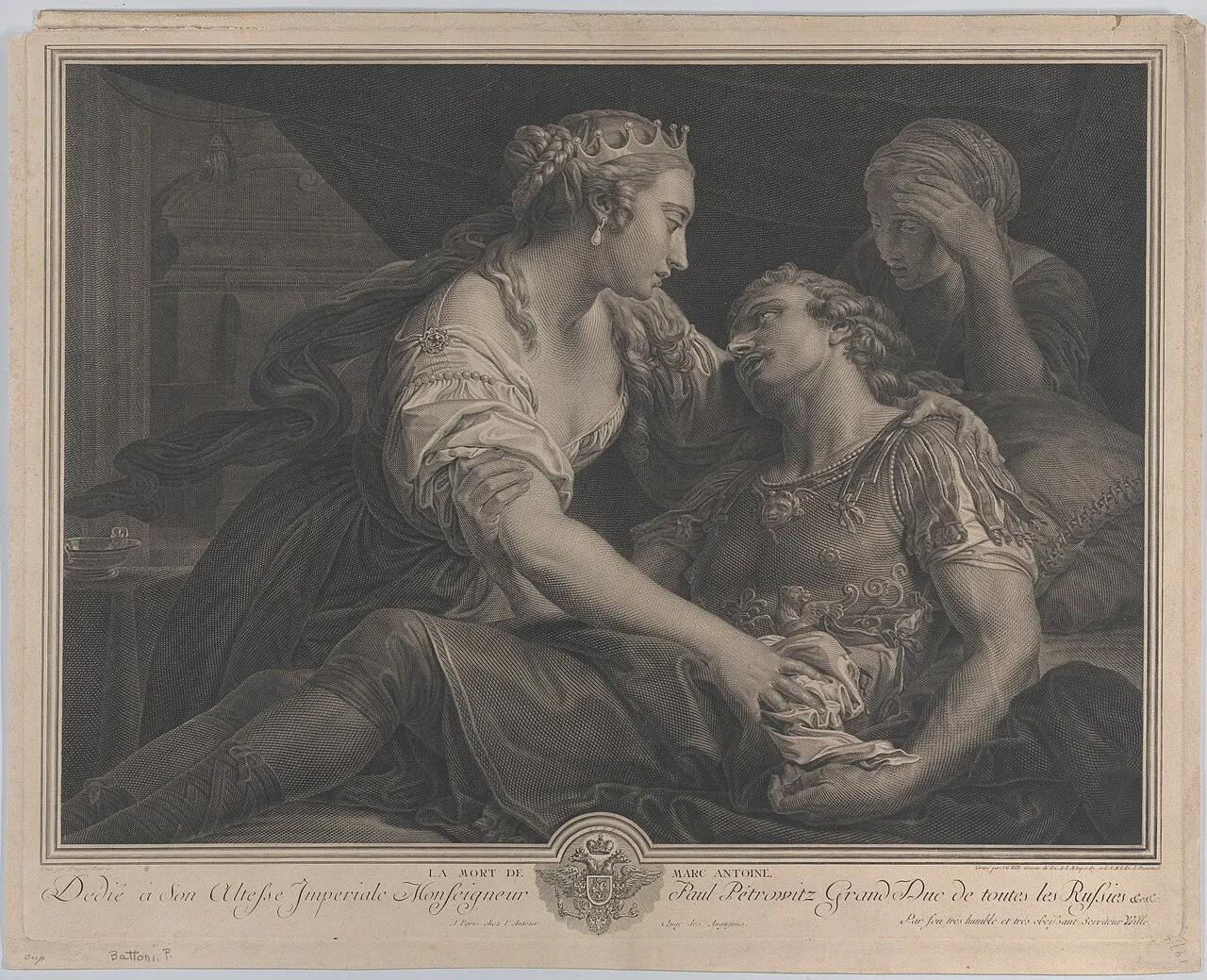
L'anno seguente Ottaviano invase l'Egitto. Antonio si suicidò ad Alessandria il 1° agosto 30 a.C., gettandosi sulla spada dopo aver ricevuto la falsa notizia della morte di Cleopatra. La regina lo seguì il 10 agosto, secondo la tradizione facendosi mordere da un'aspide nascosto fra i fichi. Cesarione, diciassettenne, fu cacciato e ucciso per ordine di Ottaviano: «troppi Cesari non vanno bene» — frase consigliata al giovane vincitore dal filosofo Areio Didimo. L'Egitto fu annesso come provincia Aegypti, governata personalmente dall'imperatore tramite un prefetto equestre: granaio personale di Roma.
The following year Octavian invaded Egypt. Antony committed suicide in Alexandria on 1 August 30 BC, throwing himself on his sword after receiving false news of Cleopatra's death. The queen followed on 10 August, by tradition having herself bitten by an asp hidden among figs. Caesarion, seventeen, was hunted down and killed by Octavian's order: «too many Caesars is no good thing» — a phrase suggested to the young victor by the philosopher Arius Didymus. Egypt was annexed as provincia Aegypti, governed personally by the emperor through an equestrian prefect: Rome's personal granary.
08Eredità — Dal Triumviro al PrincepsLegacy — From Triumvir to Princeps
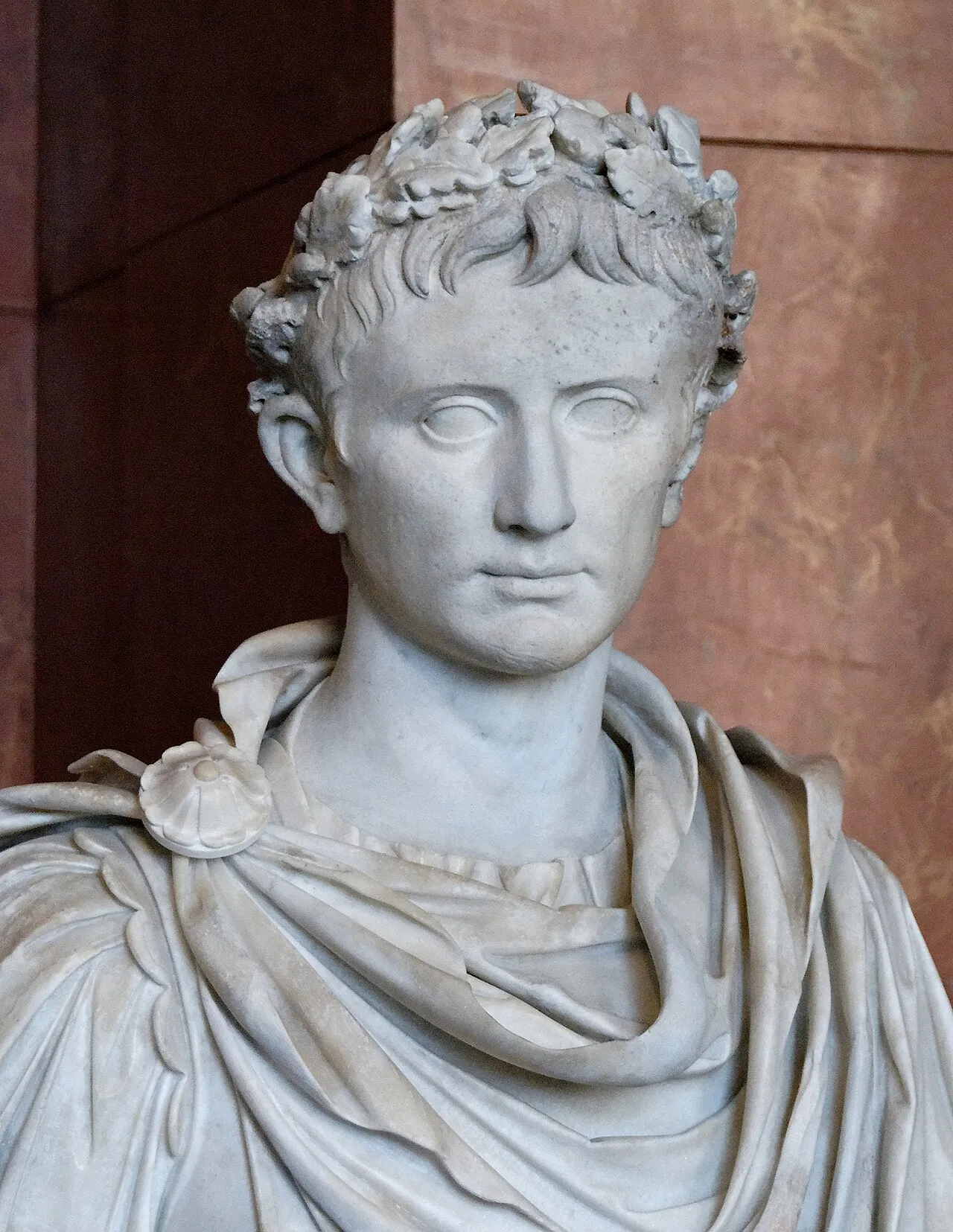
Ottaviano tornò a Roma nell'agosto del 29 a.C. e celebrò un triplice trionfo (per la Dalmazia, Azio, l'Egitto) che durò tre giorni. Aveva trentaquattro anni; era padrone unico del mondo romano. Ma trasse dalle vicende del triumvirato due lezioni che avrebbero plasmato il suo intero principato:
Octavian returned to Rome in August 29 BC and celebrated a triple triumph (for Dalmatia, Actium, Egypt) that lasted three days. He was thirty-four; he was sole master of the Roman world. But he drew from the triumvirate's events two lessons that would shape his entire principate:
- Lezione ILesson I Mai più sangue alle proscrizioni.Never again proscription blood. Le proscrizioni del 43 a.C. avevano funzionato sul piano militare ma macchiavano per sempre la legittimità. Ottaviano, da Augusto, avrebbe sempre preferito l'esilio alla condanna a morte: voleva apparire clemente, l'opposto di un dittatore arbitrario.The proscriptions of 43 BC had worked militarily but stained legitimacy forever. Octavian, as Augustus, would always prefer exile to capital punishment: he wanted to appear clement, the opposite of an arbitrary dictator.
- Lezione IILesson II Spersonalizzare il potere.Depersonalise power. Il triumvirato era crollato per gelosie personali. Augusto avrebbe rifiutato titoli odiosi (dictator, rex), accettando invece accumuli costanti di tribunicia potestas e imperium proconsulare, presentandosi come «primo cittadino» — princeps civitatis, che restaurava (formalmente) la Repubblica.The triumvirate had collapsed through personal jealousies. Augustus would refuse hateful titles (dictator, rex), accepting instead continuous accumulations of tribunicia potestas and imperium proconsulare, presenting himself as «first citizen» — princeps civitatis, restoring (formally) the Republic.
Il 13 gennaio 27 a.C. Ottaviano si presentò in Senato e «restituì» formalmente al popolo e al Senato i propri poteri straordinari. Era una commedia attentamente preparata: tre giorni dopo, il 16 gennaio 27 a.C., il Senato gli conferì il titolo onorifico di Augustus («venerabile», dal verbo augere, «aumentare»), gli affidò per dieci anni le province militarmente delicate (Spagna, Gallie, Siria, Egitto, dove stavano le legioni), gli concesse la corona civica, lo scudo d'oro nella Curia. Era il principato: una monarchia mascherata da magistratura repubblicana. La Repubblica era ufficialmente morta, ma nessun documento lo diceva.
On 13 January 27 BC Octavian appeared in the Senate and formally «returned» his extraordinary powers to the people and Senate. It was a carefully prepared comedy: three days later, on 16 January 27 BC, the Senate conferred on him the honorific title of Augustus («venerable», from augere, «to increase»), entrusted him for ten years with the militarily delicate provinces (Spain, Gauls, Syria, Egypt, where the legions were), granted him the civic crown, the gold shield in the Curia. This was the Principate: a monarchy masked as a Republican magistracy. The Republic was officially dead, but no document said so.
Lepido morì dimenticato a Circeo nel 12 a.C. Antonio era morto dal 30 a.C. Cesarione, Antillo (figlio maggiore di Antonio), Cesario il giovane, tutti gli eredi maschili degli altri attori, erano stati eliminati metodicamente. Augusto regnò ancora quarantun anni; quando morì nel 14 d.C., una generazione intera di romani non aveva mai conosciuto altro che il suo principato. Il sistema reggeva sulla sua persona. Sarebbe servito un altro secolo perché i romani capissero che la Repubblica non sarebbe tornata mai più.
Lepidus died forgotten at Circeii in 12 BC. Antony had been dead since 30 BC. Caesarion, Antyllus (Antony's eldest son), Cesario the younger, all the male heirs of the other actors, had been methodically eliminated. Augustus reigned forty-one more years; when he died in AD 14, an entire generation of Romans had known nothing but his principate. The system held on his person. It would take another century before Romans understood the Republic would never return.
09Differenze dal Primo TriumviratoDifferences from the First Triumvirate
Le due esperienze triumvirali, formalmente analoghe, divergono in tre punti decisivi:
The two triumvirate experiences, formally analogous, diverge on three decisive points:
- FormaForm Il Primo fu un patto privato, mai sancito da legge: il Senato continuò a sedere, anche se senza voce reale. Il Secondo fu costituito ufficialmente come magistratura straordinaria dalla Lex Titia: poteva emanare editti con forza di legge, condannare senza processo. Il Senato fu spogliato di ogni autonomia formale.The First was a private pact, never sanctioned by law: the Senate continued to sit, though without real voice. The Second was officially constituted as an extraordinary magistracy by the Lex Titia: it could issue edicts with the force of law, condemn without trial. The Senate was stripped of every formal autonomy.
- ViolenzaViolence Il Primo non si macchiò di sangue: la fame e l'esilio (Cicerone, Catone) furono i suoi strumenti. Il Secondo invece nacque con le proscrizioni, e le centinaia di cadaveri di senatori e cavalieri stesi nei portici resero impossibile ogni residua finzione repubblicana.The First did not stain itself with blood: hunger and exile (Cicero, Cato) were its tools. The Second was born with the proscriptions, and the hundreds of corpses of senators and knights stretched in the porticoes rendered any residual Republican fiction impossible.
- EsitoOutcome Il Primo si concluse con una guerra civile fra i sopravvissuti (Cesare contro Pompeo) e la dittatura cesariana, vinta solo per essere assassinata. Il Secondo si concluse con la guerra fra gli ultimi due (Ottaviano contro Antonio) e con la costruzione consapevole del principato: la prima dittatura romana che si presentò come restaurazione legittima.The First ended in civil war among the survivors (Caesar vs Pompey) and Caesarian dictatorship, won only to be assassinated. The Second ended in war between the last two (Octavian vs Antony) and the conscious construction of the principate: the first Roman dictatorship that presented itself as legitimate restoration.
Il Primo Triumvirato fu il metodo, l'invenzione di un governo di tre uomini sopra le istituzioni repubblicane. Il Secondo Triumvirato ne fu la versione legale e radicale: stesso metodo, ma sancito da legge, con poteri di vita e di morte e bagno di sangue iniziale. Per questo solo il Secondo poté trasformarsi, attraverso il sopravvissuto Ottaviano, in regime stabile. Il principato augusteo è la prosecuzione consapevole del triumvirato, depurata dei suoi tratti più odiosi e mascherata da continuità repubblicana.
The First Triumvirate was the method, the invention of a three-man government above Republican institutions. The Second Triumvirate was its legal and radical version: same method, but sanctioned by law, with powers of life and death and an inaugural bloodbath. For this reason only the Second could be transformed, through the survivor Octavian, into a stable regime. The Augustan principate is the conscious continuation of the triumvirate, purged of its most odious traits and masked as Republican continuity.