01Le CauseThe Causes
Per dieci anni Roma era stata governata da un patto privato fra tre uomini, il Primo Triumvirato: Pompeo, Crasso e Cesare. Era un'alleanza disuguale fra il più ricco (Crasso), il più popolare (Pompeo) e il più ambizioso (Cesare). Funzionò finché tutti e tre ne ebbero bisogno. Si ruppe nel 53 a.C., quando Crasso morì a Carre contro i Parti, e Pompeo, rimasto solo a Roma, si avvicinò agli aristocratici conservatori del senato. Cesare era ancora in Gallia, alla testa di un esercito veterano e fedele. La domanda non era se ma quando i due si sarebbero affrontati.
For ten years Rome had been governed by a private pact between three men, the First Triumvirate: Pompey, Crassus, and Caesar. It was an unequal alliance among the richest (Crassus), the most popular (Pompey), and the most ambitious (Caesar). It worked as long as all three needed it. It broke in 53 BC, when Crassus died at Carrhae against the Parthians, and Pompey, left alone in Rome, drew close to the conservative aristocrats of the senate. Caesar was still in Gaul, at the head of a veteran and loyal army. The question was not if but when the two would clash.
Il pretesto giuridico fu la fine del proconsolato gallico di Cesare. Il senato, manovrato da Pompeo e da Catone l'Uticense, gli intimò di tornare a Roma senza l'esercito: una volta privato cittadino, sarebbe stato processato per gli abusi amministrativi commessi e probabilmente esiliato. Cesare offrì un compromesso: se Pompeo avesse rinunciato al suo comando in Spagna, lui avrebbe rinunciato a quello in Gallia. Pompeo rifiutò . Il 7 gennaio 49 a.C. il senato emise il senatusconsultum ultimum, dichiarando Cesare nemico pubblico. Tre giorni dopo, Cesare attraversò il piccolo fiume Rubicone alla testa della XIII legione, pronunciando la celebre frase: alea iacta est. La guerra civile era cominciata.
The legal pretext was the end of Caesar's Gallic proconsulship. The senate, manoeuvred by Pompey and Cato the Younger, ordered him to return to Rome without his army: once a private citizen, he would be tried for administrative abuses and probably exiled. Caesar offered a compromise: if Pompey gave up his command in Spain, he would give up his in Gaul. Pompey refused. On 7 January 49 BC the senate issued the senatusconsultum ultimum, declaring Caesar a public enemy. Three days later, Caesar crossed the small Rubicon river at the head of the 13th legion, uttering the famous phrase: alea iacta est. The civil war had begun.
In tre mesi Cesare conquistò tutta l'Italia senza una vera battaglia: Pompeo, sorpreso dalla rapidità dell'avanzata, abbandonò Roma e si imbarcò con tutto il senato a Brindisi, fuggendo in Grecia. Fu una mossa strategica brillante (in Oriente Pompeo aveva clienti, alleati e flotte) ma psicologicamente disastrosa: il dittatore-in-pectore aveva abbandonato l'Italia ai cesariani. Cesare, padrone di Roma, non perse tempo. Sottomise la Spagna pompeiana in quaranta giorni (Ilerda, agosto 49 a.C.), e poi nell'inverno del 49–48 a.C. attraversò l'Adriatico per affrontare Pompeo nella sua roccaforte greca.
In three months Caesar conquered all of Italy without a real battle: Pompey, surprised by the speed of the advance, abandoned Rome and embarked with the entire senate at Brundisium, fleeing to Greece. It was a brilliant strategic move (in the East Pompey had clients, allies, and fleets) but psychologically disastrous: the dictator-in-waiting had abandoned Italy to the Caesarians. Caesar, master of Rome, lost no time. He subdued Pompeian Spain in forty days (Ilerda, August 49 BC), and then in the winter of 49–48 BC crossed the Adriatic to face Pompey in his Greek stronghold.
02Le Forze in CampoThe Forces
Cesare a Farsalo aveva otto legioni, ma erano legioni decimate. Sette anni di Gallia, l'inverno greco, le malattie, la fame durante l'assedio di Durazzo: i suoi reparti, nominalmente di 5.000 uomini, erano scesi a circa 2.700 effettivi ciascuna. Il totale: 22.000 fanti e 1.000 cavalieri. Erano però veterani assoluti, fedeli personalmente al loro generale: la Decima Legione, la sua preferita, lo seguiva da nove anni. Cesare poteva contare su una disciplina, una velocità e una coesione tattica che nessun altro esercito romano possedeva.
Caesar at Pharsalus had eight legions, but they were decimated legions. Seven years of Gaul, the Greek winter, diseases, hunger during the siege of Dyrrhachium: his units, nominally of 5,000 men, had fallen to about 2,700 effectives each. The total: 22,000 infantry and 1,000 cavalry. But they were absolute veterans, personally loyal to their general: the Tenth Legion, his favourite, had followed him for nine years. Caesar could count on a discipline, speed, and tactical cohesion no other Roman army possessed.
Pompeo aveva un'armata più che doppia: 45.000 fanti e 7.000 cavalieri. Undici legioni romane (alcune, come la Prima e la Terza, restituite da Cesare alla legge dei mandati prima della guerra), un'enorme massa di truppe ausiliarie orientali (arcieri cretesi, frombolieri delle Baleari, fanteria gallata e cappadocia, cavalleria persiana). Era un esercito multinazionale finanziato dalla ricchezza dei clienti pompeiani in Asia, Egitto e Africa. La sua vera forza era la cavalleria: 7.000 cavalieri ben addestrati comandati da Tito Labieno, ex-luogotenente di Cesare in Gallia passato dalla parte di Pompeo, un traditore con tutta la conoscenza dei punti deboli del nemico.
Pompey had an army more than double: 45,000 infantry and 7,000 cavalry. Eleven Roman legions (some, like the First and Third, returned by Caesar before the war by command order), an enormous mass of Eastern auxiliary troops (Cretan archers, Balearic slingers, Galatian and Cappadocian infantry, Persian cavalry). It was a multinational army financed by the wealth of Pompeian clients in Asia, Egypt, and Africa. Its real strength was the cavalry: 7,000 well-trained horsemen commanded by Titus Labienus, former Caesarian lieutenant in Gaul who had defected to Pompey, a traitor with all the knowledge of the enemy's weak points.
03L'Andamento della BattagliaThe Course of the Battle
Pompeo aveva atteso. Per settimane, in Tessaglia, aveva rifiutato lo scontro: la sua strategia era logorare Cesare con il blocco navale e la fame. A Durazzo (luglio 48 a.C.) aveva inflitto a Cesare una pesante sconfitta tattica, costringendolo a ritirarsi. Ma il successo lo trasse in inganno: i suoi luogotenenti senatori (Catone, Domizio Enobarbo, Lentulo, lo stesso Labieno) lo pressavano per la battaglia decisiva. Pompeo cedette. La mattina del 9 agosto 48 a.C., schierò il suo esercito nella pianura di Farsalo, sulla riva destra del fiume Enipeo.
Pompey had waited. For weeks, in Thessaly, he had refused battle: his strategy was to wear Caesar down with naval blockade and hunger. At Dyrrhachium (July 48 BC) he had inflicted on Caesar a heavy tactical defeat, forcing him to retreat. But success deceived him: his senatorial lieutenants (Cato, Domitius Ahenobarbus, Lentulus, Labienus himself) pressed him for decisive battle. Pompey gave in. On the morning of 9 August 48 BC, he deployed his army on the plain of Pharsalus, on the right bank of the river Enipeus.
Lo schieramento di Pompeo era classico: tre linee di fanteria (hastati, principes, triarii) per un fronte di ~3 km, l'ala destra appoggiata al fiume, e tutta la sua massa di cavalleria (7.000 uomini) concentrata sulla sinistra, comandata da Labieno. Il piano era semplice e devastante: la cavalleria pompeiana avrebbe travolto la cavalleria di Cesare, sbalzato sui fianchi e sul retro della fanteria nemica, e distrutto le linee romane mentre la fanteria pompeiana avanzava frontalmente. Era un piano che, su carta, non poteva fallire.
Pompey's deployment was classical: three lines of infantry (hastati, principes, triarii) for a ~3 km front, the right wing anchored to the river, and his entire mass of cavalry (7,000 men) concentrated on the left, commanded by Labienus. The plan was simple and devastating: the Pompeian cavalry would overwhelm Caesar's cavalry, charge into the flanks and rear of the enemy infantry, and destroy the Roman lines while the Pompeian infantry advanced frontally. It was a plan that, on paper, could not fail.
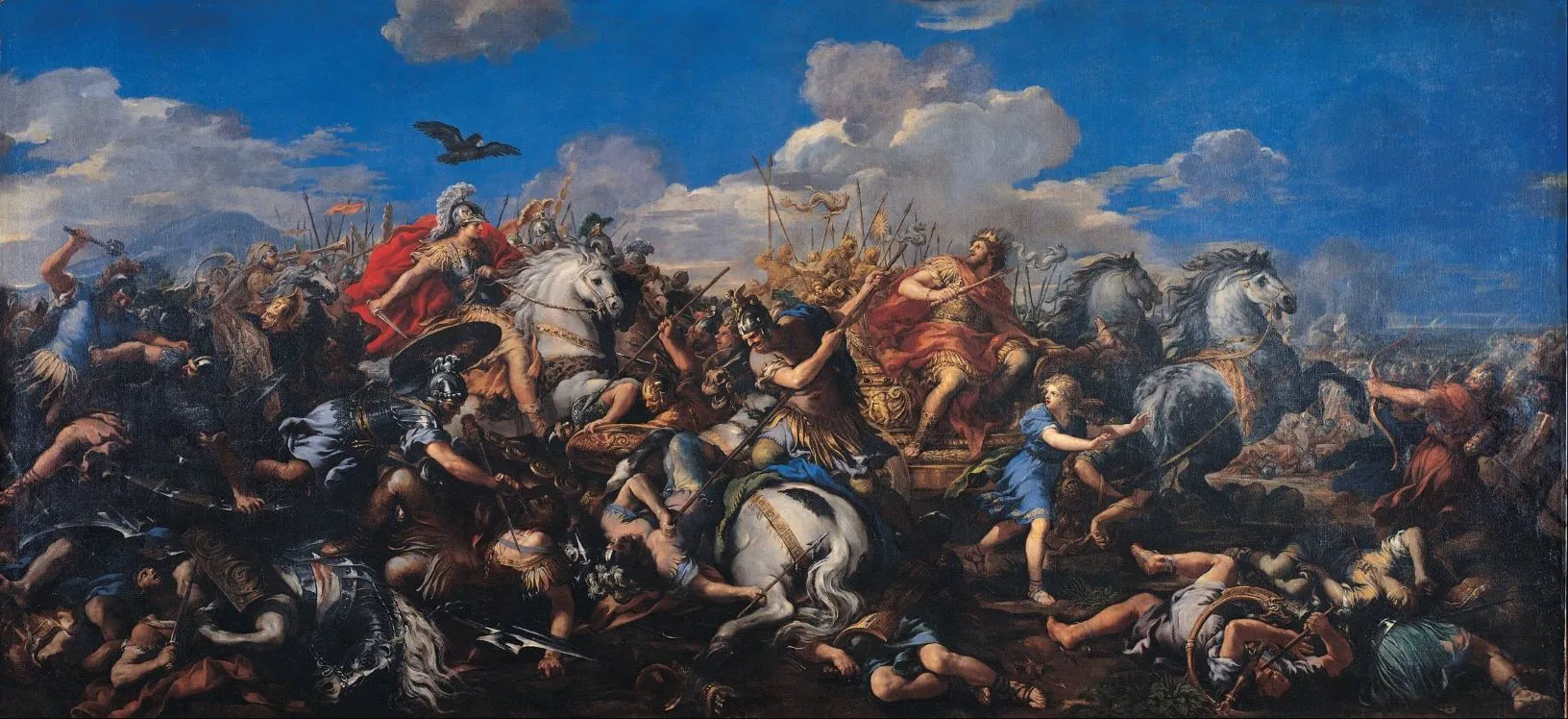
Ma Cesare aveva previsto tutto. Avendo identificato che la cavalleria pompeiana sarebbe stata l'arma decisiva, prelevò 2.000 fanti scelti (sei coorti) dalla sua terza linea e li nascose dietro la sua ala destra, fuori vista, addestrandoli per giorni a un compito specifico: colpire al volto i cavalieri pompeiani con il pilum. Era un'idea quasi burlesca, ma calcolata sul fatto che la cavalleria del tempo di Pompeo era costituita in gran parte da nobili giovani, vanitosi del proprio aspetto. Quando la battaglia iniziò , la cavalleria di Labieno carichò come previsto, sbaragliando la cavalleria di Cesare. Si lanciava contro la fanteria romana per chiuderne il fianco, quando le sei coorti nascoste sbucarono e attaccarono ai cavalli, non con le aste come fanti normali, ma con i pila usati come picche, mirando agli occhi e al volto. Cavalli e cavalieri caddero in disordine, la formazione si frantumò , la cavalleria pompeiana fuggì senza più ricomporsi.
But Caesar had anticipated everything. Having identified that the Pompeian cavalry would be the decisive weapon, he took 2,000 selected infantry (six cohorts) from his third line and hid them behind his right wing, out of sight, drilling them for days in one specific task: strike the Pompeian horsemen in the face with the pilum. It was an almost farcical idea, but calculated on the fact that Pompey's cavalry was largely made up of young nobles, vain about their looks. When the battle began, Labienus's cavalry charged as expected, sweeping aside Caesar's cavalry. They were charging against the Roman infantry to close its flank when the six hidden cohorts emerged and attacked the horses, not with shafts as ordinary infantry, but with pila used as pikes, aiming for eyes and faces. Horses and riders fell in disorder, the formation shattered, the Pompeian cavalry fled and never reformed.
A questo punto Cesare invertì il colpo: la sua riserva era libera di colpire ai fianchi e alle spalle l'esercito pompeiano. Quando le sue legioni avanzarono frontalmente, le legioni pompeiane, già messe a dura prova dalla fatica della formazione lunga e statica, cedettero. Pompeo, vedendo dalla collina la cavalleria fuggire, capi che era finita. Si tolse il mantello militare, scese a cavallo dal campo, raggiunse il suo accampamento, prese una piccola scorta e fuggì via mare. Il suo esercito si arrese in massa: 15.000 morti, 24.000 prigionieri. Cesare aveva perso solo 1.200 uomini, fra i quali però trenta centurioni dei suoi veterani.
At this point Caesar reversed the blow: his reserve was free to strike the Pompeian army on its flanks and rear. When his legions advanced frontally, the Pompeian legions, already worn down by the fatigue of the long static formation, gave way. Pompey, seeing the cavalry flee from the hill, understood it was over. He removed his military cloak, rode down from the field, reached his camp, took a small escort, and fled by sea. His army surrendered en masse: 15,000 dead, 24,000 prisoners. Caesar had lost only 1,200 men, among whom however thirty centurions of his veterans.
Pompeo fuggì in Egitto, sperando nell'asilo del giovane re Tolomeo XIII. Ma il re-bambino calcolò che dare la testa di Pompeo a Cesare gli avrebbe procurato il favore del vincitore. Quando Pompeo si avvicinò alla costa egiziana il 28 settembre 48 a.C., fu invitato a salire su una piccola barca per raggiungere terra. Mentre si voltava a salutare la moglie, fu pugnalato alle spalle. Sotto gli occhi di Cornelia, gli mozzarono la testa e la conservarono per offrirla a Cesare. Quando Cesare arrivò pochi giorni dopo, vedendo la testa di Pompeo, pianse: era stato suo amico, suo socio, il marito della sua figlia morta Giulia. Lo seppellì con onore. Ma la sua morte aveva chiuso definitivamente la guerra civile principale.
Pompey fled to Egypt, hoping for asylum with the young king Ptolemy XIII. But the boy-king calculated that handing Pompey's head to Caesar would earn him the victor's favour. When Pompey approached the Egyptian coast on 28 September 48 BC, he was invited to step into a small boat to reach shore. As he turned to wave to his wife, he was stabbed in the back. Before Cornelia's eyes, his head was cut off and preserved to be offered to Caesar. When Caesar arrived a few days later, seeing Pompey's head, he wept: he had been his friend, his partner, the husband of his dead daughter Julia. He buried him with honour. But his death had definitively closed the main civil war.
04Le TatticheThe Tactics
Farsalo è uno dei rarissimi casi in cui un esercito numericamente metà dell'avversario vinse senza alcuna ambiguità . La differenza fu tutta nella preparazione tattica. Cesare aveva trascorso settimane a osservare la cavalleria di Labieno: ne conosceva la tattica, la composizione, i punti deboli. Nel De bello civili III, 86, scrive che pochi giorni prima della battaglia disse ai suoi tribuni: "Sappiate che la cavalleria nemica non ci affronterà con le aste, ma cercherà di travolgerci con la massa: dobbiamo fermare il loro impeto, non riceverlo". Da qui l'idea della quartum aciem, la "quarta linea" nascosta di sei coorti.
Pharsalus is one of the rarest cases in which an army numerically half its opponent's won without ambiguity. The difference was entirely in tactical preparation. Caesar had spent weeks observing Labienus's cavalry: he knew its tactics, composition, weak points. In De bello civili III, 86, he writes that a few days before the battle he told his tribunes: "Know that the enemy cavalry will not engage us with shafts, but will try to overwhelm us with mass: we must stop their charge, not receive it". Hence the idea of the quartum aciem, the hidden "fourth line" of six cohorts.
L'innovazione tattica fu di tre ordini. Primo: uso di fanti contro cavalleria. La dottrina antica voleva che la cavalleria si battesse con altra cavalleria. Cesare ribaltò il dogma: usare i fanti, mobili e protetti, contro cavalieri cavalcanti. Secondo: il pilum come picca. Il pilum era un giavellotto da lancio (peso ~2 kg, gittata ~30 m). I cesariani lo usarono come picca corta, attaccandolo a doppio mano per pugnalare verso l'alto: una variazione tattica mai descritta prima nella letteratura militare romana. Terzo: l'attacco al volto. Mirare agli occhi dei cavalieri, non al cavallo o al corpo, sfruttando l'aspetto sociale della cavalleria pompeiana, composta soprattutto da giovani nobili che istintivamente proteggevano il viso, perdendo la coordinazione di gruppo.
The tactical innovation was of three orders. First: use of infantry against cavalry. Ancient doctrine held that cavalry fought other cavalry. Caesar overturned the dogma: use the mobile, protected infantry against mounted horsemen. Second: the pilum as a pike. The pilum was a throwing javelin (weight ~2 kg, range ~30 m). The Caesarians used it as a short pike, gripping it two-handed to thrust upward: a tactical variation never described before in Roman military literature. Third: the attack on the face. Aiming at the riders' eyes, not at the horse or body, exploiting the social aspect of the Pompeian cavalry, composed mostly of young nobles who instinctively protected their faces, losing group coordination.
Il secondo elemento fu lo schieramento profondo e flessibile di Cesare. Pompeo aveva schierato la sua fanteria in tre linee classiche, ognuna molto lunga (la sua massa numerica gli imponeva un fronte di 3 km). Cesare, con metà degli uomini, scelse uno schieramento più corto e profondo, con una quarta linea in riserva mobile dietro l'ala destra. Questa profondità gli diede flessibilità : dopo aver respinto la cavalleria, la riserva si trasformò immediatamente in massa d'urto contro il fianco scoperto della fanteria pompeiana.
The second element was Caesar's deep and flexible deployment. Pompey had arrayed his infantry in three classical lines, each very long (his numerical mass forced him onto a 3 km front). Caesar, with half the men, chose a shorter and deeper formation, with a fourth line in mobile reserve behind the right wing. This depth gave him flexibility: after repelling the cavalry, the reserve immediately transformed into a striking mass against the exposed flank of the Pompeian infantry.
Sul piano strategico, Pompeo aveva commesso un solo errore: accettare la battaglia. La sua strategia originale era corretta, logorare Cesare con il blocco e la fame, in territorio nemico, costringerlo alla resa per esaurimento. A Durazzo aveva quasi vinto così . Ma cedette alla pressione politica del senato, che voleva una vittoria spettacolare. Cesare, dal canto suo, aveva bisogno della battaglia decisiva: era a corto di rifornimenti, lontano dall'Italia, e il tempo lavorava contro di lui. Una battaglia ritardata di un mese gli sarebbe costata la guerra. Pompeo, dando battaglia, regalò a Cesare l'unica strada per vincere.
Strategically, Pompey had committed only one mistake: accepting battle. His original strategy was correct: wear down Caesar with blockade and hunger, in enemy territory, force him to surrender by exhaustion. At Dyrrhachium he had almost won this way. But he yielded to senate political pressure, which wanted a spectacular victory. Caesar, for his part, needed the decisive battle: he was short of supplies, far from Italy, and time worked against him. A battle delayed by a month would have cost him the war. By giving battle, Pompey handed Caesar the only road to victory.
« L'hanno voluta loro: io, Gaio Cesare, dopo aver vinto in tante guerre, sarei stato condannato se non avessi cercato l'aiuto del mio esercito.» « They have willed it: I, Gaius Caesar, after winning so many wars, would have been condemned had I not sought my army's help.» — Cesare, citato da Svetonio (Vita Iulii Caesaris, 30)
05Le ConseguenzeThe Consequences
Farsalo decise la guerra, anche se non la concluse formalmente. Restavano sacche di resistenza: i pompeiani in Africa (sotto Catone e Scipione, distrutti a Tapso nel 46 a.C.), in Spagna (sotto i figli di Pompeo, distrutti a Munda nel 45 a.C.), il giovane Sesto Pompeo che resisterà sul mare per altri otto anni. Ma la spina dorsale dell'opposizione era spezzata. Cesare divenne dittatore a vita nel febbraio del 44 a.C. Il suo titolo fu dictator perpetuo: un mese dopo, alle Idi di marzo, fu assassinato in senato da una congiura di sessanta senatori. Il sogno della Repubblica era morto a Farsalo; la sua memoria morì con Bruto e Cassio.
Pharsalus decided the war, even if it did not formally end it. Pockets of resistance remained: the Pompeians in Africa (under Cato and Scipio, destroyed at Thapsus in 46 BC), in Spain (under Pompey's sons, destroyed at Munda in 45 BC), the young Sextus Pompey who would resist at sea for another eight years. But the backbone of opposition was broken. Caesar became dictator for life in February 44 BC. His title was dictator perpetuo: a month later, on the Ides of March, he was assassinated in the senate by a conspiracy of sixty senators. The dream of the Republic had died at Pharsalus; its memory died with Brutus and Cassius.
Sul piano politico, Farsalo segnò la nascita del regime dell'uomo solo. Per cinque secoli Roma era stata governata dal senato, dai consoli, dai comizi: una macchina collegiale fatta di mediazioni e compromessi. Da Cesare in poi, nonostante la finzione repubblicana che Augusto avrebbe accuratamente conservato, il vero potere fu sempre di un singolo uomo, l'imperatore. Augusto, il pronipote ed erede adottivo di Cesare, portò al perfezionamento istituzionale ciò che zio Giulio aveva strappato con le armi.
Politically, Pharsalus marked the birth of the one-man regime. For five centuries Rome had been governed by the senate, the consuls, the assemblies: a collegial machine made of mediations and compromises. From Caesar on, despite the republican fiction that Augustus would carefully preserve, real power always belonged to a single man: the emperor. Augustus, Caesar's grandnephew and adopted heir, brought to institutional perfection what uncle Julius had seized by arms.
Per Cesare personalmente, Farsalo fu l'apice del suo genio militare. Per Pompeo, l'ultima dimenticanza in cui un'intera carriera di vittorie si dissolse in un solo pomeriggio. Pompeo aveva sconfitto Sertorio, ucciso Spartaco, sterminato i pirati cilicii, sottomesso Mitridate del Ponto, riorganizzato l'Oriente: era stato il più grande generale del mondo per vent'anni. Morì con la testa mozzata su una spiaggia egiziana, tradito da un re-bambino, alla soglia dei cinquantanove anni. Lucano, nel suo poema epico Pharsalia, lo dipinse come l'ultimo eroe della Repubblica morta, la sua tragedia personale fu il prezzo umano della trasformazione politica di Roma.
For Caesar personally, Pharsalus was the apex of his military genius. For Pompey, the final lapse in which an entire career of victories dissolved in a single afternoon. Pompey had defeated Sertorius, killed Spartacus, exterminated the Cilician pirates, subdued Mithridates of Pontus, reorganised the East: he had been the world's greatest general for twenty years. He died with his head severed on an Egyptian beach, betrayed by a boy-king, on the threshold of fifty-nine. Lucan, in his epic poem Pharsalia, depicted him as the last hero of the dead Republic: his personal tragedy was the human price of Rome's political transformation.